
Depop removed its 10% selling fee for Australian sellers on eligible AUD sales on 22 July 2026. Payment processing and optional boosting fees still apply.
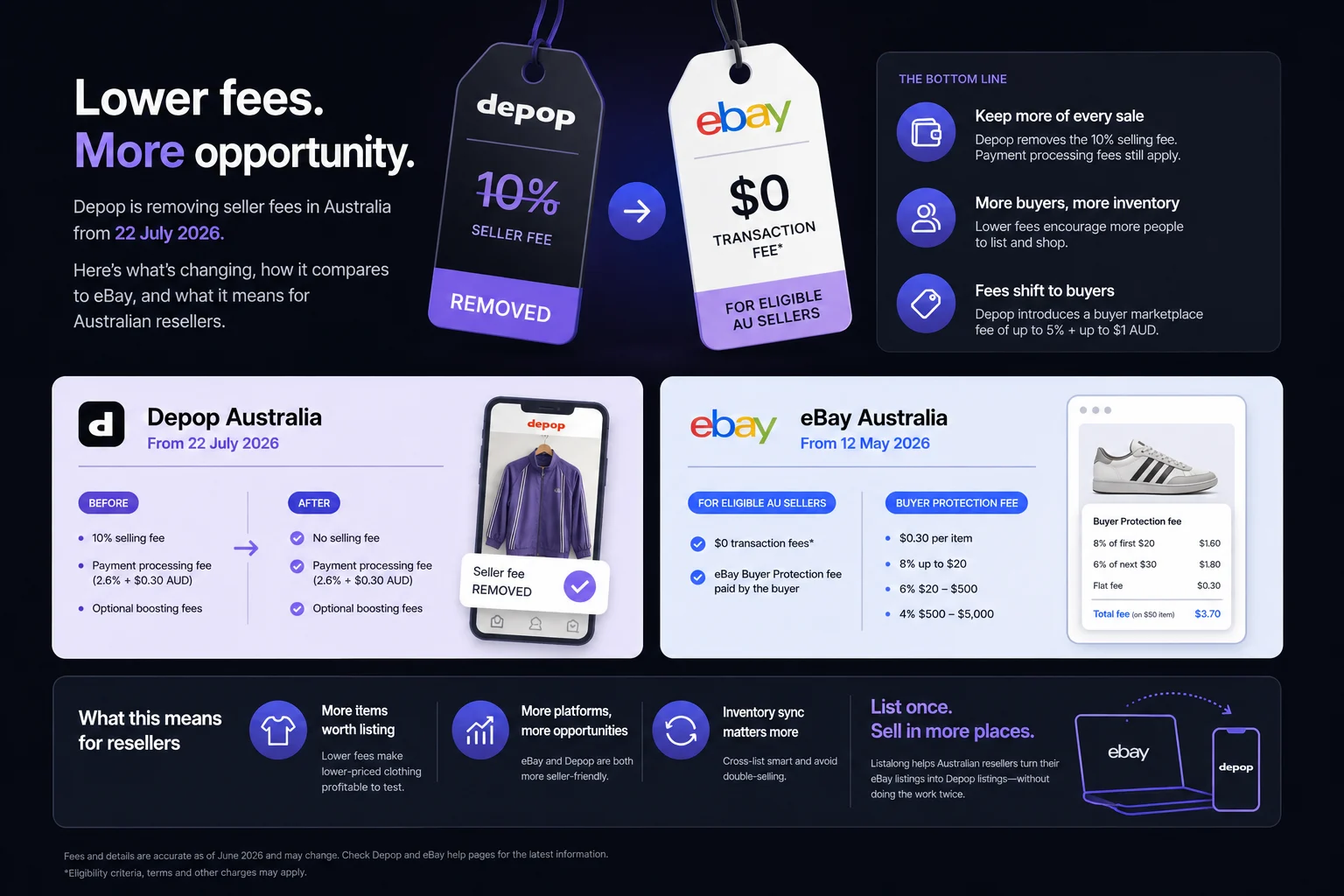
Before the change, Australian sellers generally paid a 10% selling fee plus payment processing. Depop’s Australian processing charge remains 2.6% + $0.30 AUD, calculated on the item price, shipping and applicable taxes.
The July announcement followed eBay Australia’s May 2026 free-selling update for eligible sellers. The comparison below explains what changed for sellers and buyers, with a worked $50 example.
What exactly is Depop changing?
On 22 July 2026, Depop removed selling fees for sellers based in Australia on AUD sales.
Depop says the change is designed to help Australian sellers keep more money from every sale and make fashion resale more accessible. It also says Australia is one of Depop’s fastest-growing markets globally.
Before the change, Australian sellers were generally dealing with:
- a 10% Depop selling fee
- payment processing fees
- optional boosting fees if they promoted listings
After the change, Australian sellers generally pay:
- no Depop selling fee
- payment processing fees still applying
- optional boosting fees still applying
Depop also introduced a buyer marketplace fee in Australia on 22 July 2026. This fee can be up to 5% of the item purchase price, excluding taxes and shipping, plus up to $1 AUD.
So the fee has not disappeared from the marketplace entirely.
It has mostly moved away from the seller and toward the buyer.
That might sound like a small accounting change, but psychologically it matters a lot.
A seller wants to know: “If I list this shirt for $40, how much do I actually get?”
The easier that question is to answer, the more likely people are to list.
A simple Depop fee example
Let’s keep it simple and ignore shipping, taxes and boosting.
Imagine you sell a $50 item on Depop.
Before the change, a rough seller-side fee calculation looked like this:
- Depop selling fee: $5.00
- Payment processing fee: $1.60
- Approximate seller fees: $6.60
- Approximate amount before postage costs: $43.40
After the change, using the same simplified example:
- Depop selling fee: $0
- Payment processing fee: $1.60
- Approximate seller fees: $1.60
- Approximate amount before postage costs: $48.40
The buyer may now pay a marketplace fee of up to 5% of the item price, excluding shipping and taxes, plus up to $1 AUD. Depop shows the exact fee at checkout, so the published maximum should be treated as a guide rather than a guaranteed charge.
For casual sellers, that matters.
For resellers, it also matters because it changes the maths on lower-margin clothing.
A $25 shirt that was barely worth listing on Depop may suddenly be worth testing.
How does this compare to eBay’s free selling update?
eBay Australia made a similar move earlier in 2026.
From 12 May 2026, eBay introduced free selling for eligible Australia-based sellers with up to $25,000 in sales in the past 12 months. These sellers do not pay transaction fees when items sell on eBay.com.au, but eBay adds a Buyer Protection fee to listings from Australia-based sellers who do not have a Pro plan.
The eBay Buyer Protection fee is paid by the buyer to eBay. eBay says the fee is included in the item price buyers see, so buyers do not get a surprise fee at checkout.
The fee is calculated as:
- $0.30 per item
- 8% of the item price up to $20
- 6% of the item price from $20 to $500
- 4% of the item price from $500 to $5,000
For a $50 eBay item from a free-selling eligible seller, the Buyer Protection fee would be:
- 8% of the first $20 = $1.60
- 6% of the next $30 = $1.80
- flat fee = $0.30
- total Buyer Protection fee = $3.70
So the seller lists the item at $50 and receives $50 before any other seller-paid costs, while the buyer sees a higher total price.
Depop’s new model is not identical, because sellers still pay payment processing fees. But the direction is very similar.
The platform is trying to make selling feel cheaper and simpler.
This is not really “free selling”
This is the part sellers need to understand.
When a platform says “no selling fees”, that does not always mean the platform is taking no money.
It usually means the money is being collected somewhere else.
On eBay, eligible sellers avoid transaction fees, but buyers of items from non-Pro Australia-based sellers pay a Buyer Protection fee.
On Depop, Australian sellers avoid the 10% selling fee, but sellers still pay payment processing fees, boosting fees can still apply, and buyers may pay a marketplace fee.
That does not make the change bad.
It is still a major improvement for sellers.
But it does mean sellers should stop thinking in terms of “free” and start thinking in terms of “who pays, when, and how visible is it?”
That is the real change.
Why would Depop remove seller fees in Australia?
Depop’s official explanation is that removing selling fees helps sellers keep more from each sale and encourages more people to sell secondhand. Depop also says that when it removed selling fees in the UK and US, listings increased by 30-45% in the 28 days after the change compared with the 28 days before.
That is probably the biggest reason.
For a marketplace, listings are oxygen.
More listings create more choice. More choice brings more buyers. More buyers create more sales. More sales encourage more sellers.
The hard part is getting that flywheel moving.
Removing seller fees is one of the easiest ways to do it.
But there are probably a few other reasons too.
Reason 1: eBay moved first in Australia
eBay made a huge seller-friendly change in Australia in May 2026.
For casual sellers under the $25,000 threshold, eBay became much easier to understand. List an item, sell it, and avoid the old transaction fee structure. There are still conditions and buyer-side fees, but from the seller’s point of view, the pitch is simple: keep more of what you sell.
That puts pressure on Depop.
If an Australian seller is choosing where to list a $40 jacket, and eBay has no seller transaction fee while Depop takes 10% plus payment processing, eBay suddenly feels like the safer starting point.
Depop removing the 10% selling fee makes that decision less obvious.
It gives sellers a reason to list on Depop again, especially for fashion, vintage, streetwear, sneakers, boots and branded clothing.
Reason 2: eBay is trying to win fashion resale
This is where it gets interesting.
In February 2026, eBay announced it had entered into an agreement to acquire Depop from Etsy for approximately US$1.2 billion. eBay described Depop as a mobile-first fashion marketplace with about US$1 billion in gross merchandise sales in 2025, 7 million active buyers, and more than 3 million active sellers. It also said nearly 90% of Depop’s active buyers were under 34.
That tells you a lot.
eBay already has scale, search, buyer trust and a massive general marketplace.
Depop has youth culture, style, community and secondhand fashion credibility.
eBay does not just want more listings. It wants younger buyers and stronger fashion resale positioning.
Depop’s fee change in Australia fits that bigger picture.
If eBay wants Depop to grow here, the platform cannot feel expensive compared with eBay itself.
Reason 3: Vinted has entered Australia
Depop is not only competing with eBay.
Vinted has also launched in Australia, and its model is very seller-friendly. Vinted’s Australian site is live, and its how-it-works page describes a zero-seller-fee model where buyers pay a protection fee instead.
That matters because Vinted has trained a lot of secondhand sellers overseas to expect no seller commission.
Now that Vinted has arrived in Australia saying “list for free, keep what you earn”, Depop cannot easily keep charging Australian sellers 10% and expect there to be no impact.
There is an important difference, though. Vinted’s ordinary Australian accounts prohibit commercial selling, while Depop supports business sellers. Our Depop versus Vinted Australia comparison explains why the cheapest-looking option is not automatically the right one for a reseller.
Depop’s new fee model looks less like a random change and more like a response to where the whole resale market is heading.
Seller fees are becoming harder to defend when competing platforms are removing them.
Reason 4: The platform wants more supply
Depop’s own numbers make the logic pretty clear.
It says removing seller fees in the UK and US led to a 30-45% increase in listings after those changes.
That is the whole game.
If you are Depop, you want more people listing:
- wardrobe clean-outs
- vintage pieces
- streetwear
- sneakers
- designer finds
- thrifted clothing
- Y2K pieces
- one-off items
The more inventory Depop has, the more useful the app becomes.
A fashion marketplace without fresh stock feels dead quickly. Buyers open the app, see the same stale items, and leave.
Removing the seller fee gives people a reason to upload more.
What does this mean for Australian resellers?
For Australian clothing resellers, this is good news.
It means Depop becomes more worth considering, especially if you already list clothes on eBay.
Before this change, a reseller might look at a $30 shirt and think:
“By the time Depop takes 10%, payment processing comes out, and I deal with postage, is it even worth the effort?”
After 22 July 2026, the answer may be different.
It does not mean every eBay clothing item should go to Depop.
But it does mean more items are worth testing.
Good candidates include:
- Harley-Davidson shirts
- Nike jackets
- Adidas track jackets
- Levi’s jeans
- Dr. Martens boots
- RM Williams boots
- vintage graphic tees
- Gorman dresses
- Country Road pieces
- Y2K tops
- oversized shirts
- streetwear
- workwear-style jackets
- statement pieces with strong photos
The biggest opportunity is not generic clothing.
It is clothing with a clear style, brand, fit or audience.
But buyer price still matters
Here is the catch.
If seller fees move to buyer fees, the buyer still sees the cost somewhere.
That can affect conversion.
A seller might be happy because their payout is higher, but if the buyer sees a higher total price, they may offer less or walk away.
That means pricing still matters.
For example, if you were previously pricing a jacket at $50 because you needed to cover Depop’s 10% seller fee, you may now have room to lower the item price slightly while still keeping more profit.
That could make your listing more competitive.
The sellers who win from this change will not just be the ones who keep every price the same and pocket the difference.
The winners will be the sellers who understand the new maths and price accordingly.
eBay vs Depop after the fee changes
The difference between eBay and Depop is not just fees.
The bigger difference is the buyer.
eBay is broad. It is good for almost everything: clothing, electronics, games, collectibles, tools, parts, homewares and random one-off items.
Depop is narrower but more style-driven. It is better for fashion, vintage, streetwear, sneakers, accessories and pieces that someone buys because they want a specific look.
That means the best strategy for many Australian resellers is not “eBay or Depop”.
It is:
List on eBay first, then cross-list the right fashion items to Depop.
eBay can stay your main workflow.
Depop can become a second audience for the items that suit it.
The fee cuts make cross-listing more tempting
This is probably the biggest practical change.
When both eBay and Depop feel cheaper for sellers, there is more reason to use both.
But that also creates a new problem.
If the same jacket is listed on eBay and Depop, it can sell on either platform.
That is great until it sells on both.
Double-selling is one of the most annoying risks of cross-listing. You sell an item on eBay, forget to remove it from Depop, then someone buys it again. Now you have to cancel, apologise, and potentially damage your account.
Lower fees make cross-listing more attractive.
They do not make inventory management less important.
If anything, they make it more important because more sellers will start listing across multiple platforms.
What should sellers do now?
If you sell clothing in Australia, this is a good time to review your stock.
Start by looking at your current eBay listings and asking:
- Which items are fashion-focused?
- Which items have a clear brand?
- Which items have a strong style?
- Which items have clean photos?
- Which items are priced high enough to justify another platform?
- Which items would a Depop buyer actually search for?
- Which items should stay on eBay only?
The goal is not to dump your entire eBay store onto Depop.
That is how sellers create clutter and double-selling problems.
The smarter move is to cross-list selectively.
A PlayStation console belongs on eBay.
A Harley-Davidson shirt might deserve Depop as well.
A basic Kmart tee probably does not need the extra work.
A pair of Doc Martens probably does.
Where Listalong fits in
This is exactly why Listalong is built around a simple idea:
You should not have to create the same listing twice.
If you already list clothes on eBay or Depop, most of the work has been done:
- photos
- title
- brand
- size
- condition
- price
- measurements
- description
The challenge is cross-listing to the other marketplace without copying everything manually, uploading the same photos again, or losing track of what has sold.
Listalong is designed for Australian resellers using eBay and Depop. It cross-lists existing listings in either direction automatically, or when sellers choose items themselves.
That review step matters more than ever.
Lower fees can make Depop more attractive, but not every eBay item belongs there.
Final thoughts
Depop removing seller fees in Australia is good news for resellers.
But it is also part of a bigger shift.
eBay removed transaction fees for eligible Australian sellers in May 2026. Depop removed Australian selling fees in July 2026. Vinted has entered Australia with a seller-friendly model. The resale platforms are all fighting for the same thing: more sellers, more listings and more buyer attention.
For Australian clothing resellers, that creates an opportunity.
You can keep using eBay as your main listing workflow, then use Depop for the items that suit its audience.
The mistake would be thinking lower fees mean you should list everything everywhere.
The smarter approach is:
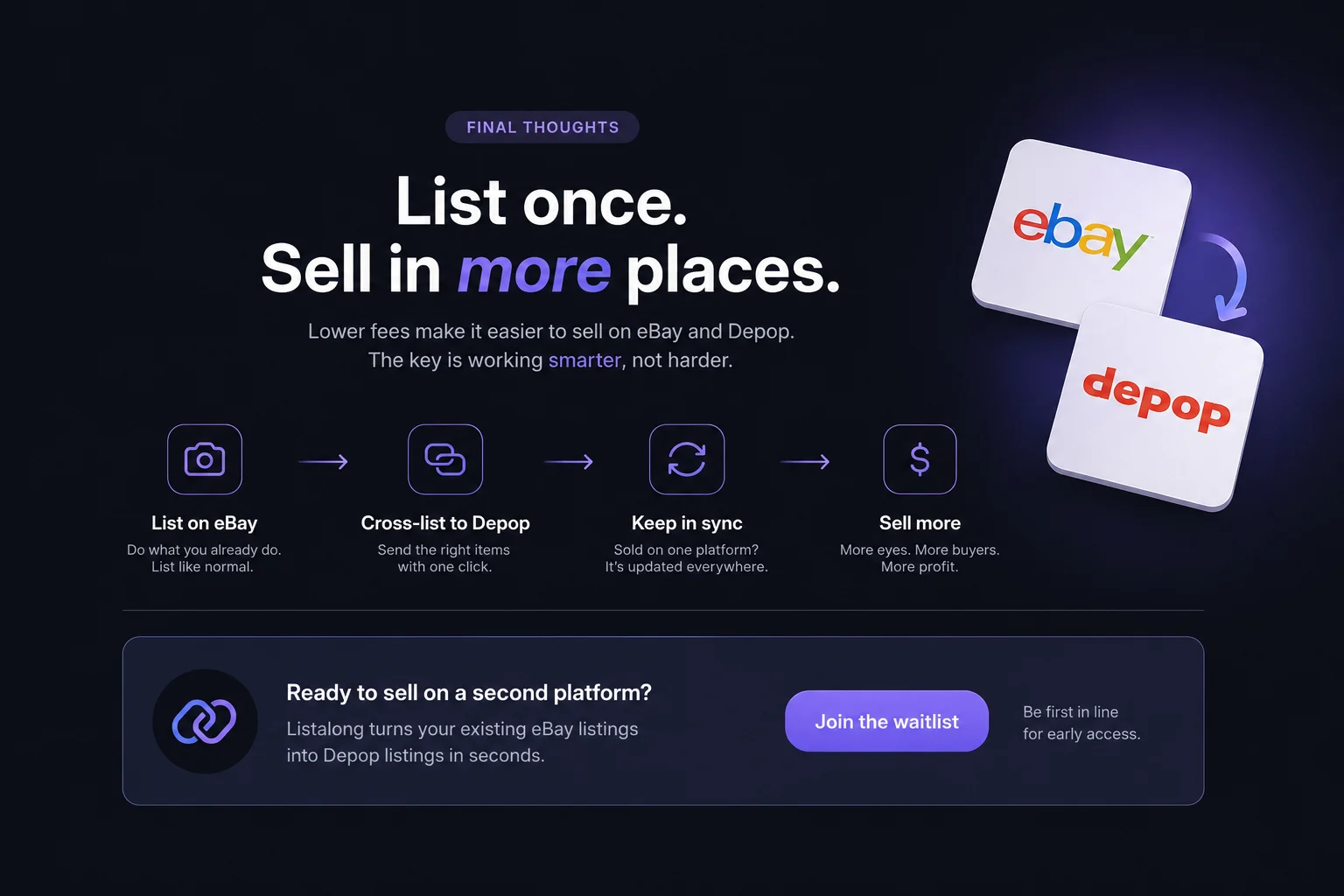
List once. Cross-list carefully. Keep your inventory in sync.
Because selling on more platforms is only useful if it actually helps you sell more, without creating more admin than it solves.
Sources and further reading
Depop seller fees and the July announcement rechecked 29 September 2026. The wider market discussion reflects the July announcement period. Rules can change, so check the official pages before pricing or listing items: