
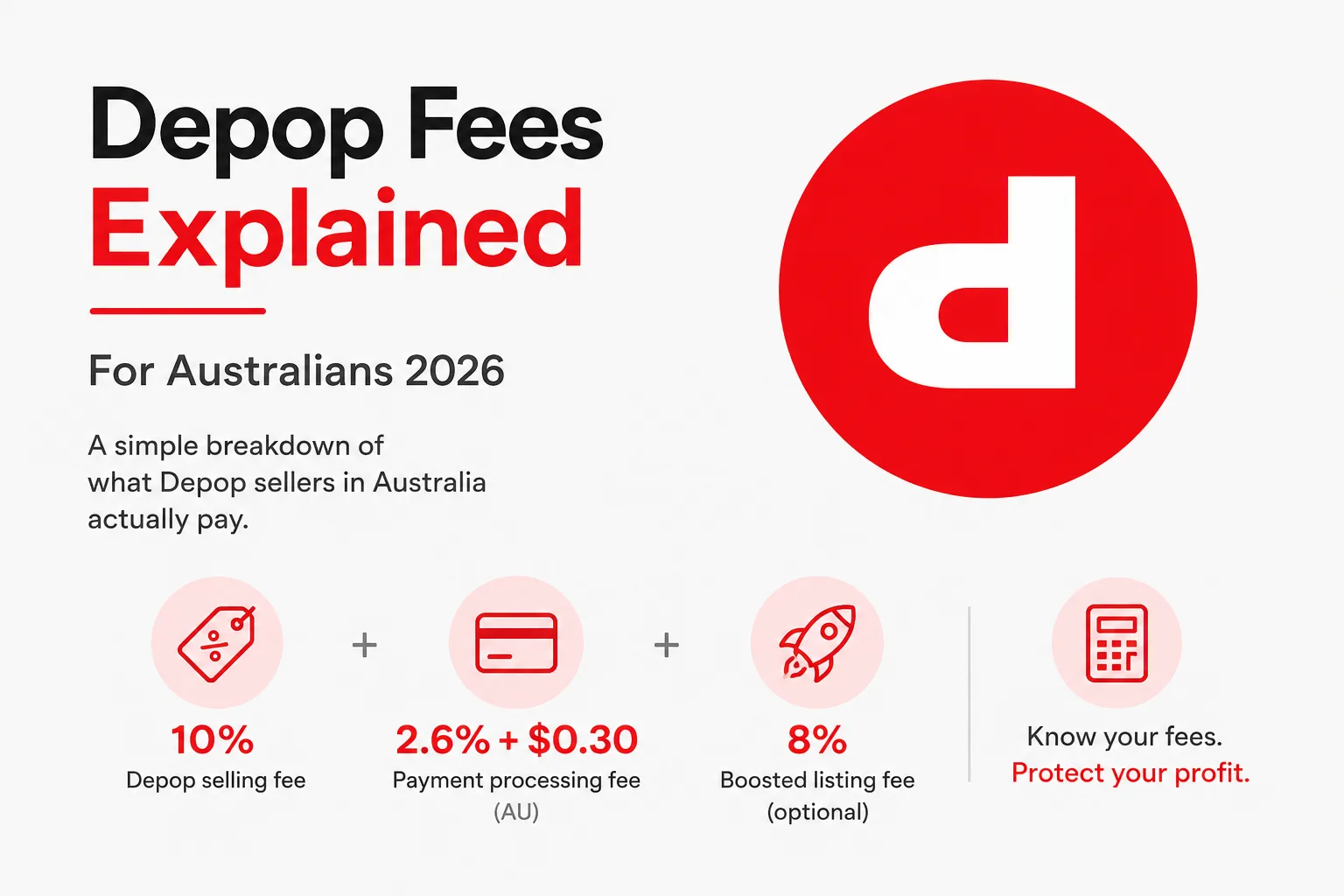
Australian sellers pay no standard Depop selling fee on eligible AUD sales. Payment processing and optional boosting can still reduce the amount you receive. This guide explains those deductions and keeps the buyer’s marketplace fee separate.
That does not mean every Depop sale is completely free. Australian sellers still need to allow for Depop Payments processing, and an 8% boosting fee can apply if they choose to boost a listing and that boost leads to the sale. Buyers may also see a separate marketplace fee at checkout.
If you are checking an older sale, the date matters. Sales before 22 July still sit under the old 10% seller-fee rules.
Depop fees in Australia at a glance
| Fee | From 22 July 2026 | Before 22 July 2026 | Who pays it? |
|---|---|---|---|
| Depop selling fee | 0% | 10% | Seller |
| Depop Payments processing | 2.6% + $0.30 AUD | 2.6% + $0.30 AUD | Seller |
| Boosting fee | 8% if applicable | 8% if applicable | Seller |
| Marketplace fee | Up to 5% of item price + up to $1 | Not part of the old AU model | Buyer |
| Postage, packaging and stock | Varies | Varies | Seller’s business costs |
These are different kinds of costs. The buyer marketplace fee affects what the buyer sees at checkout. It should not be subtracted again when you calculate the seller payout.
What changed on 22 July 2026?
Before the change, a normal Australian Depop sale could attract a 10% selling fee as well as payment processing. From 22 July, Depop removes that 10% selling fee for sellers based in Australia on eligible sales made in AUD.
Payment processing did not disappear. Depop’s Australian rate remains:
2.6% of the item, postage and applicable taxes
+ $0.30 AUD
The change is most noticeable on lower-priced clothing. Saving $3 on a $30 sale may be the difference between an item being worth packing and it sitting in an eBay store for another month.
For the exact impact on your own item, use the eBay vs Depop fee calculator. It lets you switch between sales before and after 22 July, include postage and stock cost, and test a boosted sale without mixing the buyer fee into your payout.
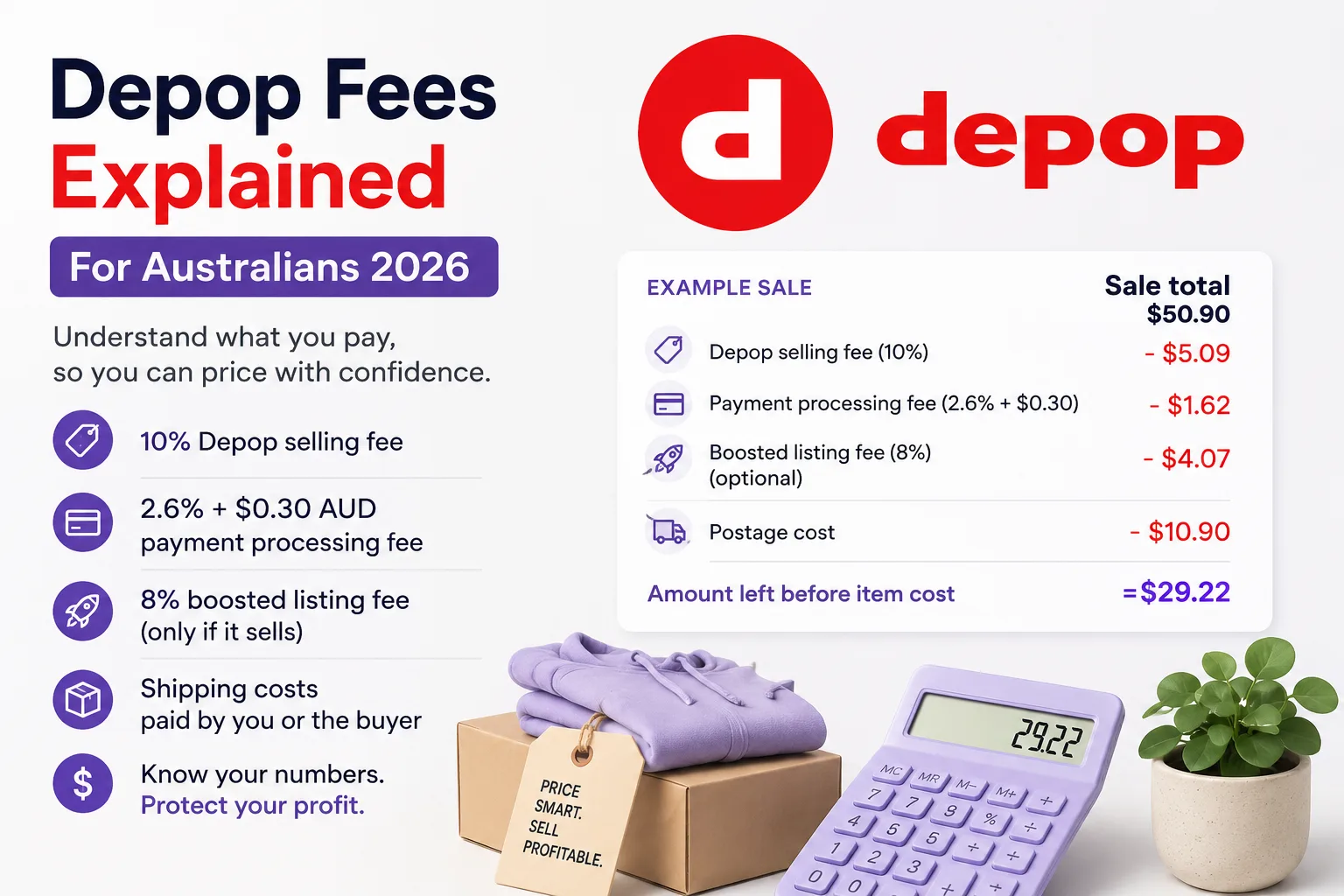
Worked example: a $40 item with $10.95 manual postage
Say a buyer purchases a jacket for $40 and pays $10.95 postage on a manual-shipping order. The seller buys the postage separately. This is an illustrative quote, not a fixed Depop shipping rate.
Item price: $40.00
Postage charged: $10.95
Total before buyer marketplace fee: $50.95
Here is the seller-side difference, with no boosting:
| Seller calculation | Before 22 July | From 22 July |
|---|---|---|
| Depop selling fee | $5.10 | $0.00 |
| Payment processing | $1.62 | $1.62 |
| Total seller fees | $6.72 | $1.62 |
| Payout before your postage cost | $44.23 | $49.33 |
| Less $10.95 postage | $33.28 | $38.38 |
| Less $6 item cost | $27.28 rough profit | $32.38 rough profit |
The change leaves roughly $5.10 more with the seller in this example. Packaging, refunds, tax and the value of your time are not included.
What does the buyer pay?
From 22 July, Depop can charge Australian buyers a marketplace fee of:
- up to 5% of the item purchase price, excluding shipping and taxes
- plus up to $1 AUD
Depop says the exact fee is shown at checkout. Because both parts are described as “up to”, it would be misleading to present the maximum as a guaranteed charge.
For the $40 jacket above, the published maximum is $3:
5% of $40 = $2
Maximum fixed amount = $1
Maximum marketplace fee = $3
The buyer’s total could therefore be up to $53.95 once the $40 item, $10.95 postage and maximum $3 marketplace fee are combined. The seller does not receive that $3, but it is also not deducted from the seller payout.
This buyer-side cost is worth remembering when you respond to offers. A buyer may be looking at a higher checkout total than the item price suggests.
What about boosted listings?
Boosting is Depop’s optional way to give a listing more visibility. Depop lists an 8% boosting fee for sellers outside the UK and US when a boosted listing results in a sale.
For manual shipping, boosting applies to the item price and postage charged. With a Depop Shipping label, the postage is excluded from the boosting-fee basis. Check the order’s shipping method before calculating it.
On the same $50.95 manual-shipping total, an 8% boost would add about $4.08 in seller fees. From 22 July the rough seller fees would then be:
Payment processing: $1.62
Boosting fee: $4.08
Total seller fees: $5.70
Boosting can make sense for a strong item with enough margin. It is harder to justify on a basic top where the photos, title or price are the real problem. I would fix those parts first, then decide whether paying for more reach is worthwhile.
The dedicated guide to Depop Boosted Listings in Australia explains the 28-day attribution rule, suitable test items and how to judge the result using profit rather than views alone.
Why is my Depop payout lower than the sale price?
Open My Depop → My Account → Depop Balance → Latest Transactions to compare the sale with its deductions. Check processing, any attributed boost and the shipping method before treating a difference as an error. The buyer marketplace fee is not your income.
Use the shipping guide to distinguish supplied labels from manual postage. For a manual order, the money reserved for postage still needs to pay for the label; it is not extra profit. Keep the order receipt and label receipt together when reconciling the sale.
A practical Depop profit formula
“Payout” and “profit” are not the same thing. A payout is what reaches your account after platform fees. Profit still needs to account for the costs of sourcing and sending the item.
For sales from 22 July, a useful estimate is:
Item price + postage charged
- payment processing
- boosting fee, if applicable
- your postage and packaging cost
- what the item cost you
= rough profit
For a sale before 22 July, also subtract the 10% Depop selling fee.
The fixed 30-cent processing charge makes very cheap sales less attractive. If you are accepting a $10 offer, do the calculation before you say yes rather than discovering afterwards that postage and stock swallowed most of it.
Should you lower your prices now?
Not automatically.
The removal of the 10% fee gives sellers room to make a choice: keep more margin, reduce the price, or meet somewhere in the middle. The right answer depends on the item.
For an in-demand jacket with watchers, keeping the price steady may be sensible. For a stale listing, passing some of the saving on to the buyer could make the item more competitive, especially now that the buyer may face a marketplace fee at checkout.
I would look at the whole sale rather than applying a blanket 10% price cut:
- recent sold prices for the same brand and style
- your item and postage costs
- whether the listing is boosted
- the likely buyer checkout total
- the lowest offer you would genuinely accept
That produces a price you can defend instead of a number copied from somebody else’s listing.
Common mistakes after the fee change
The rules are simpler, but there are still a few easy traps:
- reading an article written before 22 July and treating the 10% fee as current
- calling Depop “completely free” and forgetting payment processing
- subtracting the buyer marketplace fee from the seller payout
- forgetting that processing includes postage and applicable taxes
- boosting low-margin listings without checking the extra 8%
- treating the payout as profit before postage, packaging and stock costs
- using US or UK fee advice for an Australian account
When a fee page uses “up to” or adds country-specific conditions, keep your estimate conservative and check the final transaction record after the sale.
Are fees reversed after a refund?
Depop’s seller guidance says the relevant Depop selling, payment processing and boosting fees are reversed when a sale is refunded, with Depop Payments refunds handled automatically.
Still, keep the receipt and check the transaction after a refund. It is much easier to resolve a mismatch when you have the sale amount, refund amount and fee lines in front of you.
Is Depop worth using for Australian resellers now?
For the right stock, the new fee structure makes Depop easier to test.
It is still a fashion-led marketplace. Vintage tees, streetwear, branded denim, boots, sneakers, dresses and pieces with a clear aesthetic generally make more sense than sending every miscellaneous eBay item across.
The practical approach is selective cross-listing: keep eBay as the broad marketplace, then put suitable fashion stock in front of Depop’s audience as well. If you do that, keep sold items in sync so a fee saving is not wiped out by a double-sale and cancellation.
If you are also considering Vinted, compare the rules as well as the deductions. Vinted’s ordinary Australian accounts are intended for private, non-commercial selling; our Depop versus Vinted Australia guide explains the difference.
Listalong is built for that workflow. It cross-lists an existing eBay or Depop listing to the other marketplace automatically, or when you choose the item yourself, rather than rebuilding every listing from scratch. It is available with a 14-day free trial. Create free account.
Your free trial starts only when both eBay and Depop are connected. Setup time does not count.
Bottom line
From 22 July 2026, Australian Depop sellers keep the 10% that previously went to the selling fee on eligible AUD sales. They still pay 2.6% + $0.30 AUD for payment processing, and an optional 8% boost can apply.
Buyers may pay a separate marketplace fee of up to 5% of the item price plus up to $1. That changes the checkout experience, but it does not change the seller payout calculation.
Use the free Australian marketplace fee calculator before accepting a low offer, and check Depop’s official pages whenever the platform changes its pricing.
Sources and further reading
Seller fee bases and transaction-checking instructions rechecked 29 September 2026. Buyer marketplace-fee sources were checked 28 September 2026: