
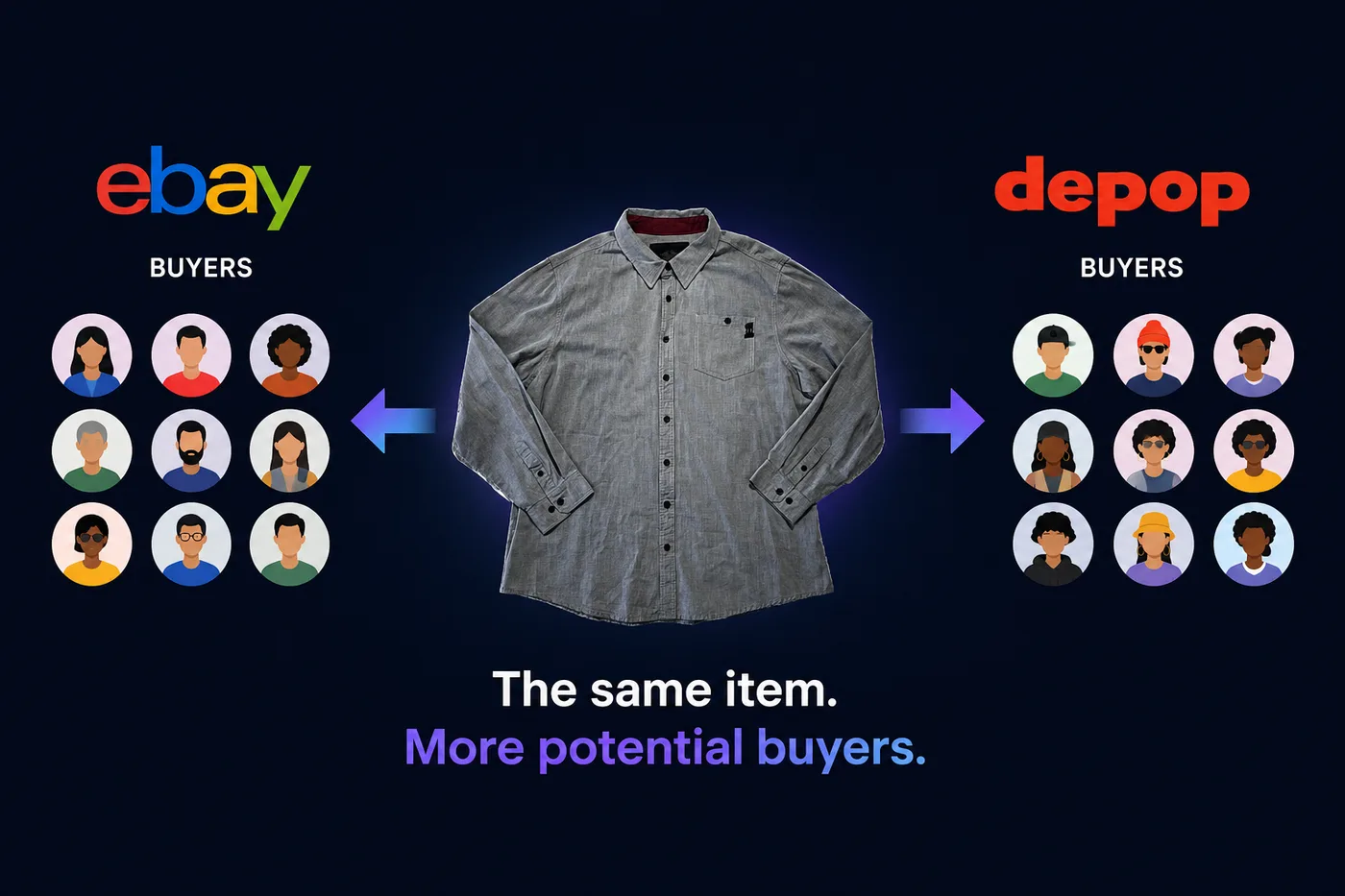
If you already sell on eBay, Depop can be a useful second marketplace for the right items. You do not need to rebuild your whole reselling process from scratch. The smarter approach is to use eBay as your main listing workflow, then adapt suitable listings for Depop.
The key word is suitable.
Depop is not simply “another eBay”. It has a different buyer mindset, a more visual shopping experience and a stronger focus on fashion, personal style, vintage, streetwear and second-hand clothing. A good eBay listing gives you most of the raw information, but the Depop version still needs to feel natural on Depop.
This guide explains how to start selling on Depop after eBay, what to list first, how to adapt your eBay listing, how to price for Australian fees and how to avoid selling the same item twice.
If you have not sold online before, begin with the broader beginner’s guide to selling on Depop Australia. It covers account setup, first photos, payments, postage and the first-sale workflow from scratch.
Quick answer: the easiest way to start
The easiest way to start selling on Depop after eBay is to choose 10 to 20 fashion-friendly eBay listings, check that each item is allowed on Depop, reuse the existing photos and item details, then rewrite the title and description so they suit Depop buyers.
Do not move your whole eBay store across on day one.
Start with a small test batch. Watch what gets likes, messages, offers and sales. Then repeat the process with the types of items that actually suit Depop.
If you need help choosing that batch, use our 2026 guide to what sells best on Depop Australia. It separates current trend evidence from the stock checks that still matter: condition, search relevance, postage and margin.
If that first batch is already live but quiet, the Depop slow-sales checklist helps you identify whether the problem is visibility, presentation, buyer hesitation or stock fit.
Should eBay sellers bother with Depop?
For some sellers, yes. For others, not yet.
eBay is strong for broad search intent. A buyer may search for a specific brand, model, size, part number, collectable, homeware item or replacement product.
Depop is more style-led. Buyers often browse by look, category, brand, aesthetic, colour, size or trend. That can make Depop useful for:
- Vintage clothing
- Branded fashion
- Streetwear
- Y2K, grunge, workwear and other style-led pieces
- Shoes, bags and accessories
- Unique prints, colours or silhouettes
- Items that photograph well
Depop can also give older eBay fashion stock another chance. A shirt that sits quietly on eBay may be more interesting when it is presented as a styled Depop listing with better photos, a cleaner title and measurements.
That does not mean every eBay item belongs there.
What to list on Depop first
Your first Depop batch should be easy to manage and likely to appeal to Depop buyers. Think of it as a test, not a full store migration.
Good first items include:
- Branded shirts, tees, jackets and jeans
- Vintage or retro clothing
- Streetwear and skatewear
- Dresses, skirts and statement pieces
- Sneakers, boots and fashion shoes
- Bags, hats, belts and accessories
- Plush, homeware or other items only if they suit Depop’s audience and rules
Leave these for later:
- Low-margin basics with weak photos
- Items with unclear sizing
- Items with complex condition issues
- Products that may be restricted or prohibited
- Categories that perform better on eBay, such as electronics, parts, tools or bulky home goods
Before listing, check Depop’s current prohibited items policy. Depop’s policy includes categories such as counterfeit items, drop-shipping, certain cosmetics, some children’s products, hazardous materials, recalled items and other restricted goods.
If you are unsure whether an item belongs on Depop, skip it for your first batch. Your goal is to learn the platform with clean, simple inventory.
Set up your Depop shop before listing
Before adding inventory, complete the basics of your Depop shop.
At minimum, set up:
- A recognisable shop name
- A clear profile photo or logo
- A short shop bio
- Payment details
- Shipping preferences
- A simple shop policy for posting times, bundles and questions
Keep the branding similar to your eBay store where it makes sense. Buyers should feel that your shop is real, organised and active.
For Australian sellers, also decide how you will handle postage. If you already use Australia Post, MyPost Business or another process for eBay, write down how that maps to Depop. Do not rely on memory once you are managing the same item in two places.
Use eBay as your source of truth
If you already list properly on eBay, you have done most of the hard work.
A complete eBay listing may already include:
- Product photos
- Brand
- Tagged size
- AU/UK/US size notes
- Colour
- Condition
- Measurements
- Material
- Faults or signs of wear
- Price
- Postage information
- Storage location or stock number
Use the eBay listing as your source of truth, then adapt it for Depop.
This matters because eBay and Depop do not always use the same categories, item details, size fields or buyer expectations. Copying everything word-for-word can make the Depop listing feel awkward, keyword-stuffed or incomplete.
What to change when moving an eBay listing to Depop
Think of the Depop listing as a translated version of the eBay listing.
You are not changing the facts. You are changing the presentation.
| Listing part | Keep from eBay | Adjust for Depop |
|---|---|---|
| Photos | Reuse clear item, label, flaw and measurement photos | Put the strongest full-item photo first |
| Title | Keep brand, item type, colour and size | Make it readable and less crowded |
| Description | Keep condition, measurements and faults | Shorten and organise for scanning |
| Category | Use the closest factual category | Check Depop's category and subcategory options |
| Size | Keep the tagged size | Add measurements and fit notes |
| Price | Use eBay sold comps as one reference | Allow for Depop fees, postage and buyer offers |
| Stock record | Keep your eBay listing ID or SKU | Add the Depop listing reference beside it |
What experienced resellers do differently
Public reseller interviews and seller guides from The Guardian, Teen Vogue and Business Insider repeat the same pattern: better sellers make their listings easy to trust, easy to compare and easy to buy.
The advice is practical, not complicated:
- Add items in small batches instead of uploading everything in one day
- Use bright, clear photos that show the whole item, labels, fabric and flaws
- Research similar listings before choosing a price
- Include measurements so buyers do not need to ask basic fit questions
- Mention true colour, sizing quirks, marks, wear and any repairs
- Offer bundles or combined postage where it makes sense
- Keep your shop active so it does not look abandoned
- Build a consistent visual style, especially if you sell fashion, vintage or streetwear
This is where many eBay sellers have an advantage. You may already have the hard facts: measurements, condition notes, postage information and stock numbers. The job is to make those details feel natural on Depop.
Community spaces such as Reddit threads and Facebook reseller groups can be useful for spotting patterns, but treat them as conversation rather than policy. Use them for ideas, then check important decisions against Depop’s own rules, fees and listing guidance.
If an item is bulky, low-margin or better suited to local pickup, Depop may not be the right place for it. Keep those items on eBay, Facebook Marketplace or another channel where buyers are more likely to search for them.
Reuse your photos, but check the order
In most cases, you can reuse your eBay photos on Depop.
Strong Depop photos usually include:
- A clear front photo
- A back photo
- Label and size tag photos
- Close-ups of logos, prints or texture
- Faults, marks or wear
- Measurement photos where useful
Depop’s search guidance encourages clear images that show details and flaws. That lines up well with what good eBay sellers already do.
The main change is the first image. On eBay, the first photo may be a plain product shot. On Depop, the first image still needs to be accurate, but it should also be visually appealing enough to stop a buyer scrolling.
Avoid using a tag photo, measurement photo or close-up as the main image unless it is genuinely the clearest representation of the item.
Rewrite the title so it sounds natural
eBay titles are often written to fit as many useful search terms as possible.
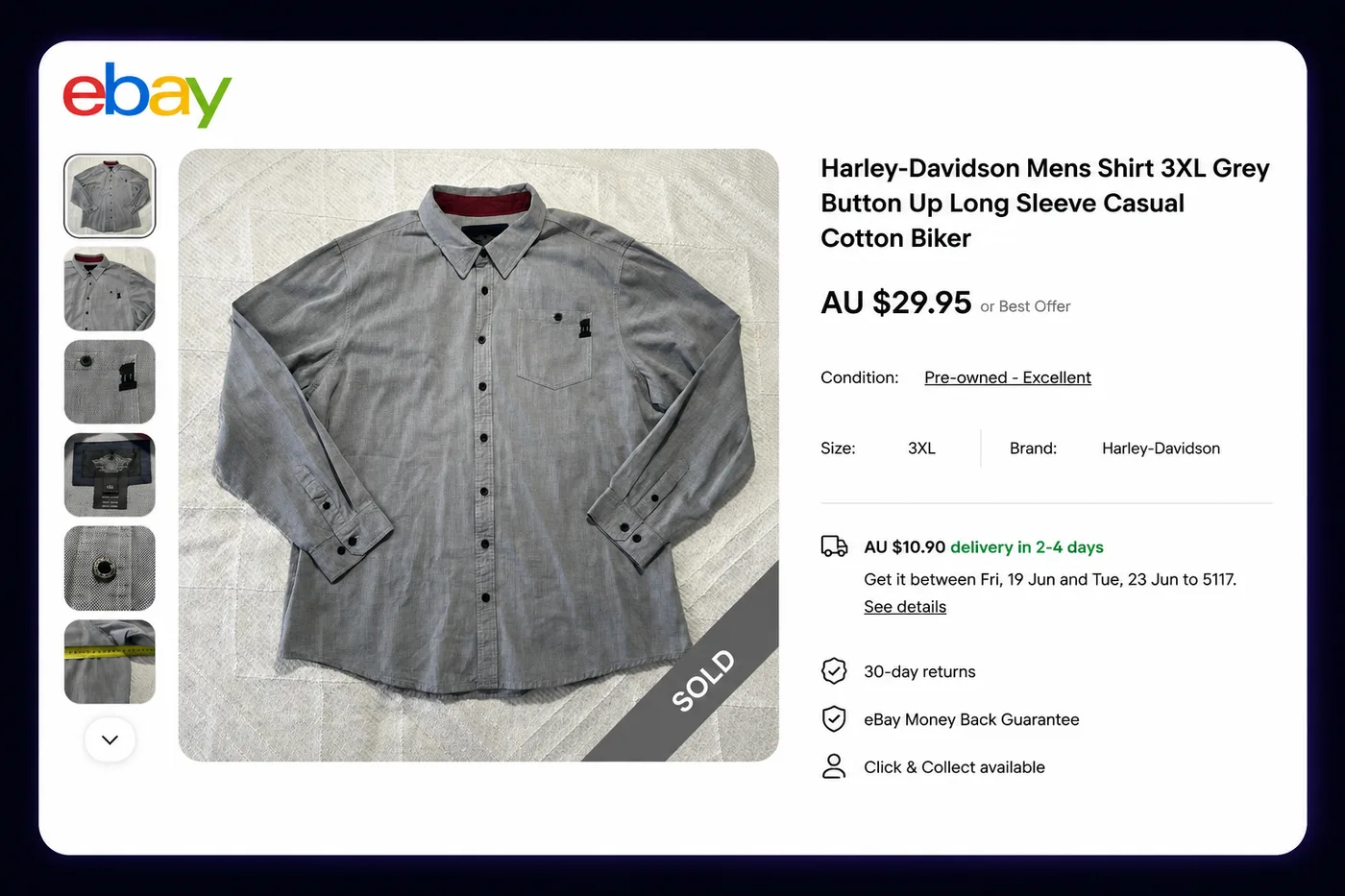
For example:
Harley-Davidson Mens Shirt 3XL Grey Button Up Long Sleeve Casual Cotton Biker
That title is useful, but it feels stiff on Depop.
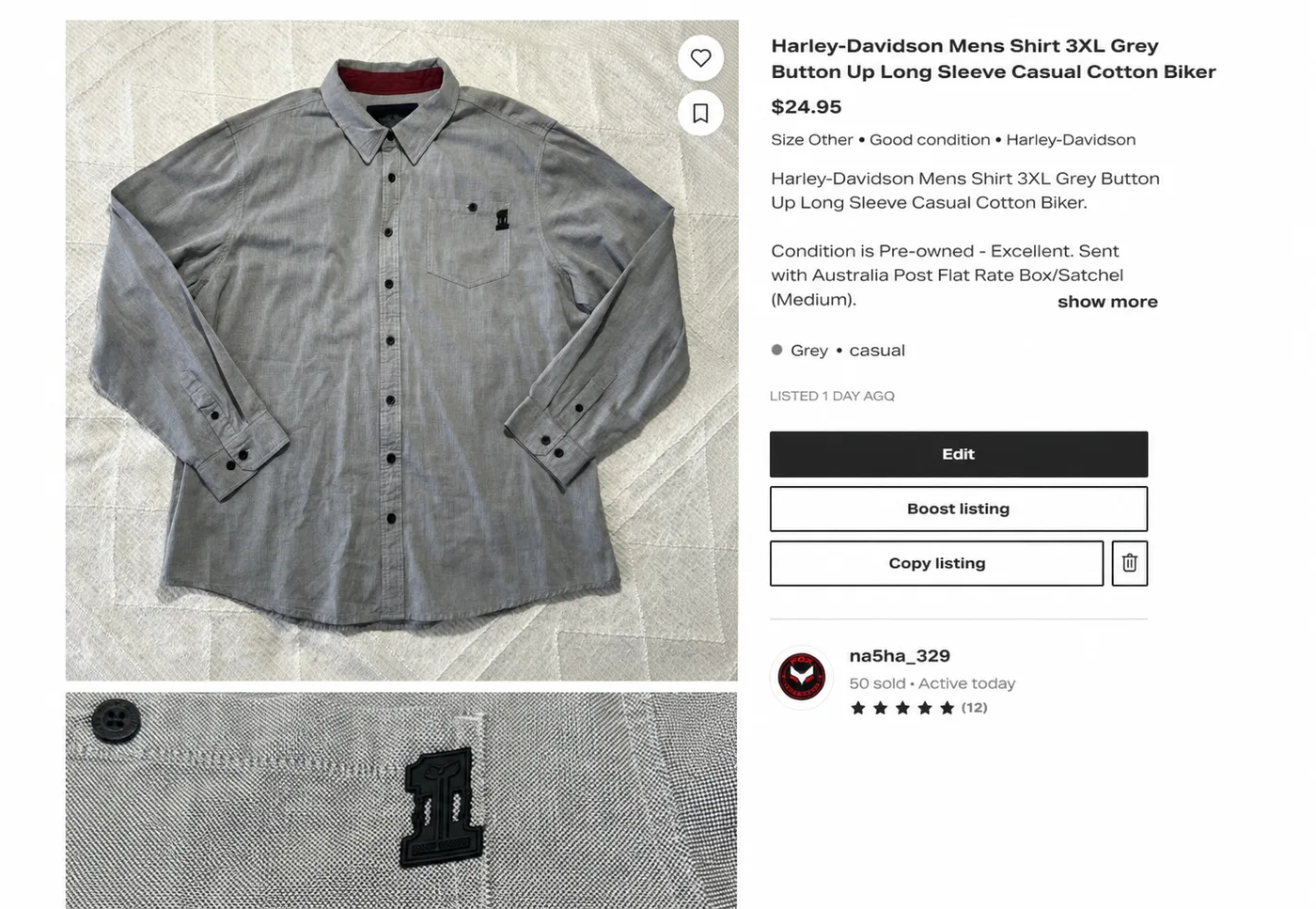
A better Depop version would be:
Harley-Davidson grey button-up shirt, men’s 3XL
The important details remain:
- Brand
- Product type
- Colour
- Size
- One or two useful style cues
What you remove is the repetitive keyword stacking.
Do not add unrelated brands, aesthetics or trend terms. Depop’s search guidance says irrelevant information, such as using a different brand to attract views, can hurt listing exposure.
Make the description easy to scan
Depop’s own description advice is simple: be clear, relevant and complete. Include measurements, fit notes, condition, shipping information and useful item details.
For clothing, a good Depop description can follow this structure:
- One-sentence item summary
- Brand and tagged size
- Measurements
- Condition and flaws
- Material or fit notes
- Shipping or bundle note
Example:
Grey Harley-Davidson men’s button-up shirt in tagged size 3XL. Long sleeves with chest pocket and small Harley-Davidson logo detail. Pre-owned in excellent condition with no obvious stains or damage. Please check measurements before buying: pit to pit 68 cm, length 82 cm. Ships from Australia.
This is still searchable, but it sounds like a real seller wrote it.
If you want a reusable starting point, the free Depop description template turns brand, size, fit, measurements, condition and flaw notes into a copy-ready draft. Treat it as a checklist and confirm every line against the item before posting.
Add measurements, not just the tag size
Measurements are one of the easiest ways to make an eBay listing work better on Depop.
They help because:
- Vintage sizing can run differently from modern sizing
- AU, UK, US and EU sizes can confuse buyers
- Men’s and women’s sizing may be interpreted differently
- Buyers want confidence before making an offer
- Accurate measurements can reduce return questions
For clothing, include the most relevant measurements:
- Tops: pit to pit, length, shoulder width, sleeve length
- Pants: waist laid flat, rise, inseam, leg opening
- Jackets: chest, length, shoulder width, sleeve length
- Dresses: bust, waist, length
- Shoes: marked size and any useful fit notes
You can use Listalong’s printable measurement guides and AU size conversion charts if you want a consistent way to measure stock before listing.
Choose the closest Depop category and details
Depop and eBay do not use identical listing fields.
When creating the Depop version, check:
- Category and subcategory
- Brand
- Size
- Colour
- Condition
- Style
- Material
- Shipping price
Do not force an item into a more popular category just to get views. If a buyer filters by category, colour, condition or size, inaccurate item details can stop the right buyer from finding it.
This is especially important for Australian fashion sellers. From 8 September 2026, eBay Australia’s clothing listing requirements require supported size and condition values for apparel and footwear, so clean source data matters before you adapt the item for Depop.
Price the item for Depop, not just eBay
You do not have to use the same price on both marketplaces.
Before pricing a Depop listing, consider:
- What similar items sold for on eBay
- What similar items appear to sell for on Depop
- The item’s condition
- Your original buy cost
- Postage and packaging cost
- Platform fees
- Whether you are willing to accept offers
From 22 July 2026, Depop removes the old 10% selling fee for eligible Australian AUD sales. Australian sellers still pay Depop Payments processing of 2.6% + $0.30 AUD on the item sale price, shipping and applicable taxes. An optional boosting fee can also apply. Buyers may see a separate marketplace fee at checkout, but that buyer fee is not deducted from the seller payout.
That means a $50 item with $10.95 postage is not really a $50 sale once fees and postage handling are included.
Use the eBay vs Depop fee calculator to compare the same item across both marketplaces, switch between the old and new Depop rules, and include your real postage and stock costs.
Decide how postage will work
Postage is where many eBay sellers get caught.
The full Depop shipping Australia guide covers the current Depop-label and tracked-post workflows, including packaging, payout timing and the unclear Australian seller-protection wording.
On eBay, you may already have business policies, calculated postage, flat-rate satchels or a MyPost Business routine. On Depop, the listing flow may feel simpler, but you still need to make sure the postage price covers the real cost.
For each item, check:
- Packed weight
- Satchel or box size
- Whether tracking is included
- Who pays postage
- Whether the item can be combined in a bundle
- Whether the Depop buyer is in Australia or overseas
Depop’s seller protection guidance says Australian sellers may be eligible for Depop Protection when the order meets the eligibility rules, including using the relevant Depop Shipping label and sending to the address on the Depop receipt. Always check the current protection terms before relying on coverage.
The practical rule is simple: do not guess postage on your first batch. Weigh the item, choose the packaging and know the cost before publishing.
Use SKUs or stock numbers from the start
When the same physical item is listed on eBay and Depop, you need a way to connect the two listings.
Use a simple SKU or stock number such as:
- H001 for a Harley-Davidson shirt
- J014 for a denim jacket
- S022 for sneakers
Record it in your inventory system and, where appropriate, in the listing fields. Depop has official SKU functionality for sellers who want to track stock inside Selling Hub.
Your record should include:
- SKU or stock number
- Storage location
- eBay listing ID
- Depop listing reference
- eBay price
- Depop price
- Cost of goods
- Postage method
- Current status
This does not need to be fancy. A spreadsheet is fine when you are starting. The important part is consistency.
Avoid selling the same item twice
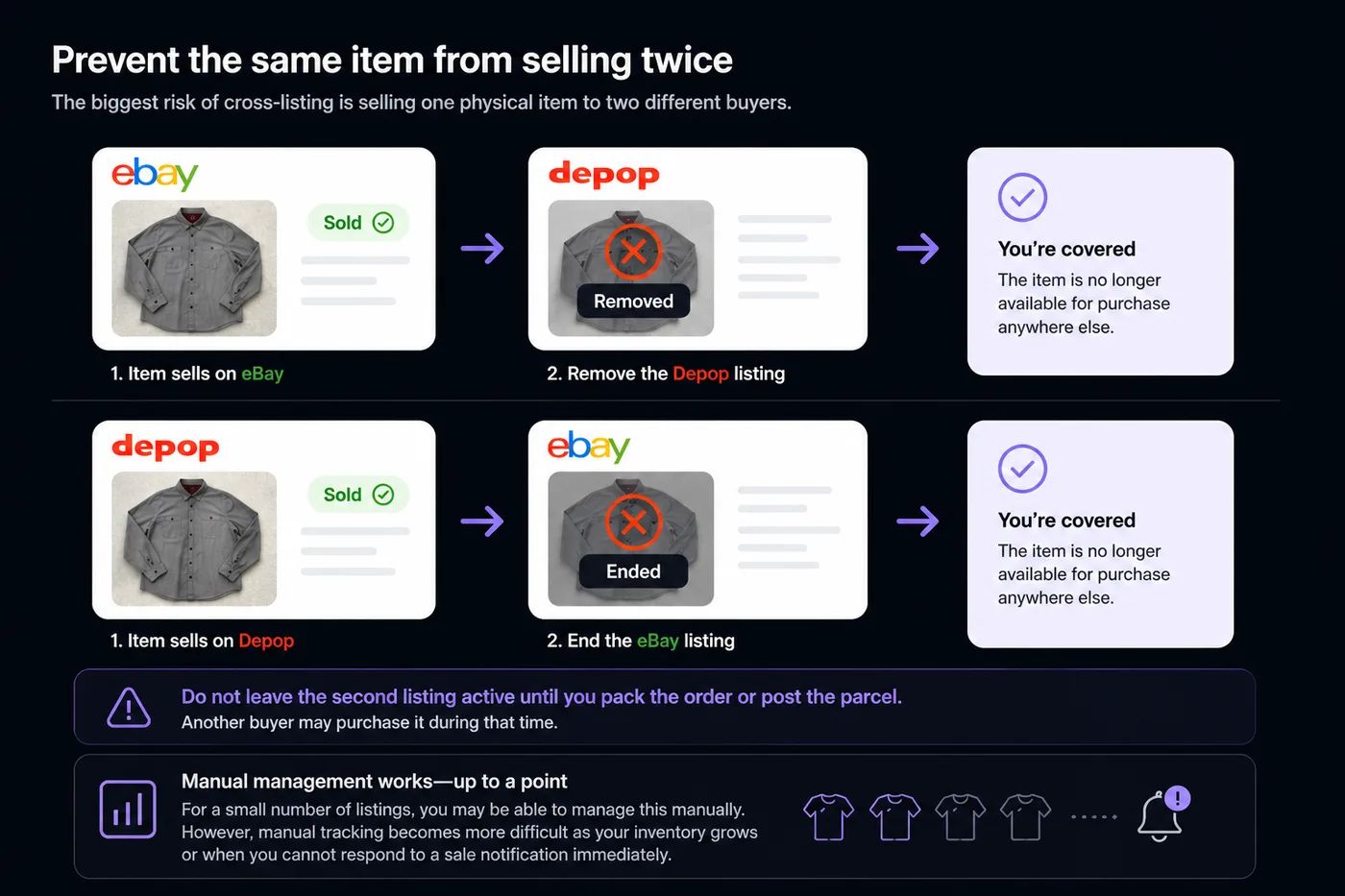
The biggest risk of selling on eBay and Depop at the same time is double-selling.
Double-selling happens when one physical item sells on one platform while the matching listing remains active on the other. If a second buyer purchases it, you now have two buyers and one item.
To reduce the risk:
- Check notifications daily
- Remove the matching listing as soon as an item sells
- Keep eBay and Depop listing IDs together
- Use SKUs or storage codes
- Avoid cross-listing more items than you can manage
- Use software once manual tracking becomes too slow
Do not wait until you pack the order. Remove the matching listing first.
For a deeper process, read our guide on how to avoid selling the same item twice.
Review your first 20 Depop listings
After your first batch has been live for a little while, review what happened.
Track:
- Which items received likes
- Which items received offers
- Which items received questions
- Which items sold
- Which marketplace sold the item first
- Whether your pricing left enough margin
- Whether your descriptions caused buyer questions
This helps you decide what to list next.
You may find that vintage tees and branded jackets are worth cross-listing, while plain basics are not. Or you may find that Depop works well for shoes but not for the homeware you sell on eBay.
That is useful information. The point of the first batch is not to be perfect. It is to learn what deserves more of your time.
Beginner checklist for eBay sellers moving to Depop
Before publishing your first Depop batch, check:
- Your Depop profile looks trustworthy
- You understand Depop’s prohibited items policy
- You have chosen 10 to 20 suitable items
- Your photos clearly show condition and flaws
- Your titles sound natural on Depop
- Your descriptions include measurements
- Your categories and sizes are accurate
- Your price allows for fees and postage
- Each item has a SKU or stock number
- You know where the item is stored
- You can remove the matching listing quickly after a sale
If you can tick those off, you are ready to test Depop without turning your whole eBay workflow upside down.
A simpler way to move eBay listings to Depop
Listalong helps Australian resellers cross-list existing eBay or Depop listings to the other marketplace automatically, or when they choose items themselves. This guide focuses on the eBay-to-Depop direction.
The idea is simple:
- Keep eBay as your main listing workflow
- Reuse the photos and item details you have already entered
- Check whether the item belongs on Depop
- Prepare the Depop listing without retyping everything
- Keep the connected listings easier to manage after publication
That matters most once you have more than a handful of listings. Manual cross-listing is manageable at first, but it gets harder as your inventory grows.
If you are testing Depop after eBay, start manually with a small batch. Once you know which items are worth cross-listing, a tool like Listalong can help reduce the repeated work.
Final thoughts
Starting on Depop after eBay is not about copying your whole store across.
It is about choosing the right items, adapting them properly and keeping your inventory under control.
Start with a small batch of strong fashion-friendly listings. Reuse the useful eBay information, rewrite the title and description for Depop, add measurements, price with fees in mind and remove the matching listing immediately when an item sells.
That gives you the best chance of learning Depop without creating a mess behind the scenes.