
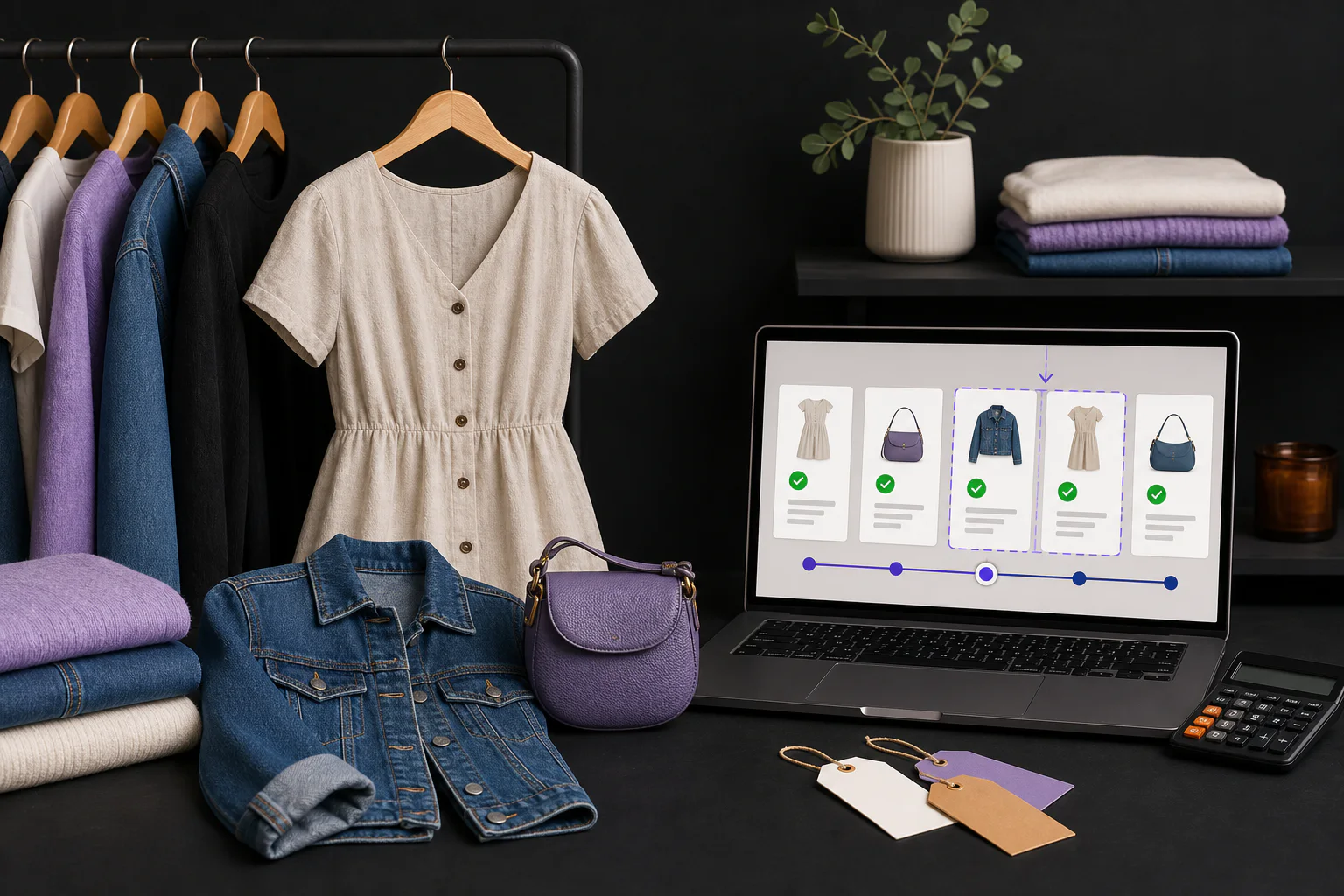
Pricing second-hand clothes is not about finding the highest number attached to the brand.
It is about finding what buyers have recently paid for an item genuinely similar to yours.
The quickest free starting point for Australian resellers is eBay’s sold-items search. It lets you see completed sales, rather than relying on the hopeful prices of items that are still sitting unsold.
My preferred workflow is:
- Search for the brand and item type.
- Turn on Sold items.
- Sort by Price + postage: highest first.
- Study why the top examples sold for more.
- Remove anything that is not truly comparable.
- Price from the realistic group that remains.
Sorting by highest price is useful because it shows the ceiling. It does not mean the first result is what your item is worth.
Written by Nathan, an Australian reseller and the founder of Listalong. The eBay Australia workflow and examples in this guide were checked on 14 July 2026. Marketplace interfaces and fees can change.
Why active listings give you the wrong answer
Active listings tell you what sellers are asking. Sold listings tell you that a buyer was prepared to complete a purchase.
Suppose you search for a second-hand dress and see active listings at:
- $45
- $60
- $80
- $125
- $180
It is tempting to pick $125 because your dress looks just as nice. But those listings may have been active for months. The $180 seller may never receive an offer.
Now imagine closely matched sold listings cluster around $48 to $72. That is better evidence of the current market.
Active listings still matter later because they show your present competition. They just should not be your only evidence.
Before searching, identify exactly what you have
A useful sold search starts before you open eBay.
Check the garment for:
- brand
- item type: dress, jacket, jeans, blouse, blazer or another category
- style name or product code, if available
- size and whether it is standard, petite, tall, curve or plus size
- fabric: linen, wool, silk, cotton, leather or a blend
- length and cut: mini, midi, maxi, wide leg, straight, cropped or oversized
- recognisable features: print, embroidery, belt, pockets or hardware
- condition: new with tags, excellent pre-owned, ordinary wear or visible flaws
- age: current, older, discontinued or genuinely vintage
Photograph the care and product labels while you inspect the item. A style code can turn a vague search into an exact match.
For example, these searches become progressively more useful:
Country Road dressCountry Road linen dressCountry Road linen midi dress size 12Country Road black linen midi dress size 12 belted
Do not begin so narrowly that eBay returns no useful sales. Start with the core identifying words, then tighten the search after you see the market.
How to find sold clothes on eBay Australia
Step 1: Search for the item
Open eBay Australia and search using the brand, garment type and one or two important features.
Good starting searches include:
Gorman linen dressRM Williams mens shirtLevi's 501 jeans womenCountry Road wool coatNike vintage track jacket
Avoid subjective words such as “beautiful” or “stunning”. Search terms should describe facts a buyer would use.
Step 2: select Sold items
On desktop, scroll down the filters to Show only and select Sold items. eBay may also show Completed items as selected.
You can also open Advanced Search, enter the keywords and choose completed listings. eBay’s current help guidance recommends completed listings when researching previous sale prices.
On mobile, run the search first, open the filters and look for the sold or completed option. The exact layout may move as eBay updates the app.
Step 3: sort by highest price
Open the sort menu and choose Price + postage: highest first.
This is the useful part of the user’s suggested method. Starting at the top lets you ask:
What made buyers pay the most for this type of item?
It may be:
- new with tags
- a rare or discontinued print
- silk, wool, leather or a premium fabric blend
- an in-demand size
- a complete set or bundle
- a highly desirable vintage version
- excellent photography and measurements
- an international sale with expensive delivery
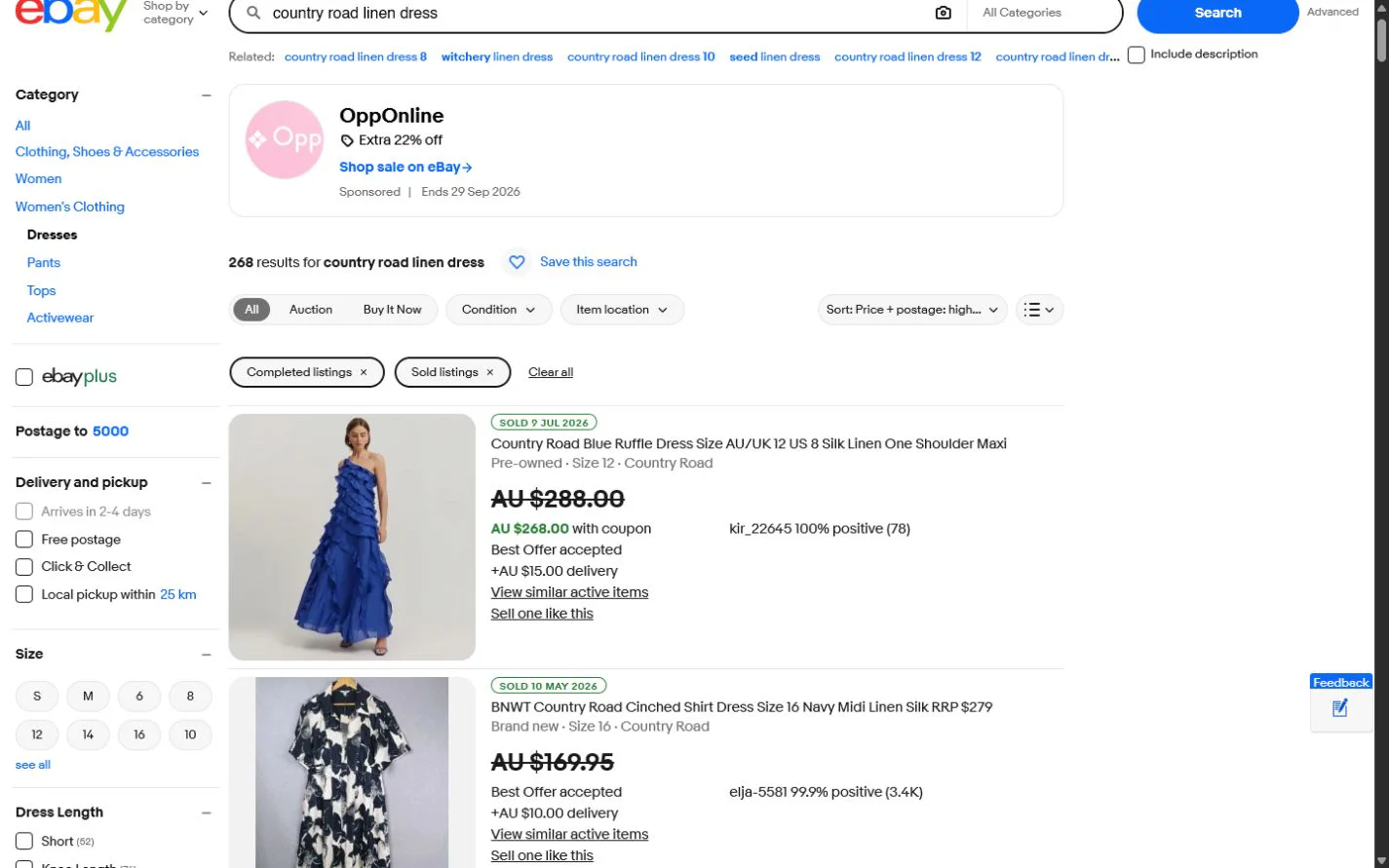
The screenshot immediately shows why the first result should not become your price. The high result has silk-linen fabric and a distinctive one-shoulder ruffle design. Another prominent result is brand new with tags. Those are not fair comparisons for an ordinary pre-owned linen day dress.
Step 4: apply the condition filter
If your garment is pre-owned, select Pre-owned. Otherwise the top of the search may be dominated by new-with-tags stock.
Condition can move a clothing price significantly. Separate these groups:
- new with tags
- new without tags
- excellent pre-owned condition
- normal pre-owned condition
- flawed, altered or incomplete items
Do not treat “worn once” as new. If tags are removed, price it against pre-owned items unless the marketplace’s current condition definitions clearly say otherwise.
For eBay Australia, condition is also a required listing field rather than loose descriptive wording. Before 8 September 2026, use our clothing size and condition requirements checklist to review active apparel and footwear listings.
Step 5: check location and currency
Australian sellers should normally begin with Australia-based results and prices in Australian dollars.
An overseas sale may not reflect local demand. International postage can also make the displayed total difficult to compare.
If Australian results are scarce, widen the search, but treat overseas examples as supporting evidence rather than direct price matches.
Step 6: inspect the listings, not just the prices
Open at least five to ten plausible sold listings.
Compare:
- garment photos
- exact style and silhouette
- size
- fabric composition
- condition and flaws
- whether accessories such as a belt were included
- item price
- postage price
- auction versus Buy It Now
- whether Best Offer was accepted
The title alone can hide major differences. A listing called “linen dress” may be a linen blend, while another is 100% linen. One may be a recent basic and another a desirable vintage Made in Australia piece.
Highest price is the start, not the answer
Imagine the first seven results for your broad search look like this:
| Sold result | Key detail | Use as a direct comparable? |
|---|---|---|
| $145 + postage | New with tags, rare print | No: useful for the ceiling |
| $110 delivered | Silk-linen limited style | No: premium fabric and style |
| $78 + postage | Pre-owned linen midi, same size | Yes |
| $69 delivered | Pre-owned linen midi, close size | Yes |
| $62 + postage | Pre-owned linen day dress | Yes |
| $44 + postage | Visible mark near hem | Only for flawed-condition pricing |
| $35 delivered | Simpler sleeveless shift | No: different style |
The broad sold range is $35 to $145. That range is too wide to guide a listing.
The trustworthy comparable group is $62 to $78. A reasonable balanced starting price might be around $72 to $79, depending on postage, photographs, measurements and how quickly you want it sold.
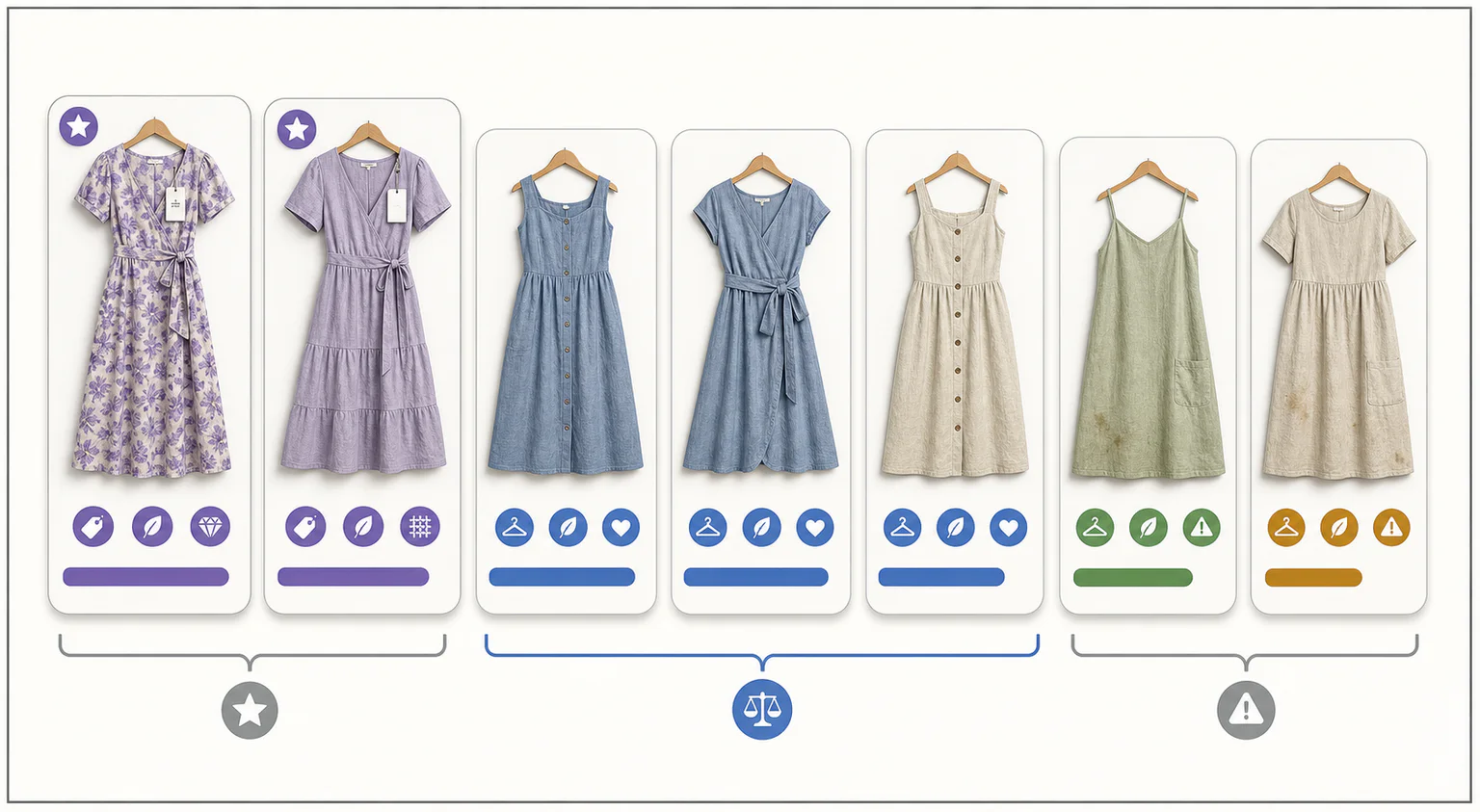
This is the core pricing skill: explain the difference between each result and your item.
Build a low, middle and high sold range
Once you have at least five useful comparisons, write down three numbers.
Low price
The lower end of credible sales for comparable condition. This can suit:
- a quick sale
- weaker photos
- an unpopular colour
- minor wear
- a seller account with little feedback
Middle price
The centre of the believable sold group. This is usually the strongest starting point for a normal listing.
You do not need a complicated statistical model. With an odd number of comparable sales, order the totals and look at the middle one. With an even number, use the centre pair as a guide.
High price
The upper end achieved by genuinely similar items in equal or better condition.
Use this when your garment has:
- excellent condition
- the more desirable size, colour or print
- complete accessories
- strong photos and measurements
- time to wait for the right buyer
Do not use the highest outlier simply because your item is the same brand.
Compare total buyer cost, including postage
Always compare item price plus delivery.
These two listings are nearly the same to a buyer:
- $45 item + $15 postage = $60 total
- $60 item + free postage = $60 total
The second listing may look more expensive in a quick spreadsheet even though the checkout total is identical.
When eBay sorts by price plus postage, it helps expose this difference. Still inspect the delivery destination because postage shown to you can depend on your location.
Use the Listalong postage comparison tool to estimate Australian parcel options before promising free delivery.
Be careful with Best Offer accepted
A regular eBay sold result may display a crossed-out asking price and say Best Offer accepted. The actual accepted amount can be lower.
Do not record the crossed-out asking price as a confirmed sale price.
When eBay Product Research is available in your account, eBay says it can provide:
- actual sold prices, including accepted Best Offers
- average sold price
- sold price range
- average postage
- up to three years of sales data
- filters for condition, location, marketplace and listing format
Public eBay pages currently describe Product Research access slightly differently, so check the Research tab in your own Seller Hub or selling area. The normal sold-items search remains a practical free starting point even when Product Research is unavailable.
If pricing is only one part of the problem, our Australian eBay seller tools guide compares research with traffic, photo, offer, advertising, postage and profit tools.
Check active competition after sold prices
Once the sold range makes sense, turn off the sold filter and inspect current listings.
Ask:
- How many close matches are available now?
- Are better-condition items priced below my planned price?
- Do competing listings include free postage?
- Are their photos and measurements better?
- Are several identical items already sitting unsold?
Sold evidence tells you what buyers have paid. Active competition tells you what they can choose today.
If your realistic sold range is $60 to $75 but three better examples are active at $55, listing yours for $85 is unlikely to be competitive.
Choose a price based on your selling goal
| Goal | Starting position | Trade-off |
|---|---|---|
| Sell quickly | Near the lower end of the credible sold range | Less profit, faster chance of interest |
| Balanced sale | Around the middle of the credible range | Practical default for most items |
| Allow offers | Slightly above the expected sale price | Gives room to negotiate without becoming unrealistic |
| Wait for the right buyer | Near the upper comparable range | More profit potential, longer storage time |
| Clear flawed stock | Below clean comparable sales | Honest condition and price can reduce disputes |
If the evidence supports a likely sale near $55, listing at $60 to $65 may leave a modest offer buffer. Listing at $95 because one rare version sold there is not an offer strategy. It is an unrelated price.
Work backwards from profit, not just sale price
A garment can sell for a respectable amount and still be a poor resale purchase.
Use this basic calculation:
Expected sale price - marketplace costs - postage paid by you - packaging - purchase cost = estimated profit
For example:
| Item | Amount |
|---|---|
| Expected sale price | $65 |
| Postage paid by seller | -$11 |
| Packaging | -$1 |
| Marketplace and payment costs | -$4 |
| Op-shop purchase cost | -$12 |
| Estimated profit before tax and labour | $37 |
The marketplace-cost row is only an example. Actual fees depend on the platform, seller status, advertising, payment processing and the date of sale.
Eligible Australian eBay sellers may currently qualify for eBay’s free-selling experience, while optional promotions, international sales and other costs can still apply. Depop’s Australian fee arrangements are also changing in July 2026. Check the current platform rules and use the eBay versus Depop fee calculator rather than relying on an old percentage.
For sourcing decisions, the reseller ROI calculator helps work backwards from your target return.
How much should you pay when sourcing?
Once you have a cautious expected sale price, calculate a maximum purchase cost.
Maximum buy cost = expected sale price - expected selling costs - minimum profit required
If a dress is likely to sell for $60, expected selling costs are $12 and you require at least $30 profit, the maximum buy cost is:
$60 - $12 - $30 = $18
That does not mean you should automatically pay $18. It means paying more would break your target under those assumptions.
Use the middle or lower sold estimate for sourcing. Buying stock based on the best outlier is how cheap op-shop finds become expensive storage.
Our guide to op-shop clothes worth reselling in Australia explains which item signals are worth stopping to research.
Pricing the same clothing on eBay and Depop
eBay sold listings can give you a useful evidence base even when you plan to sell on Depop.
Then consider the marketplace difference.
eBay buyers often search for an exact brand, item type and size. Depop can be more visual and style-led, particularly for vintage, Y2K, streetwear and distinctive pieces.
The same garment may therefore have:
- a search-driven price on eBay
- a presentation-driven opportunity on Depop
- different current fees and postage expectations
- different active competition
You do not need to force the exact same asking price everywhere. You do need to understand the reason for any difference and keep both listings accurate.
Listalong helps Australian resellers start with an existing eBay or Depop listing and cross-list it to the other marketplace automatically, or choose which items to send themselves.
Listalong is available with a 14-day free trial for Australian sellers, and no access code is required.
Your free trial starts only when both eBay and Depop are connected. Setup time does not count.
See where to sell clothes online in Australia for a broader marketplace comparison.
Common second-hand clothing pricing mistakes
Copying the highest result
The highest result often has a premium feature your item does not share. Use it to understand the ceiling, then move down to true comparisons.
Using active asking prices as proof
An active listing proves only that the seller selected that price. It does not prove a buyer will pay it.
Searching by brand alone
Most brands contain weak basics and desirable pieces. Item type, fabric, size, style, age and condition can matter more than the label.
Ignoring postage
Comparing $50 plus $15 postage with $58 delivered as if the first is cheaper produces bad pricing decisions.
Treating a Best Offer asking price as the sold price
The accepted amount may have been lower. Use Product Research when available or mark that result as uncertain.
Comparing different conditions
New-with-tags, excellent used and visibly flawed stock belong in different groups.
Pricing from what you paid
Your purchase cost does not determine market value. A $2 dress can be worth $20, while a $30 sourcing mistake can still be worth only $20.
Forgetting your time
Photography, stain treatment, measurements, messages, packing, storage and returns all consume time. A low-profit item may not be worth listing even when the sale itself would be profitable.
A reusable five-minute pricing checklist
Before listing, ask:
- Have I identified the exact item type, fabric, size and condition?
- Am I looking at sold items rather than only active listings?
- Have I sorted by price plus postage from highest to lowest?
- Can I explain why the top results sold for more?
- Have I removed new-with-tags, bundles, rare variants and other mismatches?
- Do I have at least five useful comparable sales?
- Have I compared total buyer cost, including postage?
- Did any result use Best Offer, making the shown amount uncertain?
- What are comparable active listings priced at today?
- Does the likely sale leave enough profit after every cost?
If you cannot answer those questions, the price is still a guess.
Frequently asked questions
How do I work out what second-hand clothes are worth?
Find closely matching sold items on eBay, sort from highest total price, remove mismatched results and use the middle of the trustworthy sold range. Then check active competition and your costs.
How do I find sold items on eBay Australia?
Search for the garment, open the filters and select Sold items under Show only. On desktop, Advanced Search also provides a completed-listings option.
Should I sort sold listings by highest price?
Yes, because it reveals the ceiling and the features buyers rewarded. Do not copy the first price. Use it to learn, then price from genuinely comparable sales.
Does a sold listing show the actual Best Offer?
Not always. A sold result can show the old asking price with Best Offer accepted. eBay says Product Research can show actual accepted prices when the tool is available in your account.
Should postage be included when comparing prices?
Yes. Buyers compare the total cost. Add the item and delivery amounts before recording a comparable sale.
How much room should I leave for offers?
Keep the buffer modest. If the likely sale price is $55, an asking price near $60 to $65 may be reasonable. A large unsupported markup can reduce views and delay the sale.
Can I use eBay sold prices for Depop?
Yes, as a starting point. Adjust for Depop’s audience, presentation, current fees, postage and competing listings.
Final recommendation
Start by sorting eBay sold items by Price + postage: highest first.
Use the top results to understand the best-case market. Then remove every sale that is not truly comparable to your garment.
Build a realistic range from the remaining sales, compare it with today’s active competition and choose a price that matches your goal: quick sale, balanced return or a longer wait for the right buyer.
The best price is not the biggest number you can find. It is the strongest number you can explain.