Eligible beginners can now sell on eBay Australia for free under eBay’s new seller tier, but the word “free” needs context.
For eligible Australia-based sellers, eBay now says it is free to sell on eBay.com.au if you are not on a Pro plan and you have AU $25,000 or less in sales over the past 12 months.
That sounds simple, and for many beginners it is genuinely good news. But “free selling” does not mean every cost disappears.
You still need to understand postage, packaging, optional upgrades, Promoted Listings, international sales, disputes, buyer-visible pricing and tax record keeping.
This guide explains eBay Australia’s free seller tier in plain English, with examples for new resellers who want to list properly and protect their profit.
What is eBay Australia’s free seller tier?
The simple version is this:
Eligible Australian sellers can list and sell on eBay.com.au without paying the normal eBay transaction fee when an item sells.
That is a major change for beginners because the transaction fee used to be one of the first things sellers had to subtract from every sale.
If you sold a $50 item, you could not treat the full $50 as money in your pocket. You had to allow for eBay fees, postage, packaging and your item cost.
Under the new free selling setup, eligible sellers may keep more of the item sale price because the eBay transaction fee is removed on qualifying sales.
But the word “free” needs context.
What is included and what is not included?
Here is the clean beginner version.
| Area | What it means |
|---|---|
| eBay transaction fees | Eligible sellers do not pay transaction fees on qualifying eBay.com.au sales. |
| Postage | Still a real cost. You still need to pay to send the item. |
| Packaging | Still your cost, even if it is small. |
| Optional upgrades | Subtitles, extra listing features and other paid upgrades can still cost money. |
| Promoted Listings | Advertising is separate and can cost money if you use it. |
| International sales | eBay says international sales fees can apply when the delivery address is outside Australia. |
| Disputes and performance | Extra fees can apply in some dispute or performance situations. |
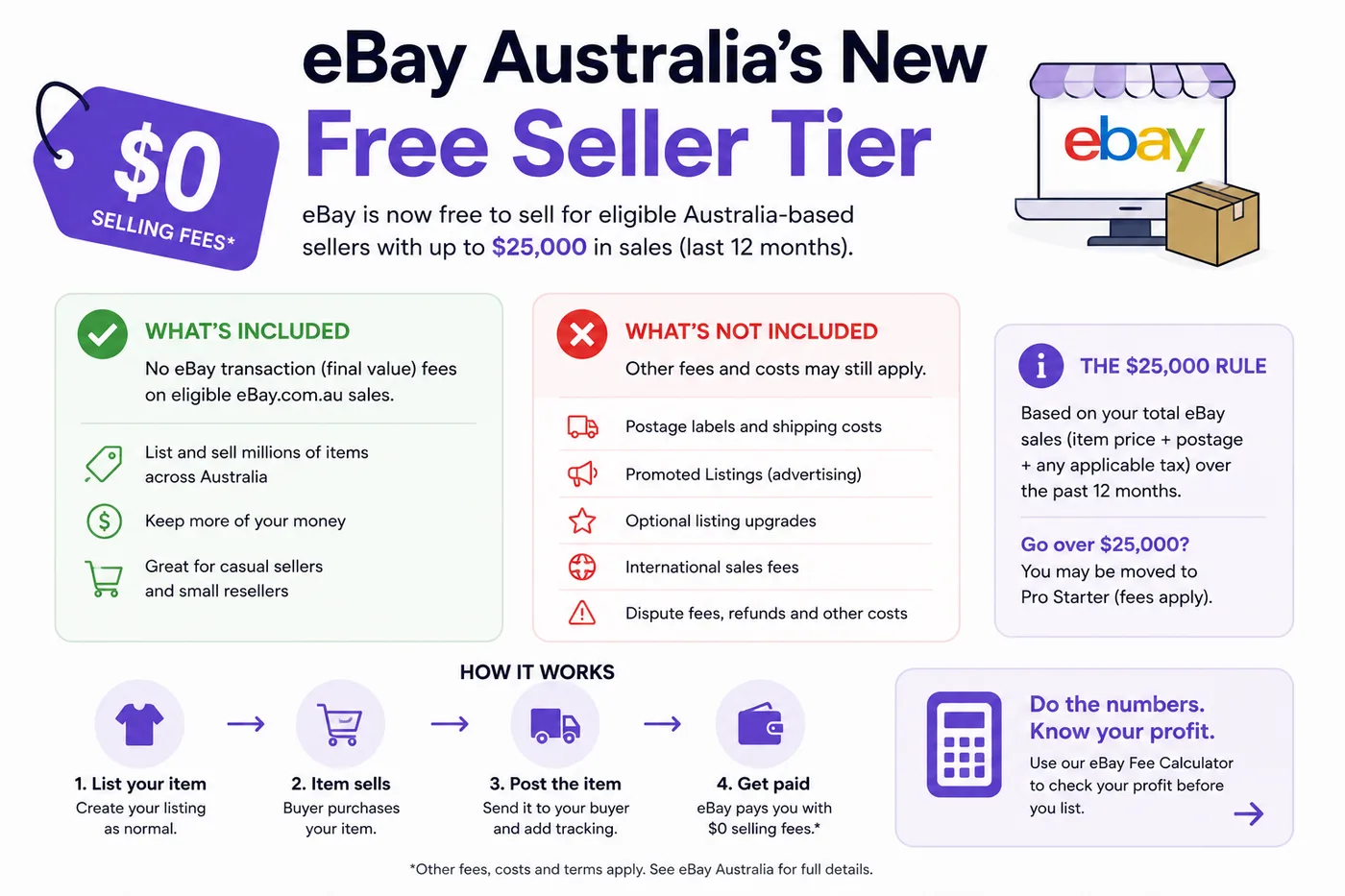
The practical lesson is simple: eBay has removed the main seller transaction fee for eligible sellers, but selling still has costs.
Who qualifies for free selling on eBay Australia?
Based on eBay Australia’s current seller fee guidance, the free selling setup is aimed at Australia-based sellers who:
- have an Australian registration address
- sell on eBay.com.au
- are not using an eBay Pro plan
- have AU $25,000 or less in eBay sales over the past 12 months
This is especially helpful for casual sellers, beginners and small resellers who are still learning.
It is less relevant for larger sellers who already use Pro features, higher-volume workflows, APIs, multi-quantity listings or other advanced selling tools.
The AU $25,000 rule is easy to misunderstand
The AU $25,000 figure is not profit.
It is not the money left after buying stock.
It is not the money left after postage.
It is an eBay sales threshold over a rolling 12-month period.
That distinction matters because a seller can have AU $20,000 in sales and still have far less than that in actual profit once item cost, postage, packaging, returns and time are included.
If you are growing from casual selling into a real reselling side hustle, start tracking your numbers early. At minimum, track:
- item sale price
- postage charged to the buyer
- postage label cost
- packaging cost
- item cost
- refunds and returns
- total eBay sales over the past 12 months
What happens if you go over AU $25,000?
eBay says that if your total sales are over AU $25,000 and you do not have a Pro plan, it will notify you on the 20th of the month before upgrading you to Pro Starter from the 1st of the following month.
The Pro Starter plan has no monthly cost, but transaction fees apply when your items sell.
So the beginner version is:
| Your eBay sales position | What may happen |
|---|---|
| At or under AU $25,000 in the past 12 months | You may qualify for free selling if the other conditions are met. |
| Over AU $25,000 in the past 12 months | You may be moved to Pro Starter and transaction fees may apply. |
| Already using a Pro plan | Pro fee rules apply to that selling setup. |
What changed compared with the old way?
Under the old casual seller fee structure, sellers usually had to allow for a transaction fee on each sale.
eBay gives a simple example: with the old fee structure, a $50 item could have meant around $7 in transaction fees, leaving the seller with $43 before postage costs. Under free selling, an eligible seller may have $0 in eBay transaction fees on the same sale.
That is a meaningful difference, especially on lower-priced second-hand items.
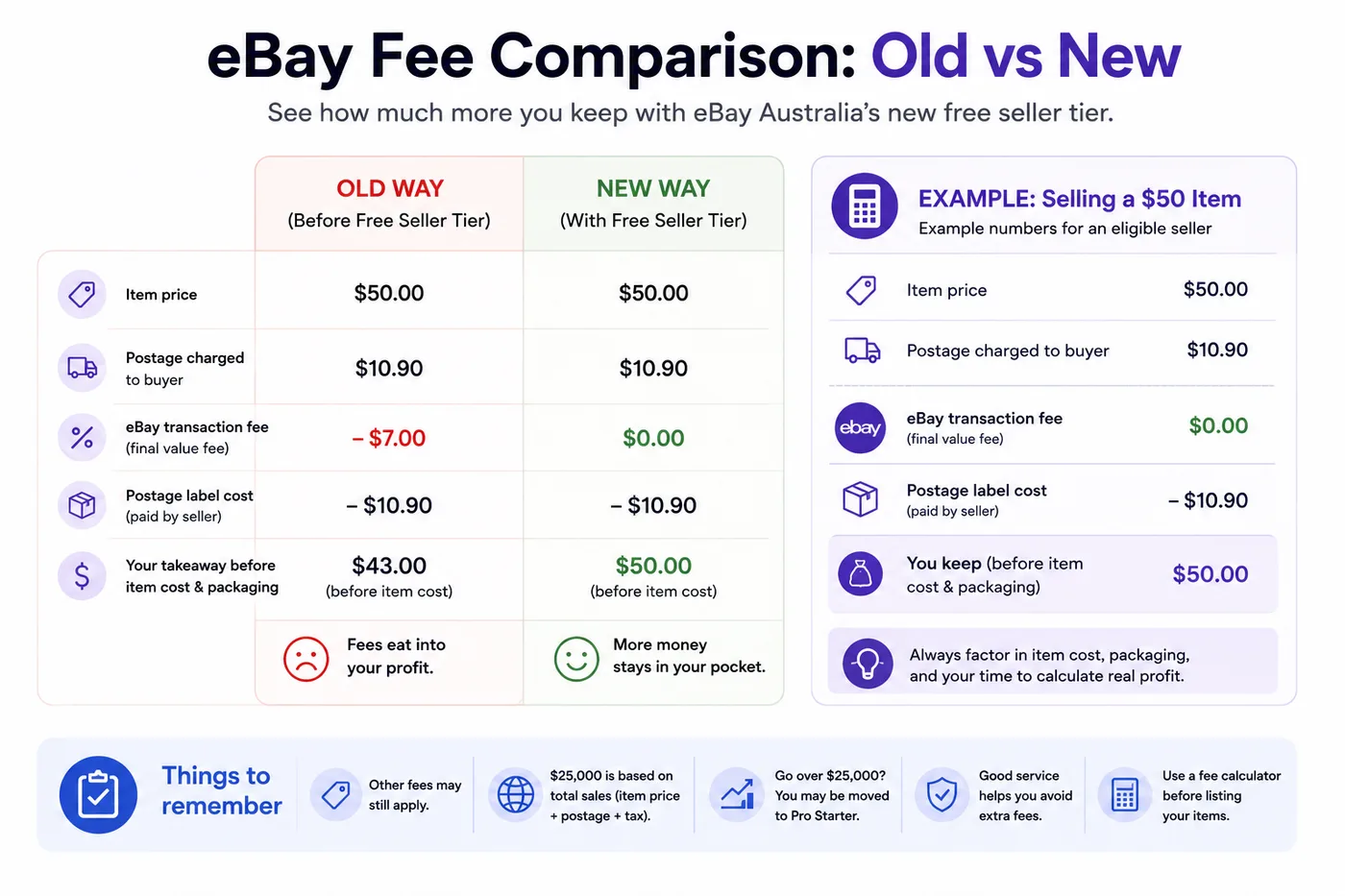
The catch is that you still need to subtract the costs that are not eBay transaction fees.
For example, if you sell a $50 item and it costs $10.90 to post, the postage label still matters.
Does free selling mean no fees at all?
No.
This is the most important point in the whole article.
Free selling means eligible sellers do not pay eBay transaction fees on qualifying eBay.com.au sales.
It does not mean:
- postage is free
- packaging is free
- Promoted Listings are free
- optional listing upgrades are free
- international selling is always fee-free
- disputes or poor account performance cannot cost money
- tax and record keeping no longer matter
eBay’s own fee page says optional listing upgrades, overseas delivery, international sales fees, performance-related fees and dispute fees can still apply depending on the situation.
How eBay free selling works in practice
For a beginner seller, the workflow is still the same:
- Create the listing.
- The buyer purchases the item.
- You pack and post the order.
- You get paid.
- You track your sales and costs.
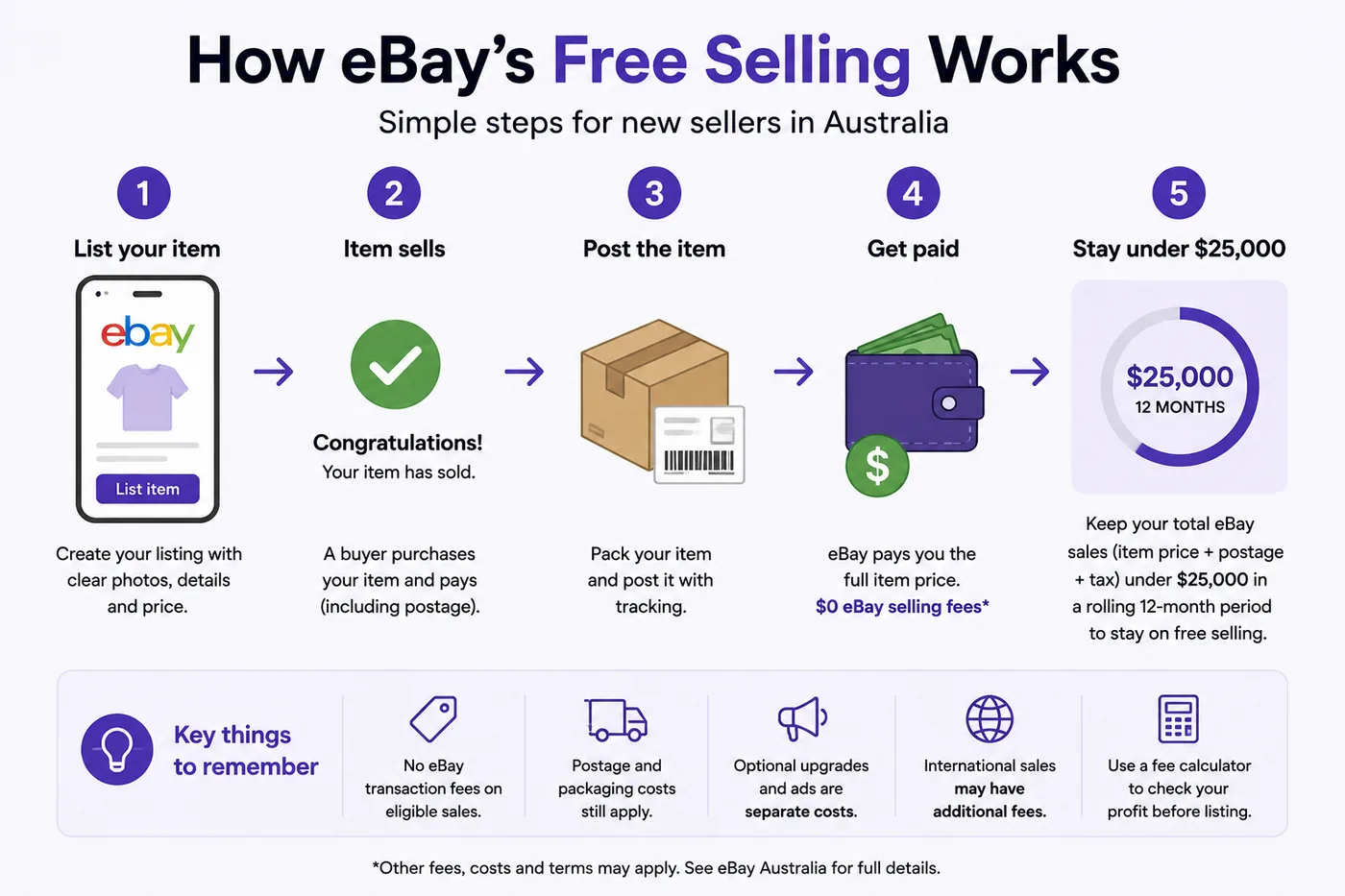
The free seller tier changes the fee side of the sale. It does not remove the need to list accurately, post on time or calculate profit properly.
Postage is still not profit
Postage is one of the easiest places for new sellers to overestimate profit.
Imagine you sell a hoodie for $40 and charge the buyer $10.90 postage.
The buyer pays:
| Line item | Amount |
|---|---|
| Item price | $40.00 |
| Postage charged to buyer | $10.90 |
| Buyer total | $50.90 |
That does not mean you made $50.90.
If the postage label costs $10.90, that money simply passes through the sale and goes back out to the carrier.
Your rough amount before item cost and packaging is:
$50.90 buyer total
-$10.90 postage label
= $40.00 before item cost and packaging
That is why a fee calculator is still useful even when seller transaction fees are $0.
You can use Listalong’s eBay vs Depop fee calculator to check the same item across platforms before listing.
Packaging, time and refunds still matter
Small costs add up.
A satchel, label, tape, printer ink, pickup time and fuel can quietly eat into low-value sales.
For a $15 or $20 item, even a small packaging cost can change whether the sale was worth doing.
Before listing, ask:
- What did the item cost me?
- What will postage actually cost?
- Am I charging postage separately or building it into the price?
- What packaging do I need?
- What happens if the buyer returns it?
- Is there enough profit for the time involved?
Free selling helps, but it does not replace basic maths.
Buyer Protection pricing can affect how competitive your item looks
There is another detail beginners should understand: seller-side fees and buyer-visible pricing are not always the same thing.
Under eBay’s newer free selling setup, Buyer Protection pricing may affect the price buyers see on some eligible non-Pro seller listings. That buyer-side cost does not reduce the seller payout in the same way a final value fee does, but it can still affect buyer behaviour because shoppers compare the final price they see.
In plain English:
- you may pay $0 seller transaction fees if eligible
- the buyer may still see a price that reflects eBay’s buyer protection pricing
- postage still adds to the buyer’s total unless you offer free postage
- your item still needs to look competitive against similar listings
So do not only ask, “What do I receive?”
Also ask, “What does the buyer see?”
That is especially important for common items where buyers can easily compare prices.
Simple profit example for a beginner
Let us say you bought a jacket from an op shop for $8.
You list it on eBay for $40 and charge $10.90 postage.
You are eligible for free selling and the postage label costs $10.90.
| Line item | Amount |
|---|---|
| Item sale price | $40.00 |
| Postage charged to buyer | $10.90 |
| eBay transaction fee | $0.00 |
| Postage label cost | -$10.90 |
| Item cost | -$8.00 |
| Rough profit before packaging and time | $32.00 |
That is much easier to understand than the old fee system, but the main lesson stays the same:
Your sale price is not your profit.
What about free postage?
Free postage can work, but it is not magic.
If you sell the same jacket for $50 with free postage, the buyer may like the simpler checkout price. But you still pay the shipping cost.
| Line item | Amount |
|---|---|
| Item sale price | $50.00 |
| Postage charged to buyer | $0.00 |
| eBay transaction fee | $0.00 |
| Postage cost paid by you | -$10.90 |
| Item cost | -$8.00 |
| Rough profit before packaging and time | $31.10 |
In this example, charging postage separately gave a slightly higher rough profit. In other categories, free postage may convert better.
The point is not that one option is always right. The point is that you need to calculate it.
Optional listing upgrades and ads are still separate
New sellers should be careful with extras.
Optional listing upgrades can cost money. Promoted Listings can also cost money depending on the campaign type and result.
That does not mean you should never use them. It means you should not turn them on blindly.
For beginner sellers, a safer order is:
- Improve the title.
- Use clear photos.
- Add the right item specifics.
- Price against sold comps.
- Set reasonable postage.
- Only then consider promotion.
If a listing is weak, promoting it often just makes a weak listing visible to more people.
Apparel and footwear sellers should also check the August 2026 eBay clothing listing requirements. Supported size and condition fields are a policy requirement, not a paid listing upgrade.
Before paying for ads or a higher seller tier, compare the eBay sales tools available to Australian sellers and match the cost to the problem you are trying to solve.
International sales can still have fees
eBay’s Australian fee page says an international sales fee can apply when the delivery address is outside Australia.
For Australia-registered sellers, eBay lists a 3% international sales fee including GST if the delivery address entered by the buyer during checkout is outside Australia.
For beginners, local sales are usually simpler while you are learning.
International selling can work, but you need to understand shipping, customs forms, returns, tracking and extra fees before relying on it.
New eBay sellers: what to remember
Free selling makes eBay more beginner-friendly, but good selling habits still matter.
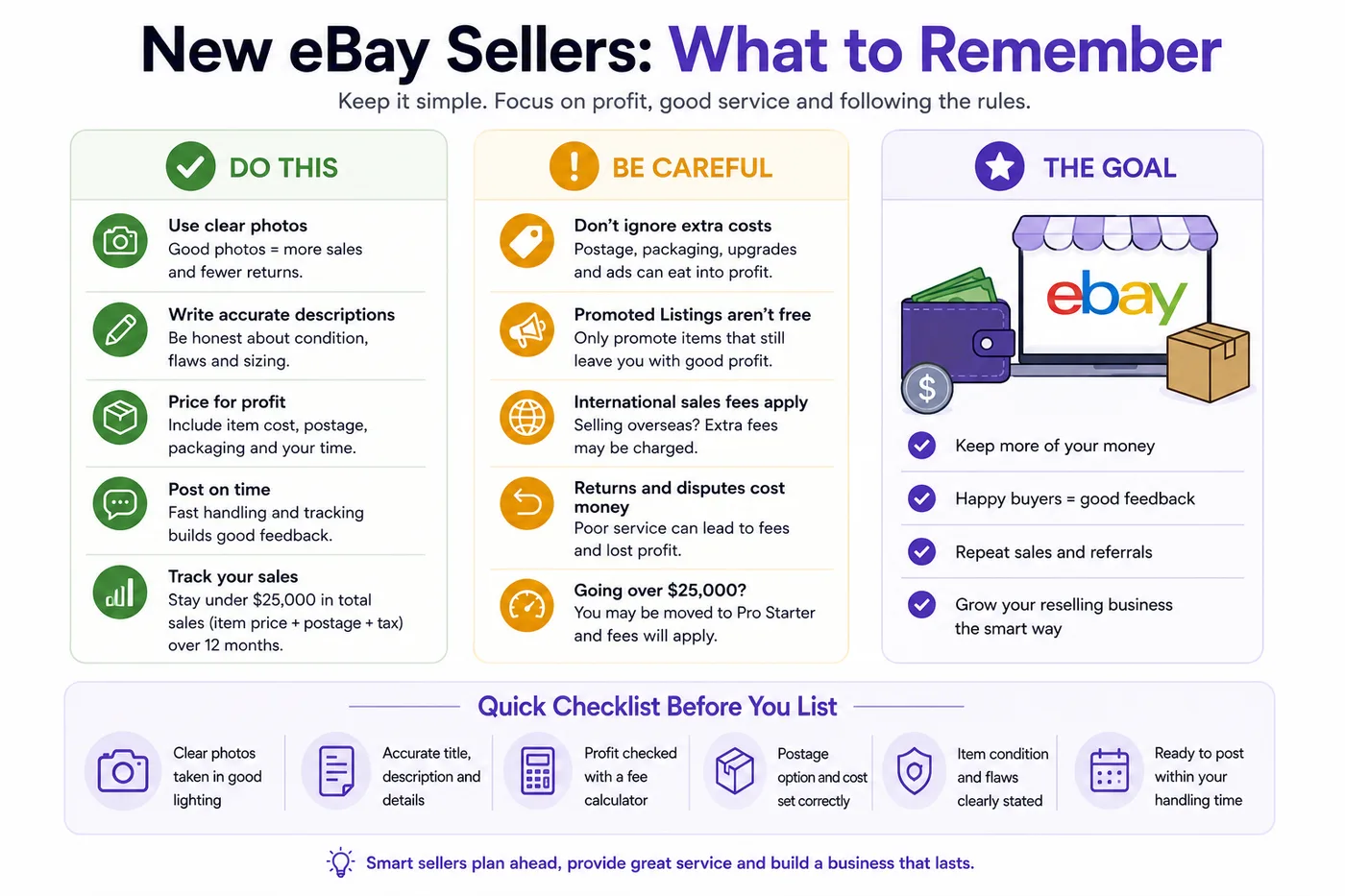
The most useful habits are:
- use clear photos in good lighting
- write honest descriptions
- mention flaws and measurements
- price for real profit
- post within your handling time
- upload tracking
- answer buyer messages politely
- track sales over the rolling 12-month period
- avoid paying for extras before you understand your margin
These basics protect your account and reduce avoidable refunds.
Is eBay now better than Depop for beginners?
For many Australian beginners, eBay is now a very strong first platform.
Why?
Because you can learn the basics without losing a large percentage of each qualifying sale to eBay transaction fees.
That makes eBay a sensible place to practise:
- photos
- titles
- item specifics
- postage
- buyer messages
- returns
- pricing
- inventory tracking
That does not mean Depop is bad.
Depop can still be a useful second platform for fashion, vintage, streetwear, shoes, bags and trend-driven items.
The smart beginner approach is usually:
- Learn eBay first.
- Get your listing and postage process under control.
- Track what sells.
- Cross-list suitable items to Depop later.
Listalong is built around that exact idea. Keep listing on eBay or Depop as normal, then let Listalong cross-list automatically to the other marketplace or choose items yourself.
Should beginners use an eBay Pro plan?
Most beginners probably do not need a Pro plan straight away.
Pro features can be useful for higher-volume sellers, stores with complex inventory, multi-quantity listings, API workflows and more advanced selling operations.
But if you are selling one-off second-hand items, clothing, shoes, collectibles, homewares or items from around the house, the free selling setup may be enough while you learn.
A simple beginner rule:
Start with free selling if you qualify.
Move to Pro only when your volume or workflow actually needs it.
Important tax note for Australian sellers
eBay’s AU $25,000 free selling threshold is an eBay fee rule.
It is not the same thing as an ATO tax rule.
Business.gov.au explains that there is no single factor that decides whether you are running a business or a hobby. Things like intending to make a profit, repeating similar activities, operating in a businesslike way and keeping records can all matter.
If you regularly buy items to resell for profit, speak with an accountant or tax professional.
Even if eBay transaction fees are $0, your record keeping still matters.
What should new sellers do now?
Here is the simplest path.
1. Start with items you already own
Sell a few items from around the house before buying resale stock.
This lets you learn photos, postage, messages and returns with less risk.
2. Keep your first listings simple
Use normal listings first.
Avoid paid upgrades until you understand your margins.
3. Price before you publish
Before listing, check:
- sold comps
- postage cost
- item cost
- packaging cost
- buyer-visible total price
- realistic profit
4. Track the AU $25,000 threshold
Do not wait until you are close to the limit to start tracking.
If reselling becomes serious, simple records will help you understand whether the free seller tier still suits you.
5. Add Depop only when it makes sense
Do not list everything everywhere from day one.
Cross-list the items that suit Depop, especially visual, style-led stock.
For Australian sellers, that often means:
- vintage clothing
- streetwear
- shoes
- bags
- accessories
- branded fashion
- trend-driven pieces
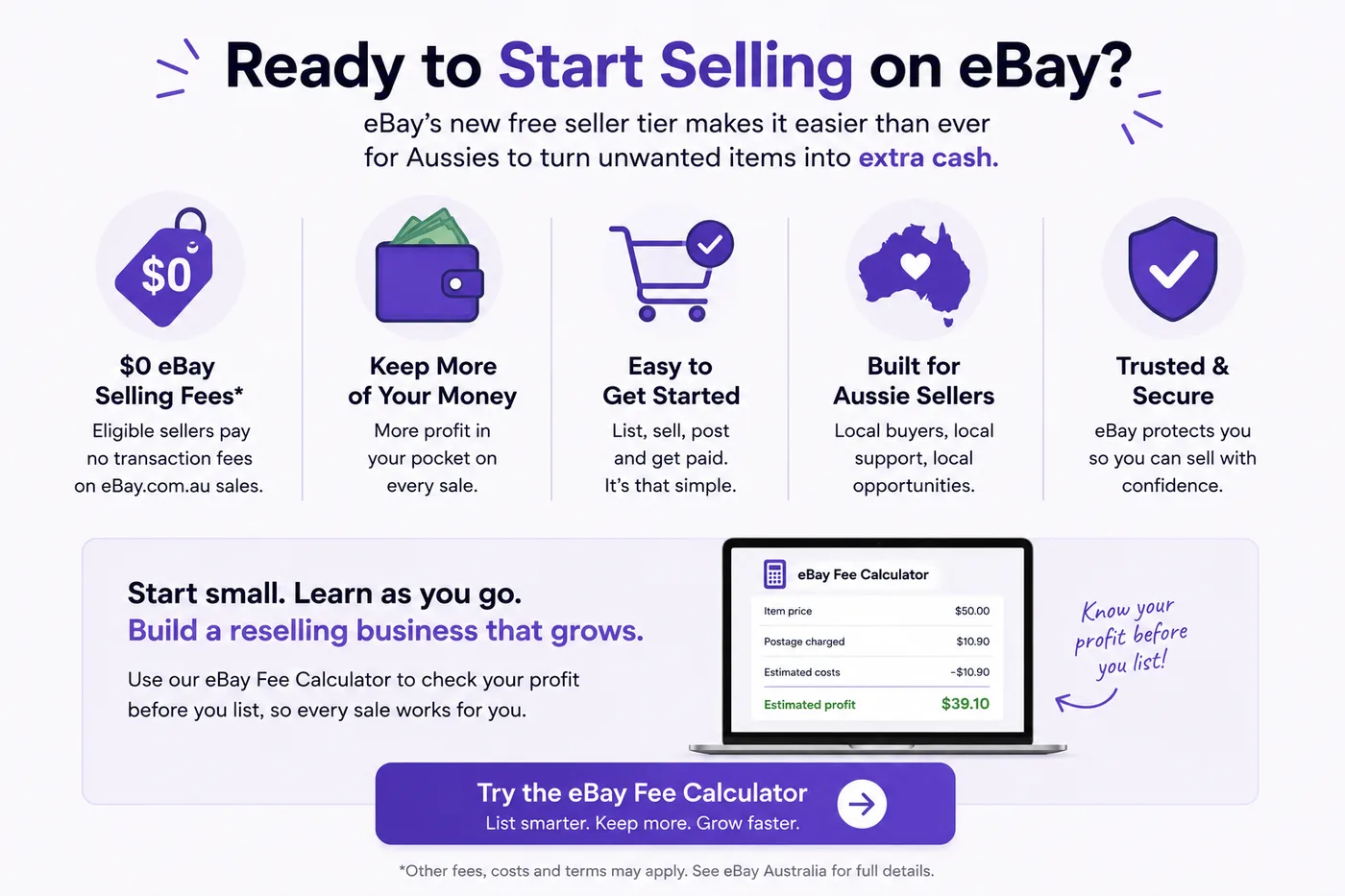
Ready to start selling on eBay?
The free seller tier lowers one of the biggest barriers for Australian beginners.
You can test selling, learn the process and keep more of your sale price if you qualify.
Just remember: free selling is not the same as guaranteed profit.
Use the eBay vs Depop fee calculator before pricing items, especially if you are comparing eBay and Depop or deciding whether free postage makes sense.
Final verdict
eBay Australia’s free seller tier is good news for beginners.
It removes the main transaction fee for eligible sellers and makes eBay a more approachable place to start selling online.
But it does not remove every cost or every responsibility.
To make the most of it:
- list accurately
- charge postage properly
- avoid unnecessary upgrades
- check buyer-visible pricing
- track your rolling sales total
- calculate profit before listing
- add Depop later for items that suit that audience
You do not need to sell everywhere from day one.
Master eBay first. Then make the listing work you already did go further.