
Australian resellers are starting to ask a new question: should I keep listing normally on eBay, or should I be trying live selling?
That question makes sense. eBay Live has started making noise in Australia, and Whatnot has become one of the loudest live-shopping platforms overseas. At the same time, many small sellers are looking at their slower eBay weeks and wondering whether buyers have moved somewhere more exciting.
The honest answer is less dramatic: live selling is worth watching, and for some sellers it is worth testing, but it is not a replacement for strong listings.
For most Australian eBay sellers, the best move is to understand where eBay Live and Whatnot fit, test them carefully, and keep your normal listings healthy across eBay, Depop and any other marketplace you use.
Why sellers are asking about live selling now
Live selling has been around for years, but it has usually felt distant for Australian resellers. It was something you heard about in the US, on TikTok, on Instagram, or in collector communities.
That is changing.
In June 2026, eBay Australia promoted a major eBay Live fashion event called 24 Hours of Drops, with more than 100 livestreams and more than 1,000 preloved fashion items reported in launch coverage. The event included celebrity wardrobe stock, designer pieces and one-cent auction-style drops, which is exactly the kind of thing that gets sellers wondering whether buyer attention is moving.
For small sellers, the worry is understandable:
- Will live auctions distract buyers from normal eBay listings?
- Should I be doing live sales too?
- Is Whatnot the next place to move stock?
- Or is live selling just Pokemon cards, hype and chaos?
The useful way to think about it is this:
Live selling is not one thing. It can be a premium fashion drop, a sneaker stream, a trading card break, a garage-clearance auction, a vintage clothing show, or a fast-moving collector event. The platform matters, but the stock and audience matter more.
What is eBay Live Australia?
eBay Live is eBay’s livestream shopping format. A host shows items in real time, buyers watch the stream, and items can be sold through a live auction or event-style drop.
For Australian resellers, the important part is not just the technology. It is the context.
eBay already has buyer trust, checkout, search behaviour, order records, seller accounts and buyer protection. That matters because second-hand buyers still care about whether the item is real, whether the seller will post it, and whether there is a process if something goes wrong.
eBay’s own Money Back Guarantee policy covers many purchases if an item does not arrive, is faulty or damaged, or does not match the listing. That kind of trust layer is one reason eBay Live could feel less risky for buyers than buying from a random social livestream.
The catch is availability. As of 26 June 2026, public Australian coverage makes eBay Live look event-led and curated, especially around preloved fashion. It does not yet look like every small Australian seller can simply open a livestream tomorrow and run a show. That may change, but sellers should not build their whole plan around access they do not yet have.
What is Whatnot?
Whatnot is a live shopping marketplace where sellers host real-time streams and buyers purchase through fast auctions, buy-it-now options and live chat.
It started with a strong collectibles feel and has since expanded into many categories. Vogue Business reported in 2025 that Whatnot had expanded to more than 140 categories across nine geographies, with apparel becoming a major category. That means it is not just one niche platform anymore.
But the way Whatnot feels is still very different from eBay.
On eBay, buyers usually search first. They type in a brand, model, size or item and compare listings.
On Whatnot, buyers often watch first. They follow hosts, hang out in streams, bid quickly and react to the pace of the show. That can be powerful if you are comfortable presenting stock live. It can be rough if you only want passive listings that sit there until the right buyer finds them.
Is Whatnot plagued with Pokemon card openers?
This is the blunt version of the question, so here is the blunt answer.
If by “plagued” you mean “is Whatnot only Pokemon cards?”, then no. Whatnot has moved well beyond one category. There are sellers in apparel, sneakers, vintage, toys, comics, luxury accessories and plenty of other areas.
If by “plagued” you mean “are Pokemon cards, trading cards, box breaks and hype-based collectible streams a very visible part of Whatnot?”, then yes, that is a fair concern.
Whatnot’s culture was built around live community selling, and trading cards are almost perfectly suited to that format. They are small, shippable, collectible, repeatable and emotionally charged. A host can open packs, run rapid auctions, create suspense and keep viewers watching. That is why Pokemon and sports card streams are so prominent.
It is also why Whatnot has attracted criticism. Reporting from The Guardian has focused on the more intense side of live collectible auctions, including rapid bidding, breaks and mystery-style mechanics that can feel more like entertainment than ordinary shopping.
That does not mean every Whatnot seller is doing something questionable. It does mean Australian resellers should understand the platform’s energy before assuming it will behave like eBay.
For fashion resellers, the question is not “is Whatnot bad?” The better question is:
Would my stock benefit from a live audience, or would it sell better through searchable listings?
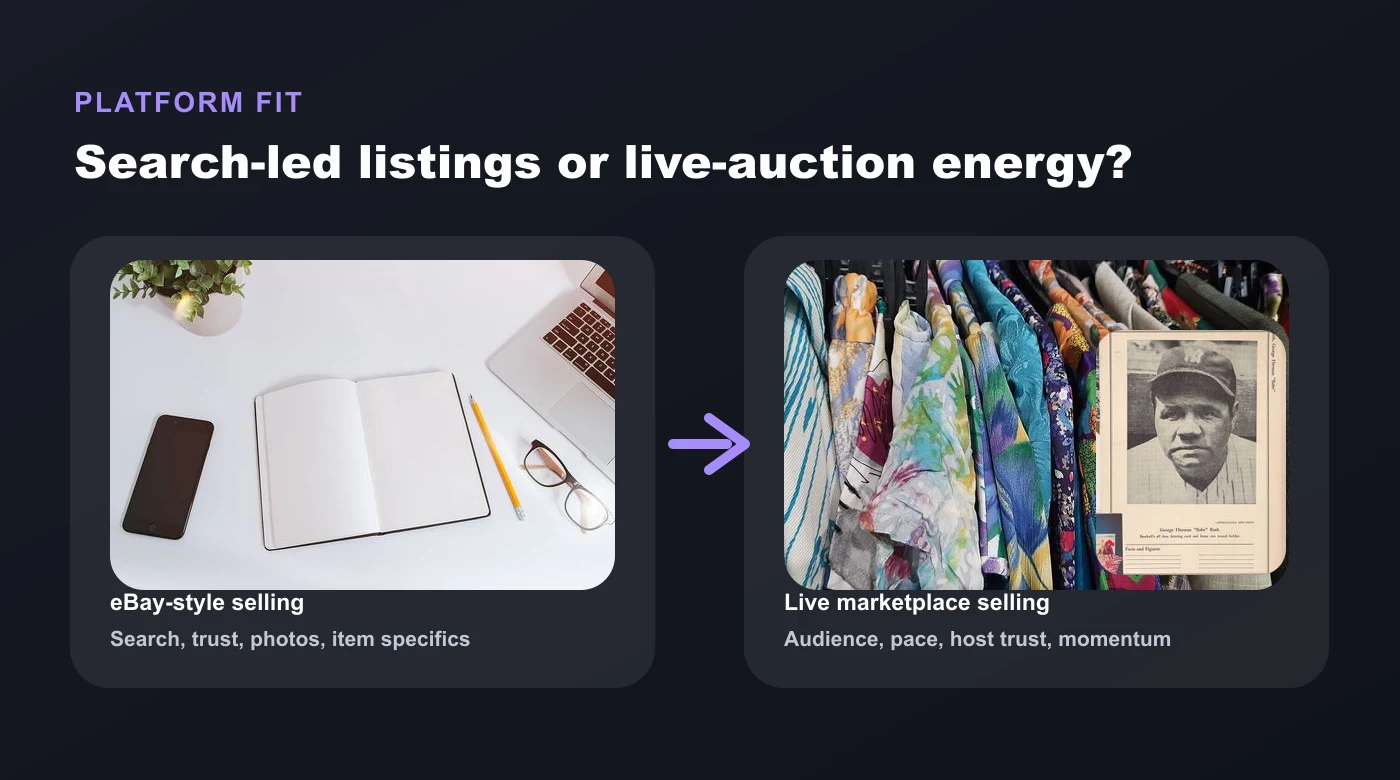
eBay Live vs Whatnot for Australian resellers
Here is the practical comparison.
| Area | eBay Live Australia | Whatnot | Reseller takeaway |
|---|---|---|---|
| Buyer mindset | Still connected to eBay's trusted marketplace environment. | More entertainment-led, community-led and host-led. | eBay Live may feel more natural for existing eBay buyers. Whatnot needs stronger showmanship. |
| Australian relevance | Public launch activity is directly tied to Australia and preloved fashion. | Global platform with growing categories, but Australian seller fit depends on audience and logistics. | Australian sellers should watch eBay Live closely and test Whatnot only if their stock suits it. |
| Best stock | Designer, vintage, fashion drops, scarce pieces, story-led stock. | Collectibles, sneakers, streetwear, vintage, repeatable stock, clearance bundles. | Live selling rewards items that are visual, easy to explain and exciting in the moment. |
| Effort required | Potentially lower if it connects with your existing eBay workflow, but access may be limited. | High. You need to host, promote, run the stream, manage chat and keep momentum. | Whatnot is more like running a show than creating a listing. |
| Trust | Benefits from eBay accounts, checkout and buyer protection expectations. | Trust is more tied to the seller's stream, reputation and community. | New sellers may find eBay easier because buyers already understand the system. |
| Pricing risk | Auction drops can create excitement, but low starts can still underperform. | Fast auctions can clear stock quickly, sometimes at lower prices than expected. | Do not test live selling with stock you cannot afford to sell cheaply. |
| Normal listing impact | Live events may create attention, but normal search listings still matter. | Separate live-first marketplace behaviour. | Live selling should sit beside normal listings, not replace them. |
What kind of stock works well live?
Live selling works best when buyers can make a quick decision and feel something while watching.
Good live-selling stock often has at least one of these traits:
- Recognisable brands
- Obvious visual appeal
- Scarcity or limited availability
- A strong story
- Collector demand
- Bundle potential
- Low enough cost that auction pricing is not terrifying
- Repeatable stock where one stream can include many similar items
For Australian resellers, that might include:
- Vintage tees and streetwear
- Branded sneakers
- Designer accessories
- Collectible toys
- Trading cards and sealed product
- Vintage jackets
- Bundles of similar items
- Clearance stock that is good, but slow on fixed-price listings
The key is momentum. A live stream needs enough items to keep people watching. One beautiful jacket might be a great eBay listing, but it may not be enough to carry a show unless you already have an audience.
What stock should probably stay as normal listings?
Some items are better suited to eBay or Depop listings than live auctions.
Be careful with:
- Items that need detailed measurements
- Items with flaws that require careful inspection
- Expensive items where you need the right buyer, not the fastest bidder
- Niche items with low live audience demand
- Items where postage is awkward
- One-off pieces that need SEO search traffic
- Stock you would regret selling below a certain price
This is especially true for clothing. A buyer watching live may like the look of a jacket, but sizing, condition, fabric, measurements and fit still matter. A rushed sale can become a return, a complaint or a disappointed buyer.
For those items, a strong eBay listing with clear photos, item specifics, measurements and postage may still be the better move.
How live auctions can go wrong
Live selling looks exciting because it feels immediate. That is also the risk.
Common problems include:
- Starting prices too low and watching good stock sell too cheaply
- Running a stream before you have enough followers
- Spending too much time entertaining and not enough time protecting margins
- Underexplaining condition flaws
- Selling items too quickly for buyers to understand what they are buying
- Creating postage headaches after the stream
- Losing track of what is sold on which platform
This is why live selling should be tested with a plan. Do not throw your best inventory into a live auction because a platform is trending.
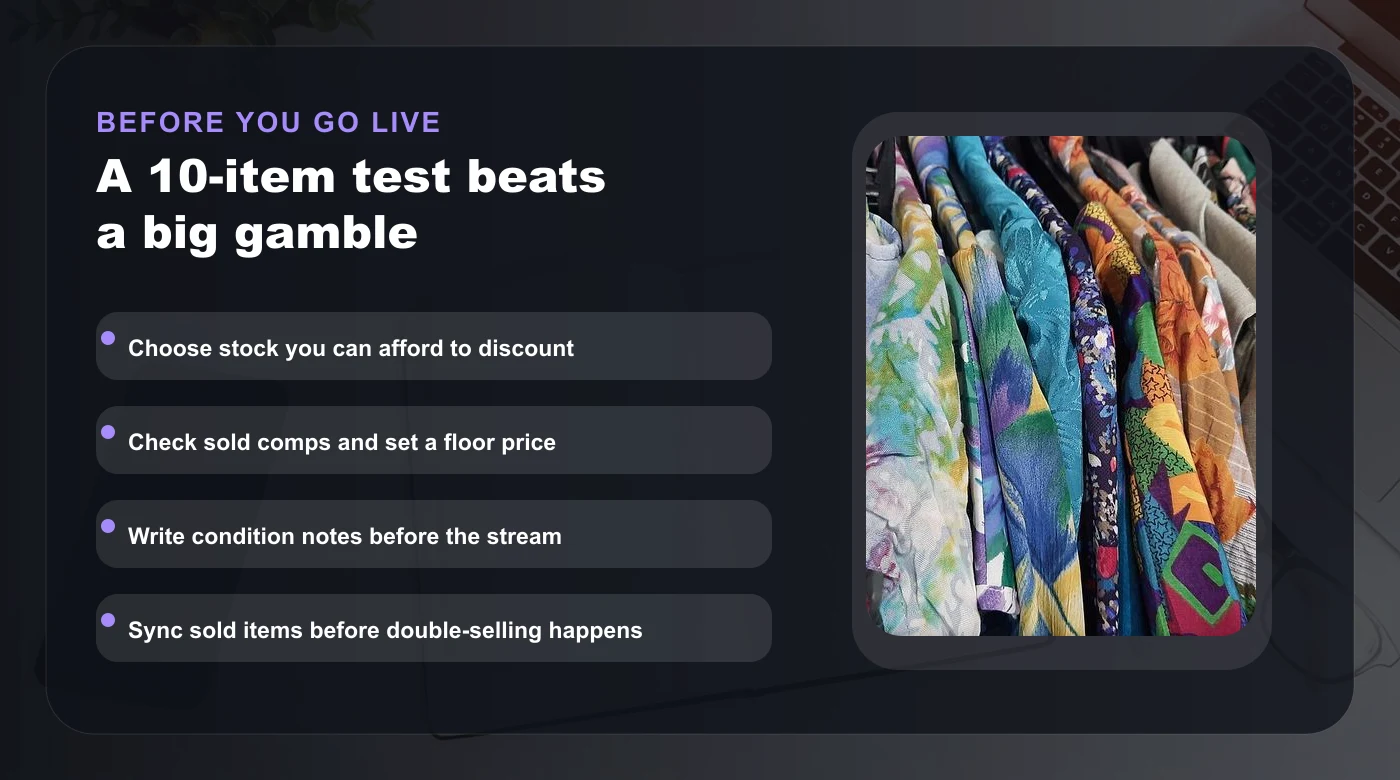
A simple 10-item live selling test
If you want to test live selling, keep it small and measurable.
Use this experiment:
| Step | What to do | Why it matters |
|---|---|---|
| 1 | Choose 10 items you can afford to sell at a discount. | You are testing the channel, not risking your best inventory. |
| 2 | Check recent sold prices on eBay first. | This gives you a floor price and stops panic pricing. |
| 3 | Group similar items together. | Live buyers stay longer when the stream has a clear theme. |
| 4 | Write condition notes before going live. | You do not want to forget flaws while moving quickly. |
| 5 | Set a minimum price you can live with. | A sale only helps if the margin still makes sense. |
| 6 | Promote the stream before it starts. | Live selling needs viewers. No viewers means no auction energy. |
| 7 | Track the result item by item. | You need to know whether live selling beat fixed-price selling. |
| 8 | Remove or sync sold items immediately. | Cross-listed stock can become a double-selling problem fast. |
Should Australian eBay sellers try eBay Live?
If eBay Live becomes available to more Australian sellers, it is probably worth testing for the right stock.
It is especially interesting for:
- Fashion resellers
- Vintage clothing sellers
- Sellers with designer or premium pieces
- Sellers with strong visual stock
- Sellers who already have eBay feedback and buyer trust
- Sellers who can prepare batches around a clear theme
The big advantage is familiarity. eBay buyers already know eBay. They know checkout. They know returns. They know feedback. That reduces friction.
The likely limitation is access and consistency. If eBay Live is mainly event-led at first, smaller sellers may not be able to rely on it as a regular sales channel straight away.
Should Australian resellers try Whatnot?
Whatnot can work, but it asks more from the seller.
You are not only listing stock. You are hosting. You are performing. You are building trust in real time. You are competing with other streams for attention. And in some categories, you are competing with highly practised sellers who know how to keep an audience engaged.
Whatnot may suit you if:
- You enjoy talking live
- You have repeatable stock
- You can run themed shows
- You sell collectibles, sneakers, streetwear or vintage
- You are comfortable with fast auctions
- You can create community, not just listings
Whatnot may not suit you if:
- You dislike being on camera
- You only have one-off items
- Your stock needs detailed measurement and inspection
- You rely on search traffic
- You cannot afford low auction results
- You do not want to manage another platform
The Pokemon card culture is not a reason to dismiss Whatnot entirely, but it is a sign that the platform rewards excitement. If your items do not create that kind of energy, you may be better off improving your eBay and Depop listings first.
Will live selling distract from normal eBay listings?
It might during big events, but that is not the same as killing normal listings.
When a major live drop is promoted, some buyer attention will go there. Sellers may notice people talking about live auctions, penny drops and celebrity wardrobes. That does not mean everyday eBay search has stopped working.
Most buyers are still going to eBay to search for specific things:
- “RM Williams boots size 9”
- “Nike vintage sweatshirt XL”
- “Mimco bag black”
- “Country Road linen shirt”
- “Pokemon booster box”
Those buyers still need normal listings.
If your eBay sales are slow, do not assume live selling is the whole reason. Check your title, main photo, price, postage, item specifics and competition first.
Where Depop still fits
Live selling is about urgency. Depop is about audience and style.
That matters because some stock is not slow because it needs a livestream. It is slow because it is in front of the wrong buyer.
For fashion, vintage, streetwear, shoes and younger style-led items, Depop can still be a better second audience than a live auction. A good Depop listing lets buyers browse visually, save items, follow your shop and discover stock through style rather than only search.
That is why the best approach is not “eBay or Whatnot or Depop”. It is:
- Use eBay for search-driven demand and buyer trust.
- Use Depop for style-led fashion discovery.
- Test live selling only when the stock has enough visual energy and auction appeal.
How Listalong fits into this
Live selling creates one practical headache immediately: inventory control.
If an item is listed on eBay, cross-posted to Depop and then sold during a live event, the other listings need to come down quickly. Otherwise, one sale can become a double-sale mess.
Listalong is built around a calmer version of multi-platform selling:
- Import from eBay or Depop
- Cross-list automatically or choose items yourself
- Copy shipping details across without rebuilding profiles
- Keep stock visible on more than one marketplace
- Reduce double-selling risk when an item sells
- Keep older stock in view so it can be refreshed or reworked
That does not mean every seller should avoid live selling. It means live selling should sit on top of good inventory discipline, not replace it.
Final verdict
eBay Live Australia is worth watching closely, especially if you sell fashion, vintage, designer, sneakers or visually strong second-hand stock.
Whatnot is worth testing only if you understand that it is not just a marketplace. It is a live entertainment channel with a strong collectibles DNA. The Pokemon card and breaker culture is real, but it is not the whole platform.
For most Australian resellers, the smartest path is:
- Keep improving normal eBay listings.
- Cross-list suitable fashion and lifestyle stock to Depop.
- Watch eBay Live access as it develops in Australia.
- Test Whatnot only with a small, controlled batch.
- Never put your best inventory into a live auction without knowing your floor price.
- Track the numbers before deciding live selling is your next channel.
Live selling may become part of the reseller toolkit. It just should not become a distraction from the basics that still make items sell: clear photos, strong titles, accurate details, fair postage, sensible pricing and clean inventory management.
Sources and further reading
- eBay Money Back Guarantee policy
- News.com.au coverage of eBay Live Australia’s 24 Hours of Drops
- Vogue Business: Can Whatnot bring live shopping to the West?
- The Guardian: the murky side of live auction site Whatnot
- Image source material: JESHOOTS.COM on Wikimedia Commons, MAKY.OREL on Wikimedia Commons and The Metropolitan Museum of Art on Wikimedia Commons.
.jpg)

_MET_DPB882284.jpg)