
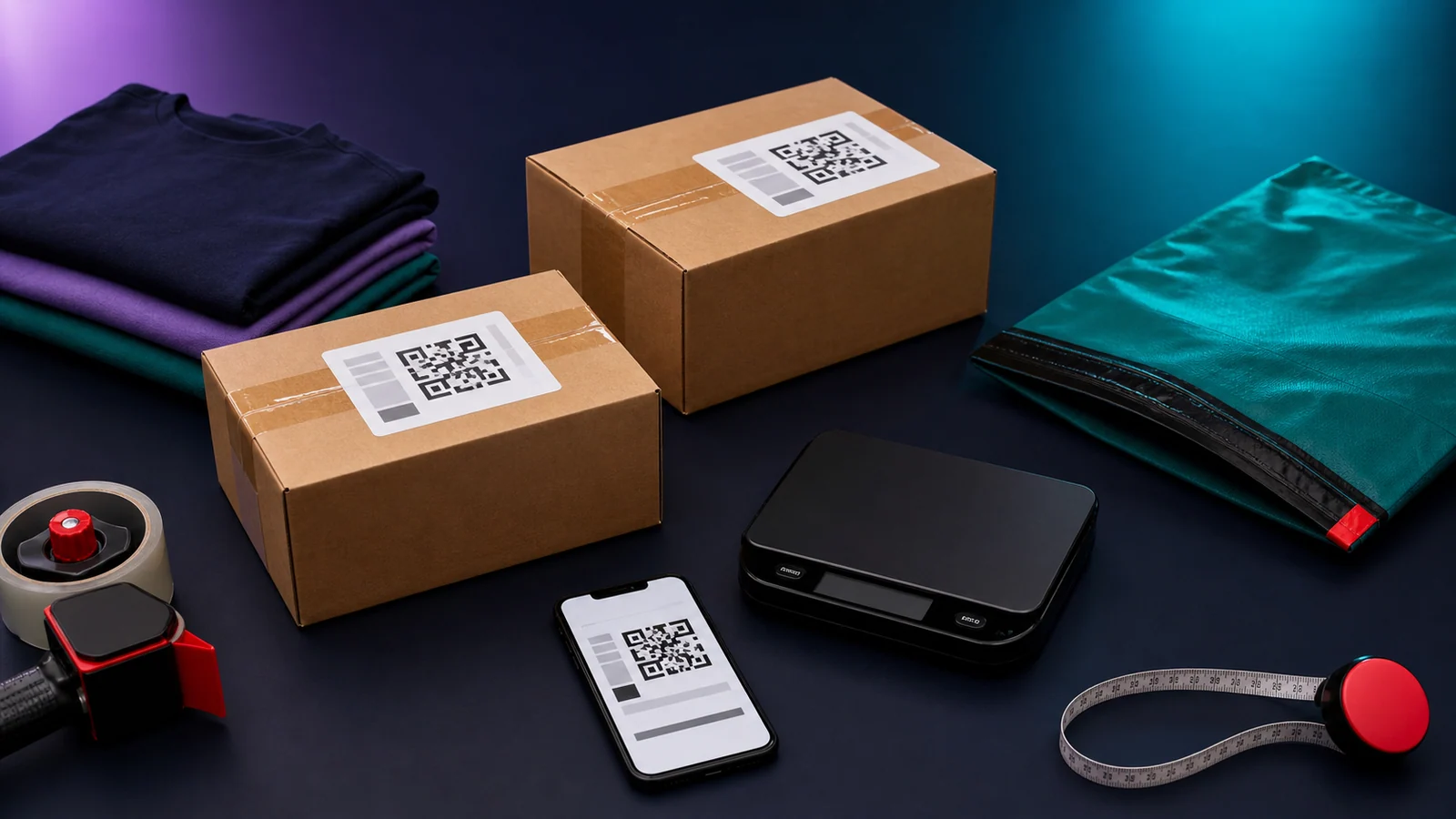
eBay postage in Australia now combines label rules, carrier choices and parcel pricing. If you use eBay’s free-selling experience, you generally have to buy the shipping label through eBay for an eligible order sent within Australia. Buying one at the post office or through another account is not always interchangeable.
This guide explains how eBay postage works for Australian sellers: when an eBay label is required, what affects the cost, how QR labels work, what to declare, and what to do with combined orders or parcels that need more than one box.
Label requirements, QR codes, combined labels and cancellation guidance rechecked: 29 September 2026. eBay and carrier rules can change. The label options, price and instructions shown on your listing or paid order should take priority over an older screenshot or social-media post.
Find your postage task
- Check whether an eBay label is required
- Understand the price shown for your parcel
- Send without a printer
- Correct or cancel an unused label
- Combine orders from one buyer
How eBay postage works in Australia
For most eligible domestic orders under eBay’s free-selling experience, the practical flow is: the buyer pays, you pack and measure the item, eBay presents the available delivery services, and you buy the label from the order. Tracking is then attached automatically.
The order screen is the final check because the available carrier, service and price depend on the parcel and delivery details. eBay currently offers Australia Post labels and is gradually making its broader delivery network available to sellers.
| Order situation | Do you generally need to buy the label through eBay? | Practical next step |
|---|---|---|
| An eligible domestic parcel sold through free selling | Yes | Pack and measure it, then use Get postage label on the paid order |
| Item sold for less than $20 | Exception applies | Check the order, then choose a suitable legal sending method |
| Item sold for more than $5,000 | Exception applies | Arrange an appropriate high-value delivery method and protection |
| Eligible item that may be sent in an envelope | Exception may apply | Confirm the listing is treated as an envelope item and consider tracking where suitable |
| Heavy or bulky item with no label available | Exception applies | Use the freight, courier or pickup arrangement shown for the order |
| Buyer selected local pickup | No postage label | Hand over the item using eBay’s pickup process and code |
| You want to use prepaid satchels or your own carrier for ordinary eligible domestic parcels | Usually not under free selling | Review whether an eBay Pro plan better suits your shipping workflow |
The rule applies to sellers enrolled in free selling, and the exceptions are not permission to ignore the order screen. eBay says the listing will indicate when its label is required. After payment, the buyer’s address is pre-filled and tracking is uploaded automatically for eligible domestic orders.
eBay’s current free-selling eligibility page says this experience is for eligible Australia-based sellers without a Pro plan and with no more than $25,000 in eBay sales during the relevant previous 12-month period. If your account is on a Pro plan, your options and fees are different.
The five published exceptions
eBay’s shipping-label help page lists five situations where the free-selling label requirement does not apply.
1. The item sold for less than $20
The exception says less than $20, not “around $20”. If an order sits exactly on the threshold, follow the instruction shown on that order.
A $14 accessory may therefore allow another sending method. That does not mean an untracked letter is always the best choice. Consider the item’s size, replacement cost and whether you would be comfortable resolving an item-not-received report without delivery tracking.
2. The item sold for more than $5,000
Very high-value sales are also excluded. Confirm carrier limits, insurance or compensation, signature arrangements and category-specific rules before accepting the order.
3. The item may be sent in an envelope
eBay’s examples include trading cards, comics, magazines, coins and banknotes, jewellery, CDs, DVDs, video games, patches, postcards, greeting cards, seeds, stamps, stickers and decals.
This is not a reason to squeeze unsuitable goods into paper. Use packaging that protects the contents and complies with carrier size, thickness and dangerous-goods rules. Confirm the available service and tracking before promising it.
4. No eBay label is available
This most often affects heavy, bulky or awkward items. A chair, exercise machine or oversized framed print may need freight, a specialist courier or local pickup because the normal eBay label flow does not offer a suitable service.
The exception applies when a label is unavailable, not whenever a parcel feels heavy. Enter accurate details and check what the flow offers first.
5. The buyer selected local pickup
No shipping label is needed when the order is genuinely set up for local pickup. eBay uses a unique pickup code to help protect the handover. Do not quietly convert a posted order into a private meetup or ask the buyer to send their address or other personal details through messages.
What if you ignore the requirement?
For an eligible domestic free-selling order, buying a tracked label elsewhere can create a bigger problem than expected. eBay’s private-seller postage guidance says the seller cannot manually upload that tracking or mark the item as sent. The buyer will not see normal tracking activity on eBay, funds may be held for up to 14 days, and eBay’s delivery protections may not apply.
Sellers who repeatedly send eligible domestic orders outside the required flow may be moved to a Pro Starter plan, according to eBay. If you rely on contracted rates, prepaid packaging or another carrier, compare the Pro-plan fees and flexibility instead of working around the rule.
How to post an item sold on eBay Australia
For an order that requires an eBay label, the basic process is straightforward. Do the packing before you pay:
- Wait until the buyer has paid.
- Pack the actual item with all protective material.
- Weigh the finished parcel and measure its outside dimensions.
- Open Orders in My eBay or Seller Hub.
- Find the sale and choose Get postage label.
- Check the sender, recipient, package and service details.
- Review package protection and signature requirements.
- Buy the label, then print it or save the available QR code.
If the buyer chose express delivery, use an express service. An eBay label does not give you permission to downgrade the service selected at checkout.
What does eBay postage cost in Australia?
There is no single eBay postage price for every Australian order. The quote depends on the carrier and service offered, the destination, the parcel’s packed weight and dimensions, and whether you use eligible flat-rate packaging or another package.
eBay says its negotiated Australia Post label rates can be lower than buying the equivalent service at the post office. Its delivery network may also show alternative carrier services as the rollout reaches your account. Compare the choices shown on the paid order rather than relying on a price remembered from an older sale.
For Australia Post parcels, the packaging decision matters:
- eligible Australia Post flat-rate packaging up to 5kg is priced by the packaging size
- other packaging is assessed using the parcel’s physical or cubic weight, whichever is greater, as well as the destination
- protection, signature and other optional services can add to the final charge
The Australia Post own-packaging versus flat-rate guide includes the current 2026 retail Parcel Post comparison. eBay’s live order quote remains the price to use for an eBay label.
Set the buyer’s postage charge before listing
Calculated postage uses the parcel details and destination to work out the buyer’s charge. A flat postage charge is an amount you set yourself; it is not the same thing as Australia Post flat-rate packaging. Pack and measure before listing so your estimate reflects what you will actually send.
Check the eBay postage options guidance when choosing the listing setting. A retail price table is useful for comparison, but the eBay quote determines what your label costs.
QR labels: useful, but only in the right situation
You do not need a label printer. A normal A4 printout can be attached securely to the parcel without covering its barcode.
For a domestic Australia Post parcel, eBay also offers a printer-free QR option. Enable the QR format while buying the label, save the code to your phone and take the packed parcel to a participating post office. Staff scan the code, print the label and attach it.
Two details catch sellers out:
- eBay says it can take about 30 minutes for parcel details to reach the carrier, so do not wait until you are in the post-office queue
- the QR option is not available for international postage labels
The code is also emailed to you and remains accessible from the order’s postage-management screen if you forget to save it.
Declare the package you are actually sending
The package declaration is not a rough estimate of the unpacked item. eBay asks for the package type, packed weight and external dimensions, and says incorrect details can cause additional charges.
Use this sequence:
- choose the protective packaging first
- close and tape the parcel as it will be lodged
- weigh it with the label, tape and inserts included
- measure the longest outside points
- select the matching package type and service
A jacket may weigh 920g on its own but cross a weight boundary after adding a mailer and protection. A light lamp in an oversized box can be assessed differently because of its dimensions. Use the Australia Post cubic-weight calculator before listing bulky own-packaging parcels, then confirm the final quote in eBay.
If you are deciding between official flat-rate packaging and your own mailer or box, read the own packaging versus flat-rate satchels guide. Australia Post says its eBay flat-rate packaging is for domestic items up to 5kg, while own packaging is available for other compatible parcel options. The cheapest choice is only valid if your parcel actually meets that option’s conditions.
Tracking and seller protection
Buying the label through eBay automatically attaches tracking to the order. That helps the buyer follow delivery and gives eBay carrier scans to assess delivery issues.
Still keep your lodgement receipt. “Label created” is not the same as the carrier receiving the parcel, and an acceptance scan is useful evidence if the first movement is delayed.
Protection also has limits. eBay says signature confirmation is required when the order total is $750 or more to be protected when a buyer reports non-receipt. Australia Post’s standard included compensation and any extra cover have their own conditions and exclusions. Review the protection offered in the label screen instead of assuming tracking covers the full sale value.
Cancelling or correcting a label
You cannot edit a purchased label. If the package details or service are wrong, cancel it and buy a replacement. For orders that require an eBay label, eBay locks the buyer address; cancelling the label does not unlock it. Resolve an incorrect delivery address through eBay before sending.
eBay currently says an unused label must be cancelled within five days of purchase to receive a credit. An approved credit can take up to 60 days. Do not use a cancelled label, and do not cancel one after lodging the parcel.
You can reprint an unchanged label at no extra cost within seven days. Reprinting is suitable for a damaged printout; cancellation is for details that need to change.
How to combine postage on eBay Australia
Combining several orders from one buyer is different from splitting one large order into several parcels. These situations sound similar but use opposite workflows.
| Situation | Correct approach |
|---|---|
| One order is too large for one parcel | Buy the first label, then choose Print another label for the same order and declare the next package separately |
| The same buyer placed two or more orders that fit safely in one parcel | On desktop, open advanced postage and bulk labels, select the orders, then choose Combine orders per buyer |
| Several unrelated orders are ready to send | Use bulk labels, but keep each buyer’s parcel and tracking separate |
Each parcel in a split shipment gets its own tracking number and charge. A combined shipment gets one tracking number applied to every order included in that parcel. Before combining, make sure the revised package weight, dimensions, protection and service remain suitable. It is not a saving if cramming two items together causes damage or pushes the box into a worse size band.
Handling time still matters
A label bought on time is not the same as an order sent on time. eBay’s postage policy requires sellers to dispatch within the handling time stated in the listing and use the service selected by the buyer.
A realistic routine is better than an ambitious promise. Set a handling time you can meet, lodge the parcel where the chosen service permits and keep the receipt until tracking shows acceptance. Contact the buyer through eBay if a genuine delay occurs.
Do not choose one-day handling because it looks attractive if you can only reach the post office twice a week.
Three quick examples
A $35 pre-owned shirt: this is an ordinary eligible domestic parcel under free selling, so the seller should expect to buy the label through eBay. Pack it, enter the finished weight and choose the service the buyer selected.
A $12 trading card: the sale is below $20 and a trading card is also listed as an envelope-type item. Check the order’s instructions, package the card against bending and decide whether the saving from untracked postage is worth the delivery risk.
A vintage armchair: if eBay offers no suitable label because it is bulky, the exception applies. Set up freight or local pickup clearly in the listing rather than selling it as a normal parcel and solving delivery afterwards.
Your pre-lodgement decision checklist
Before sending an eBay order, ask:
- Is my account currently using free selling or a Pro plan?
- Does the order say an eBay label is required?
- Is the sale genuinely covered by one of the five exceptions?
- Am I using the exact address and delivery service on the order?
- Did I weigh and measure the fully packed parcel?
- Does my package qualify for the flat-rate or own-packaging option selected?
- Is a QR code appropriate, and have I allowed time for it to activate?
- Does the value require signature or additional cover?
- Am I splitting one order or combining several orders?
- Can I lodge it within my stated handling time?
- Have I kept proof of lodgement?
For the price side of the decision, use the Australian reseller postage comparison to understand common options, but use the live eBay label quote for an order that must go through eBay.
FAQ
How does eBay postage work in Australia?
After an eligible domestic sale, pack and measure the parcel, open the paid order and buy the available label through eBay. Australia Post labels and other delivery-network options may be offered. Tracking is added automatically, and domestic Australia Post labels can use a printer-free QR code.
Do Australian eBay sellers have to buy postage labels through eBay?
Sellers in eBay’s free-selling experience generally have to buy labels through eBay for eligible domestic orders. Exceptions include items sold for less than $20 or more than $5,000, eligible envelope items, items with no label available and local-pickup orders.
Can I use my own packaging with an eBay label?
Yes, when you choose a compatible own-packaging or Parcel Post option. Enter the real packed weight, dimensions and package type. If you select an official flat-rate option, use the eligible Australia Post flat-rate packaging.
Can I get an eBay postage label without a printer?
Yes, for domestic Australia Post parcels. Select the QR-code format, save the code and take it with the packed parcel to a participating post office. International eBay labels do not currently offer the QR option.
Can I add tracking from a label bought elsewhere?
Not for an eligible domestic free-selling order that requires an eBay label. eBay says manual tracking upload and manual “sent” status are unavailable for those orders. Use the label flow shown on the paid order unless an exception applies.
Can I combine orders from the same buyer?
Yes. Combined postage is available through the desktop advanced-postage and bulk-label flow. Select the same buyer’s orders and choose Combine orders per buyer so the tracking is attached to each included order.
Official sources
- eBay Australia: Buying shipping labels on eBay
- eBay Australia Seller Centre: Postage options for private sellers
- eBay Australia: Setting up your postage options
- eBay Australia: Postage and shipping policy
- eBay Australia: Selling fees without a Pro plan
- Australia Post: eBay flat-rate packaging
- Australia Post: Cubic weight explained