
Own packaging can cost less, but a light parcel is not automatically a cheap parcel. Compare the packed weight and dimensions with the smallest eligible flat-rate packaging that safely holds the item.
Jump to the 2026 price table, packaging decision table or steps for comparing quotes.
For an eBay sale, check the eBay postage and label rules before buying postage elsewhere. For a Depop order, follow the shipping method on its receipt.
Retail prices and packaging guidance rechecked 29 September 2026 against Australia Post’s published 1 July 2026 schedule. These are retail Parcel Post rates, not a promise of the price shown by eBay or MyPost Business.
Australia Post prices from 1 July 2026
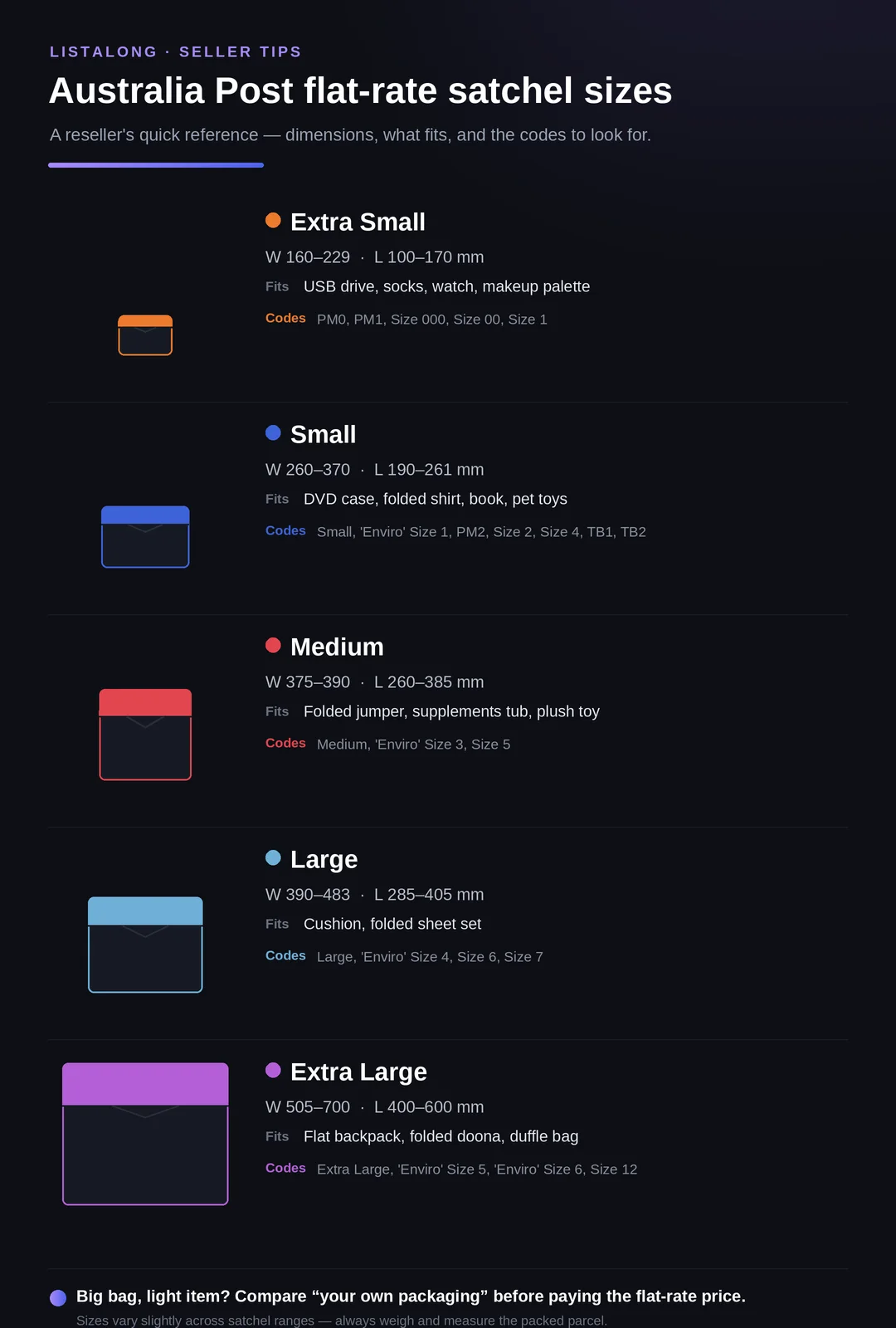
For domestic Parcel Post items up to 5kg, Australia Post’s 2026 retail postage-only prices line up across five flat-rate sizes and five other-packaging weight bands.
| Flat-rate packaging size | Parcel Post postage only | Other-packaging weight band at the same base price |
|---|---|---|
| Extra Small | $10.20 | Up to 250g |
| Small | $11.70 | Over 250g up to 500g |
| Medium | $16.00 | Over 500g up to 1kg |
| Large | $20.25 | Over 1kg up to 3kg |
| Extra Large | $24.45 | Over 3kg up to 5kg |
These are not always the final prices a seller will see. The flat-rate figures exclude the cost of non-prepaid packaging. Other packaging is charged using the physical or cubic weight, whichever is greater, and the destination also matters. Prepaid satchels include packaging and have slightly higher all-in retail prices.
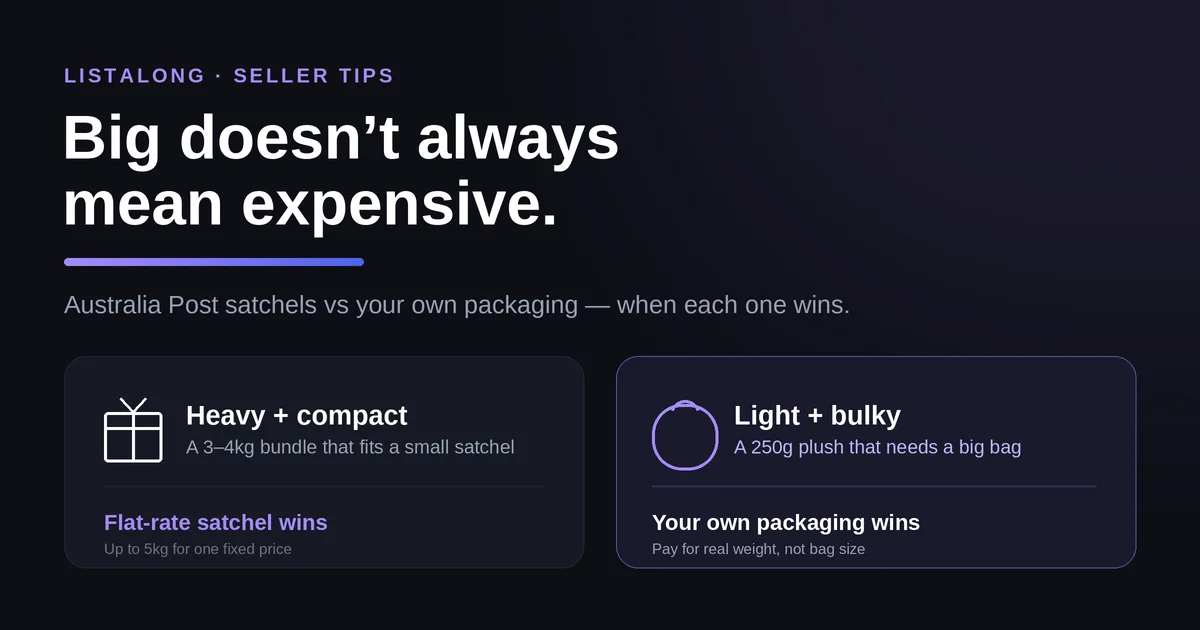
The practical opportunity is still the difference between size-based flat-rate packaging and weight-or-cubic-weight pricing for other packaging. A light item that needs a large soft mailer may fall into a lower weight band, provided its cubic weight and dimensions do not push it higher. A compact heavy item may favour an eligible flat-rate size.
The common mistake: choosing the satchel size just because the item fits
Imagine you sell a plush toy.
It is too bulky to fit in an Extra Small satchel. It may need a Large or Extra Large bag because of its shape.
But the plush only weighs 250g.
A common mistake would be to choose the Large or Extra Large flat-rate option just because that is the physical bag size being used.
That can mean paying more than you need to.
Instead, if the item is soft, lightweight and safely packed, compare the flat-rate satchel option against own packaging. Enter the real packed weight and dimensions, then choose the cheapest valid option available to you.
That is how a large bagged item can sometimes avoid the large flat-rate price.
What own packaging actually means
The phrase “own packaging” can be confusing.
It does not always mean the bag has to be plain or bought somewhere else. The label flow must match the actual packaging. A generic mailer does not become eligible flat-rate packaging just because its dimensions resemble an Australia Post satchel.
That means the two decisions are:
- What packaging safely holds the item?
- Which valid postage option is cheapest for that packed parcel?
The physical bag and the label option are related, but they are not always the same thing.
The important part is accuracy. Do not guess the weight. Do not ignore dimensions when the label flow asks for them. Do not choose an option the parcel does not qualify for.
When own packaging may beat the satchel size
For lightweight bulky items, it can be worth comparing the flat-rate satchel option against own packaging. This is especially useful when an item needs a larger bag because of its shape but does not weigh very much.
The pattern is simple:
- if the item is heavy for the bag size, flat rate may win
- if the item is light for the bag size, own packaging may win
- if the weight band and bag size line up, the price may be similar
| Packed parcel | Compare first | What could change the result? |
|---|---|---|
| Compact and heavy | Smallest eligible flat-rate pack that safely fits | Packaging cost and the 5kg limit |
| Light but bulky | Own-packaging quote against the eligible flat-rate size | Cubic weight may outweigh the scale reading |
| Fragile or crushable | Protective box with accurate dimensions | Damage risk makes a smaller soft bag a poor saving |
| Already supplied with a marketplace label | The service and packaging permitted by that label | Buying separate postage may be unnecessary or incompatible |
A 250g item is not necessarily a 250g parcel: add the packaging weight and account for dimensions. This table is a decision aid, not a postage quote.
Use Listalong’s Australia Post cubic-weight calculator to check a larger box or mailer before relying on its scale weight.
How to compare options before sending
The steps are usually the same whether you buy postage through eBay, MyPost Business, Australia Post or another label flow:
- Pack the item safely.
- Weigh the parcel after packing.
- Measure the outside dimensions of the finished parcel and enter them wherever requested.
- Compare flat-rate satchel options against own packaging.
- Choose the cheapest valid option.
Do not use the item weight from the listing as your postage weight. Packaging adds weight.
A shirt might weigh 470g on its own, but once you add a satchel, label, tape and a thank-you card, it may go over 500g. That can move it into the next postage band.
A small digital scale is one of the best tools a reseller can buy.
Flat-rate satchels are still useful
Flat-rate satchels are not bad. They can be very useful.
They tend to work best when the item is heavy but compact. For example:
- a bundle of jeans that fits in a Small or Medium satchel
- a heavy jacket that compresses into eligible packaging
- a dense clothing bundle
- a compact item that would otherwise cost more by weight
In those cases, flat-rate packaging may be a good deal because the parcel can be relatively heavy while still fitting the satchel.
The problem happens when sellers apply the same logic to light bulky items.
A 250g plush toy and a 4kg clothing bundle are very different parcels. They should not automatically be treated the same just because they need a similar-sized bag.
The simple reseller rule
Use this rule when packing orders:
If the item is heavy for its size, check flat-rate packaging. If the item is large but light, check own packaging.
This is especially useful for resellers who sell clothing, toys, plush, costumes, shoes, bags and mixed second-hand items.
Good items for bag-based shipping
Soft lightweight items are often good candidates for bag-based shipping.
Examples include:
- plush toys
- puffer jackets
- hoodies
- soft handbags
- costumes
- scarves
- light clothing bundles
- fabric items
- kids’ dress-ups
These items may look large but often weigh very little.
A box can make them more expensive because it adds structure, size and sometimes unnecessary cubic weight. A snug bag can reduce unused space, but using a bag does not by itself exempt a parcel from cubic-weight pricing.
When a box is still better
A bag is not always the right choice.
Use a box when the item needs protection. Examples include:
- shoes that may be crushed
- fragile collectibles
- boxed toys
- electronics
- ceramics
- glassware
- hats that need to hold their shape
- anything that could be damaged in a soft satchel
The goal is not to use the cheapest packaging at all costs.
The goal is to use the cheapest safe packaging.
A damaged item, refund or return will cost more than the postage saving.
Watch out for cubic weight
Cubic weight is where large boxes can become expensive.
A parcel might not weigh much on the scale, but if the box is large, the postage system may calculate a higher chargeable weight based on the parcel’s dimensions.
This is why soft items should usually not go into oversized boxes unless they need the protection.
For example, a light plush toy in a big box may cost more than the same plush toy in a large soft mailing bag.
The item did not change. The packaging did.
Australia Post explains cubic weight separately, and sellers should check that guidance for larger, heavier or unusually shaped parcels.
Build your shipping around common weight points
For many Australian resellers, the most useful weight points to watch are:
- up to 250g
- up to 500g
- up to 1kg
- flat-rate packaging limits where eligible
These points help you decide whether an item should be listed with a cheaper postage option or whether you need to build more shipping cost into the price.
If you sell a lot of clothing, plush toys or accessories, it is worth learning what your common items weigh after packing.
Suggested reseller workflow
Before listing an item, ask:
- Is this item soft or fragile?
- Can it safely go in a bag?
- What will it weigh after packing?
- Does it need a box?
- If it needs a large bag but weighs very little, should I compare own packaging?
- If it is heavy but fits in a smaller satchel, should I use flat-rate packaging?
This quick check can stop you from overcharging buyers or undercharging yourself.
Why this matters for eBay and Depop sellers
Postage can affect whether someone buys your item.
A buyer may happily pay $25 for a plush toy but hesitate if the postage looks too high. If you can safely reduce postage by choosing the right packaging option, your listings may become more attractive without lowering the item price.
This matters even more when cross-listing between eBay and Depop.
Different buyers may have different expectations around postage. Clothing and plush buyers on Depop may be especially sensitive to shipping cost, while eBay buyers may compare total price across multiple similar listings.
Better shipping choices can make your listings more competitive.
Listalong helps Australian resellers cross-list an existing eBay or Depop listing to the other marketplace automatically, or choose items themselves, then normally ends the matching linked listing after a sale.
The main takeaway
Do not choose postage only by the size of the bag.
Choose postage based on the item’s weight, shape, protection needs and the valid options available in the label flow.
A heavy compact item may be perfect for flat-rate packaging.
A lightweight bulky item may be cheaper in a large soft mailer entered as own packaging.
That is the reseller shipping lesson:
Big does not always mean expensive. Heavy matters. Shape matters. Packaging choice matters.
Before sending your next plush toy, jacket or soft bulky item, compare the flat-rate satchel price against own packaging.
You may find that the large bagged item does not need the large postage price.
FAQ
Is own packaging cheaper than Australia Post flat-rate satchels?
Sometimes. Compare the complete quotes: own packaging can suit light parcels, but cubic weight can remove the saving. Eligible flat-rate packaging can suit compact, heavy parcels up to 5kg.
Can I use a large mailer or bag but choose own packaging?
Yes, if that service accepts the mailer. Declare its packed weight and dimensions. A generic bag does not qualify as official Australia Post flat-rate packaging merely because it is the same size.
When are flat-rate satchels best for resellers?
Flat-rate satchels are often useful when an item is heavy for its size and fits inside eligible flat-rate packaging. They can be less useful for lightweight bulky items where the large bag size does not reflect the parcel weight.
Should I use a bag or a box for clothing and plush toys?
Soft, lightweight items such as clothing, plush toys and fabric items may suit bag-based shipping. Fragile, crushable or structured items should be boxed if they need protection.
Why does shipping choice matter for eBay and Depop sellers?
Postage affects the total price a buyer sees. Choosing the right safe postage option can make a listing more competitive without lowering the item price.
What are Australia Post’s 2026 Parcel Post prices for parcels up to 5kg?
From 1 July 2026, Parcel Post postage-only prices are $10.20, $11.70, $16.00, $20.25 and $24.45 across the five flat-rate sizes or corresponding other-packaging weight bands. Packaging, cubic weight, destination and optional services can affect the amount you actually pay.
Useful next reads
- Postage and reseller tools
- Free eBay to Depop cross-lister Australia
- How to sell on eBay and Depop at the same time
- eBay vs Depop fee calculator