
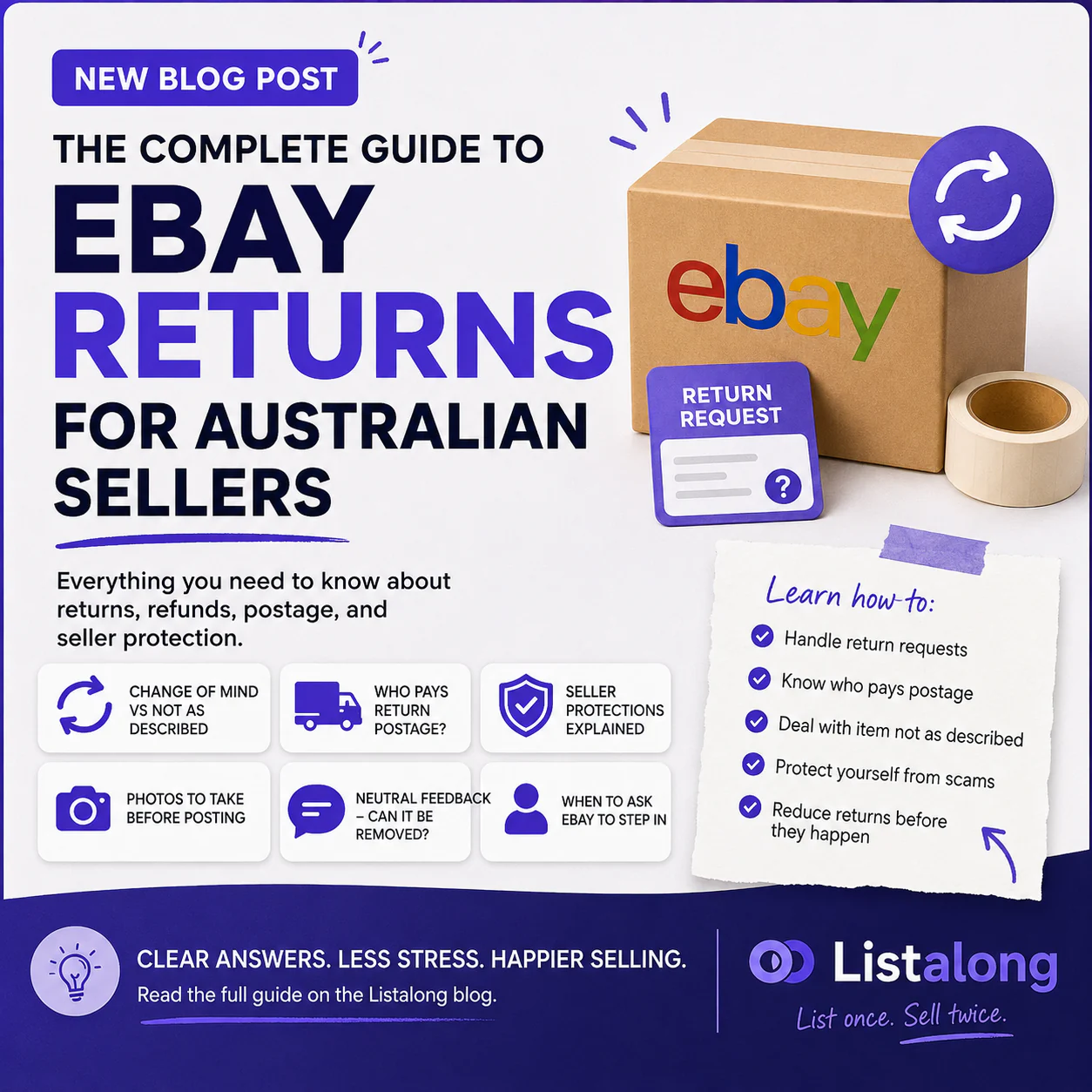
Returns are part of selling on eBay. Even careful sellers get them.
The stressful part is not usually the return itself. It is working out what type of return it is, who pays return postage, whether you should refund now or wait, and what to do if the buyer says the item is not as described.
For Australian sellers, there is another layer too: eBay’s own return rules sit beside Australian Consumer Law. That does not mean every buyer can return anything for any reason. It does mean your listing needs to be accurate, your response needs to happen quickly, and your evidence matters if something goes wrong.
This guide explains eBay returns for Australian sellers in plain English.
Quick answer
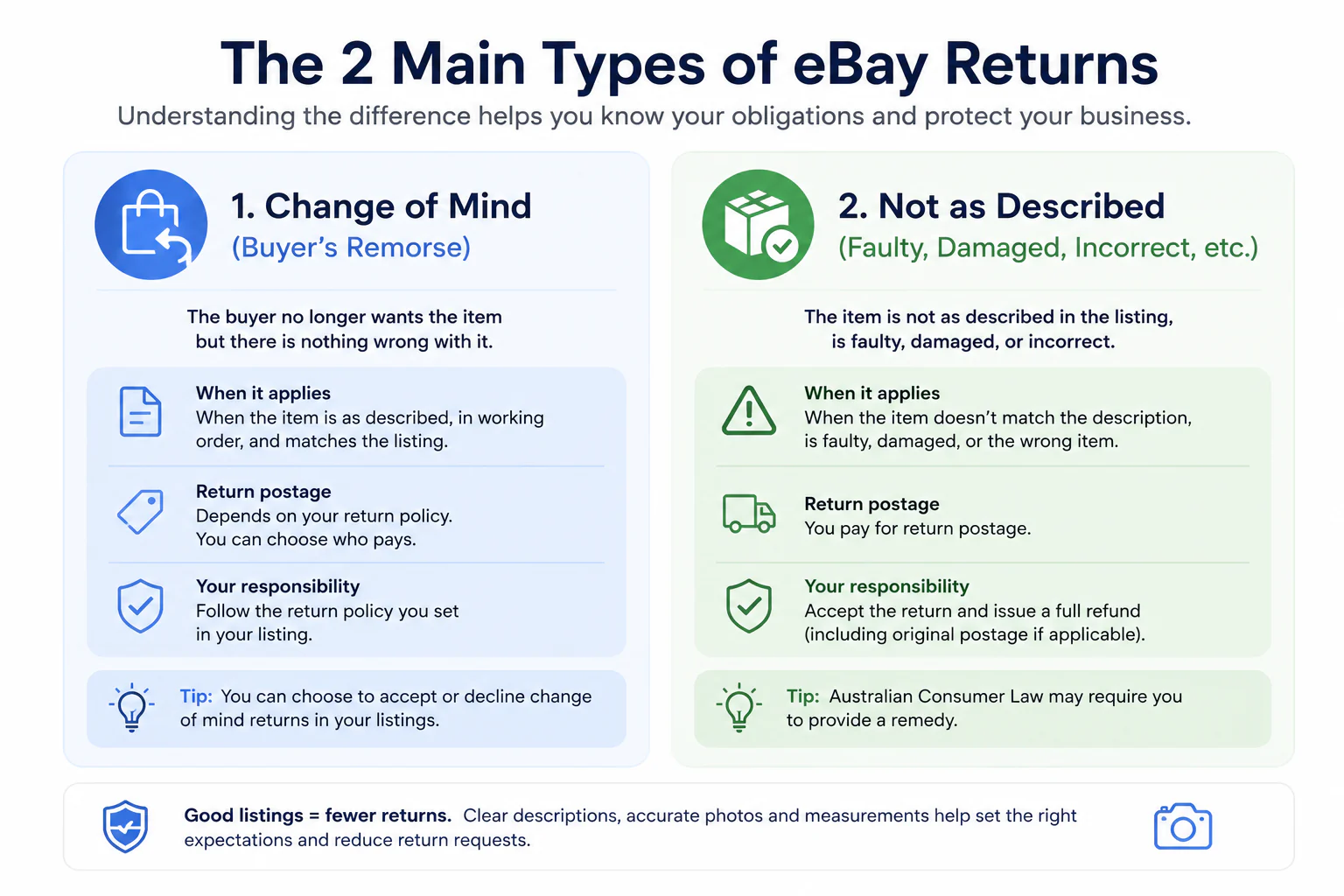
Most eBay returns fall into two buckets:
- Change of mind: the buyer no longer wants the item, ordered the wrong size, found another one, or decided it is not for them.
- Not as described: the item is faulty, damaged, wrong, missing parts, or materially different from the listing.
The difference matters.
For change-of-mind returns, your options depend on the return policy you set in the listing. For item-not-as-described returns, eBay generally expects sellers to accept the return if the purchase is covered by eBay Money Back Guarantee, even if your listing says you do not accept returns.
Why eBay returns feel confusing
Returns feel confusing because sellers often use one word, “return”, for several different situations.
A buyer might open a return because:
- They changed their mind
- The item does not fit
- They ordered the wrong thing
- The item arrived damaged
- The item has a fault
- They believe the listing left something out
- The wrong item was sent
- They want a partial refund
- They returned something different from what you sent
eBay does not treat all of these the same way.
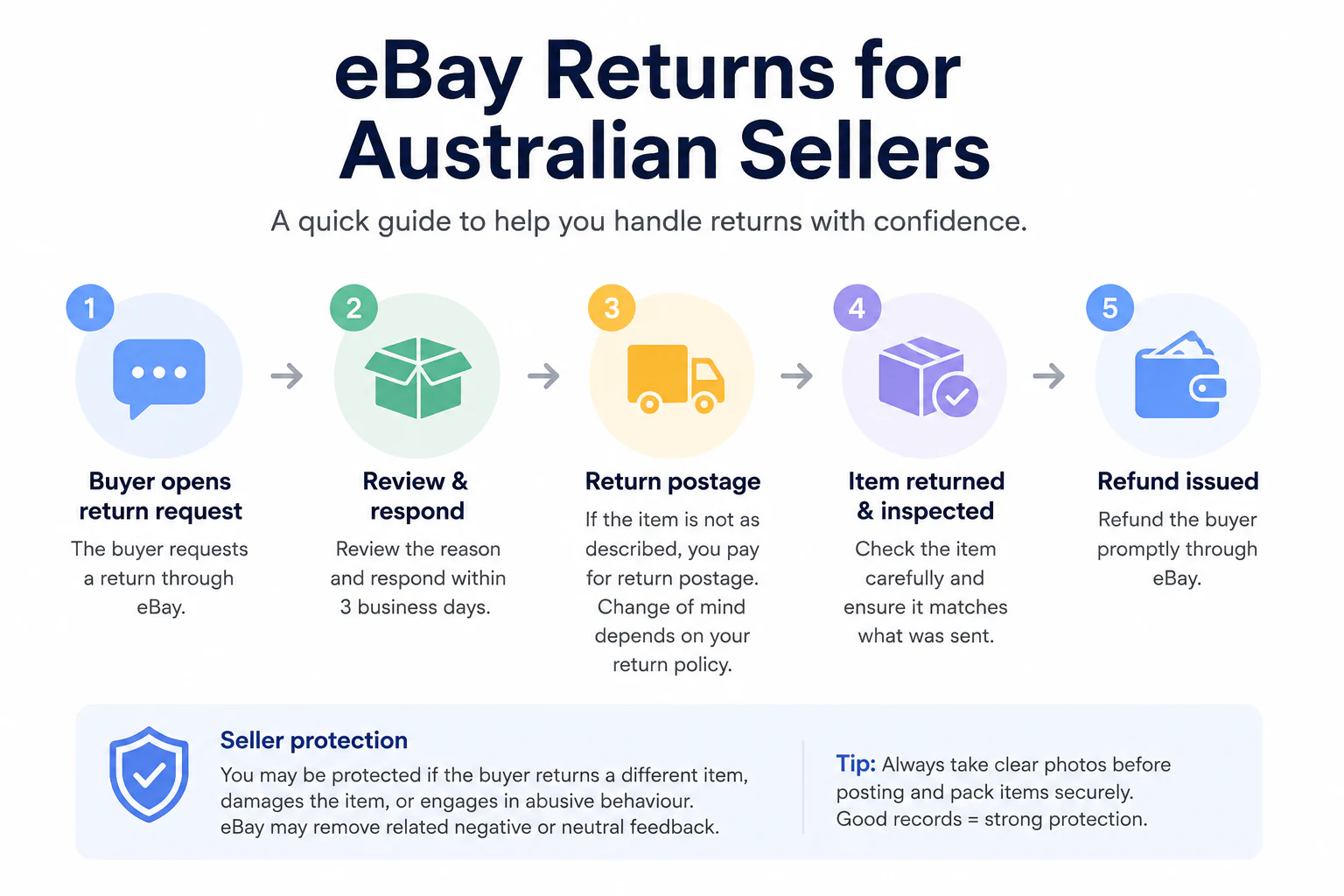
According to eBay’s return request guidance for sellers, sellers usually have 3 business days to respond to a return request. If you do not respond, eBay may step in and, in some cases, refund the buyer and seek reimbursement from you without requiring the buyer to return the item.
That is why the first rule is simple: do not ignore a return request.
The 2 main return types: change of mind vs not as described
The cleanest way to think about eBay returns is to separate buyer remorse from listing or item problems.
| Return type | What it means | Seller position |
|---|---|---|
| Change of mind | The buyer received what they ordered, but no longer wants it. | Depends on your listing return policy. |
| Not as described | The item is faulty, damaged, wrong, missing parts, or different from the listing. | eBay generally expects the seller to accept the return if covered by eBay Money Back Guarantee. |
eBay says sellers can choose whether to accept returns when a buyer changes their mind. But eBay also says that if an item arrives damaged, does not match the listing description, or the buyer receives the wrong item, the seller generally needs to accept the return.
The wording in your listing matters here.
If your listing says “no returns” and the buyer simply changed their mind, you may be able to decline. If your listing has a 30-day return policy, then a change-of-mind return inside that policy is normally part of the deal you offered.
But “no returns” does not protect you from a genuine item-not-as-described claim.
The Australian Consumer Law angle
Australian Consumer Law is often misunderstood in reseller groups.
The ACCC explains that consumer guarantees apply when a business sells products or services to consumers, and those basic rights cannot be taken away by what a business says or does. Products must be of acceptable quality, fit for stated purpose, and match their description.
The ACCC also says a buyer is generally not entitled to a remedy just because they changed their mind, found the product cheaper somewhere else, decided they did not like it, or had no use for it. If a business offers a change-of-mind policy, the business must follow that policy.
There is one big nuance for small sellers: the ACCC says most consumer guarantees do not apply to one-off private sales between two people where the seller is not running a business. Examples include individuals selling through online marketplaces. However, eBay’s own platform rules and eBay Money Back Guarantee can still apply to the transaction.
So, for Australian eBay sellers, think of it this way:
- Private one-off seller: ACL consumer guarantees may be more limited, but eBay policy still matters.
- Business seller or regular reseller: ACL consumer guarantees are more relevant, especially if your item does not match the description or has a problem.
- Every eBay seller: your listing accuracy, photos, messages and return response all matter.
If you sell regularly, present yourself as a store, or operate as a business, be extra careful with “no refund” wording. It cannot override consumer rights where those rights apply.
Who pays return postage?
Return postage depends on the reason for the return.
eBay’s Money Back Guarantee policy says that when an item does not match the listing, the seller is responsible for return postage. eBay’s return-postage table also separates:
- Items that do not match the listing: seller pays
- Remorse or change-of-mind returns: depends on the seller’s return policy in the listing
Here is the practical version:
| Situation | Who usually pays? | Why |
|---|---|---|
| Item faulty, damaged, wrong, or not as described | Seller | The buyer did not receive what the listing promised. |
| Buyer changed their mind and your listing says buyer pays returns | Buyer | That was the return policy shown in the listing. |
| Buyer changed their mind and you offered free returns | Seller | You offered to cover return postage. |
| You choose to accept a change-of-mind return even though you did not offer returns | Depends what you agree through eBay | You can tell the buyer they are responsible or provide a label yourself. |
When in doubt, handle the return inside eBay’s return request. Do not arrange side payments or off-platform return deals if you want eBay to understand what happened later.
What if the buyer says the item is not as described?
An item-not-as-described claim is one of the most important return types for sellers.
The buyer might say:
- The colour is different
- The size is wrong
- A flaw was not disclosed
- A part is missing
- The item is faulty
- The item arrived damaged
- The item is not authentic
- The wrong product was sent
Do not treat every claim as a scam. Many item-not-as-described returns happen because the listing was vague, the photos were not clear, or the buyer noticed something the seller missed.
Start by checking:
- Did the listing mention the flaw?
- Did the photos clearly show it?
- Did the description match the actual item?
- Was the size field correct?
- Did you include measurements where sizing could be uncertain?
- Did the buyer provide photos?
- Could the issue have happened in transit?
If the buyer is right, accept the return and fix the process that caused it.
If the buyer is wrong, respond calmly through eBay. Keep it factual. Do not accuse the buyer. Point to the listing details, photos and any relevant evidence.
A good response might be:
Thanks for the photos. I have checked the original listing and the mark shown in your photo was disclosed in photo 6 and in the condition notes. I am happy to continue through the eBay return request so eBay can review the details if needed.
That is stronger than:
This was listed properly. You are just trying to get a free return.
eBay can only work with what it can see. Clear listing records, messages and photos are your best defence.
What if the buyer returns a different item?
This is a real seller concern.
Sometimes a buyer returns the wrong item by mistake. Sometimes a seller suspects an item swap. Either way, do not panic-refund without checking the return carefully.
When the parcel comes back:
- Photograph the package before opening if anything looks unusual.
- Take clear photos or video while unpacking if the item is higher value.
- Compare the returned item with your original listing photos.
- Check serial numbers, tags, labels, measurements, condition marks or packaging details.
- Keep the return packaging and postage label.
- Report the issue through the return request or Seller Help.
eBay’s seller protection page says that if an item is returned with significant damage or the wrong item is returned, eBay may be able to help. It also says eBay may remove associated negative or neutral feedback and defects where it determines abusive buying behaviour occurred.
The key word is may. Seller protection is not automatic. You need evidence, and you need to follow eBay’s process.
For higher-value items, make your evidence easier before the sale ever happens:
- Photograph serial numbers
- Photograph labels, tags and unique marks
- Photograph flaws you disclosed
- Use tracked postage
- Keep packing photos for expensive items
- Do not send to an address outside the eBay order details
What photos should sellers take before posting?
Good photos are not only for selling the item. They are also your record if a return becomes disputed.
For normal clothing and resale stock, take:
- Front and back photos
- Brand and size tag photos
- Care label photos if relevant
- Close-ups of marks, wear, repairs or faults
- Measurement photos where sizing matters
- Photos showing colour and texture clearly
For higher-risk or higher-value items, add:
- Serial numbers
- Model numbers
- Authentication cards or receipts where appropriate
- Packaging before sealing
- The packed parcel with label visible enough to identify the order
- Weight photo if the item is expensive and the parcel weight could matter later
Do not overcomplicate every $12 item. But if an item would hurt to lose, take better records.
For fashion sellers, measurements are especially useful. A lot of returns begin with a buyer thinking an item will fit differently from the tag size. You can reduce those problems by adding pit-to-pit, length, waist flat, rise, inseam and other relevant measurements before the listing goes live.
Listalong has free printable measurement guides and AU size conversion charts if you want a consistent process for clothing listings.
Should you refund before receiving the item back?
Usually, no.
In most return cases, the safer process is:
- Respond to the return request.
- Let the buyer send the item back using the return method inside eBay.
- Wait for the item to arrive.
- Inspect the returned item.
- Refund through the eBay return request.
eBay says that once you receive the returned item, you generally have 3 business days to review it and refund the buyer, or ask eBay to step in. eBay also says that if you do not refund within the required timeframe after receiving the item, it may automatically issue the refund on your behalf.
There are exceptions.
For a low-value item, you may choose to refund and let the buyer keep it. eBay’s return guidance lists full refund or partial refund options where the buyer keeps the item. That can make sense if return postage would cost more than the item is worth, or if the buyer is clearly unhappy and the amount is small.
But for anything meaningful, wait until the item is back.
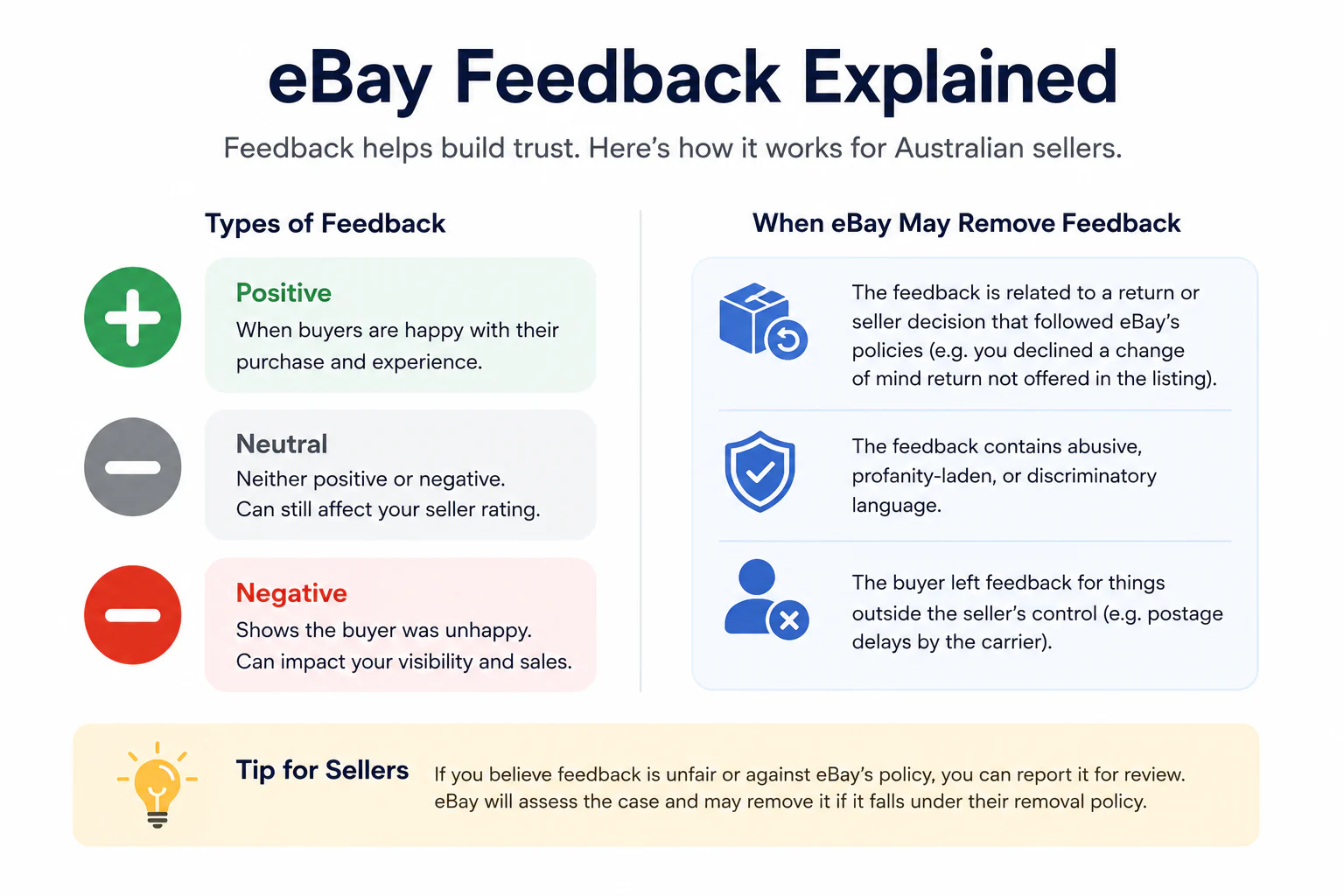
Can neutral or negative feedback be removed?
Sometimes.
eBay’s feedback policy says it may remove neutral or negative feedback in certain return-related situations. Examples include where:
- The seller declined a change-of-mind return request because the listing did not offer returns
- The buyer changed their mind and was liable for the cost of an eBay return label
- The buyer raised an issue that was correctly disclosed in the listing
- The buyer has been actioned under eBay’s abusive buyer policy
- Tracking shows delivery or handling expectations were met and the feedback references a delivery issue
- An eBay Money Back Guarantee case or payment dispute was closed with the seller having met their obligations
But eBay also says it is not there to contradict every buyer opinion. If the buyer says the item quality was poor and the listing did not clearly disclose the problem, the feedback may stay.
That means feedback prevention matters more than feedback removal.
Use accurate listings, fast replies and calm return handling. If feedback is unfair and appears to fit eBay’s removal policy, request review through Seller Help within eBay’s timeframe.
When to ask eBay to step in
You should ask eBay to step in when the return cannot be resolved through normal communication and the case is eligible for escalation.
That might include:
- The buyer will not return the item
- The buyer returned the wrong item
- The buyer returned the item damaged
- The buyer is demanding something not offered in the listing
- The buyer says not as described, but the issue was clearly disclosed
- You and the buyer cannot agree after responding
- You need eBay to review the case before refunding
eBay’s seller return guidance says that if the seller responds but cannot reach agreement with the buyer after 3 business days, either party can ask eBay to step in. It also notes that if eBay steps in, some seller options may no longer be available, such as deducting an amount from the refund even if you might otherwise qualify.
So do not escalate just because a buyer is annoying. Escalate when you need eBay to make a decision, and make sure your evidence is already in the return request.
How to reduce returns before they happen
The best return is the one the buyer never needs to open.
You will never eliminate returns completely, but you can reduce them by making the listing harder to misunderstand.
Write condition notes like a reseller, not a salesperson
Avoid vague phrases such as:
- Great condition
- No flaws
- Looks new
- Rare
- Perfect
Use factual condition notes instead:
- Light wash wear
- Small mark on left cuff, shown in photo 5
- Heel wear visible in photos
- Tagged size 12, please check waist flat and length
- Zip works, lining has a small repair
Put flaws in photos and words
Do both.
A flaw hidden in photo 12 is easy for a buyer to miss. A flaw mentioned only in text can be disputed if the photo makes it hard to see. Use both together.
Example:
Small faint mark near hem, shown in photo 7.
Add measurements for clothing
For pre-owned fashion, tag size is not enough.
Vintage sizing, brand sizing and AU/US/UK conversions can all confuse buyers. Measurements help buyers self-check before purchasing.
Useful measurements include:
- Tops: pit to pit, length, shoulder width, sleeve length
- Pants: waist flat, rise, inseam, leg opening
- Dresses: bust, waist, length
- Jackets: chest, length, shoulder width, sleeve length
- Shoes: marked size, outsole length where useful, and fit notes
Pack like the item might be returned
A return dispute is much easier to manage when the item was packed properly in the first place.
Use:
- Tracking
- Waterproof internal protection for clothing
- Strong boxes for fragile items
- Padding for breakables
- Photos for expensive items
- The correct eBay address
If an item arrives damaged because it was packed poorly, that is much harder to defend.
Keep your inventory synced
If you sell across eBay and Depop, returns are not the only source of stress. Double-selling is another one.
When one item exists in multiple places, accurate inventory records matter. If a buyer returns an item to eBay, you need to know whether the matching Depop listing is active, sold, paused or already ended.
This is where a focused tool like Listalong can help. Accurate photos, measurements, item records and sold-item sync all reduce the admin headaches that come from managing the same physical item across more than one marketplace.
For a deeper workflow, read our guide on how to avoid selling the same item twice.
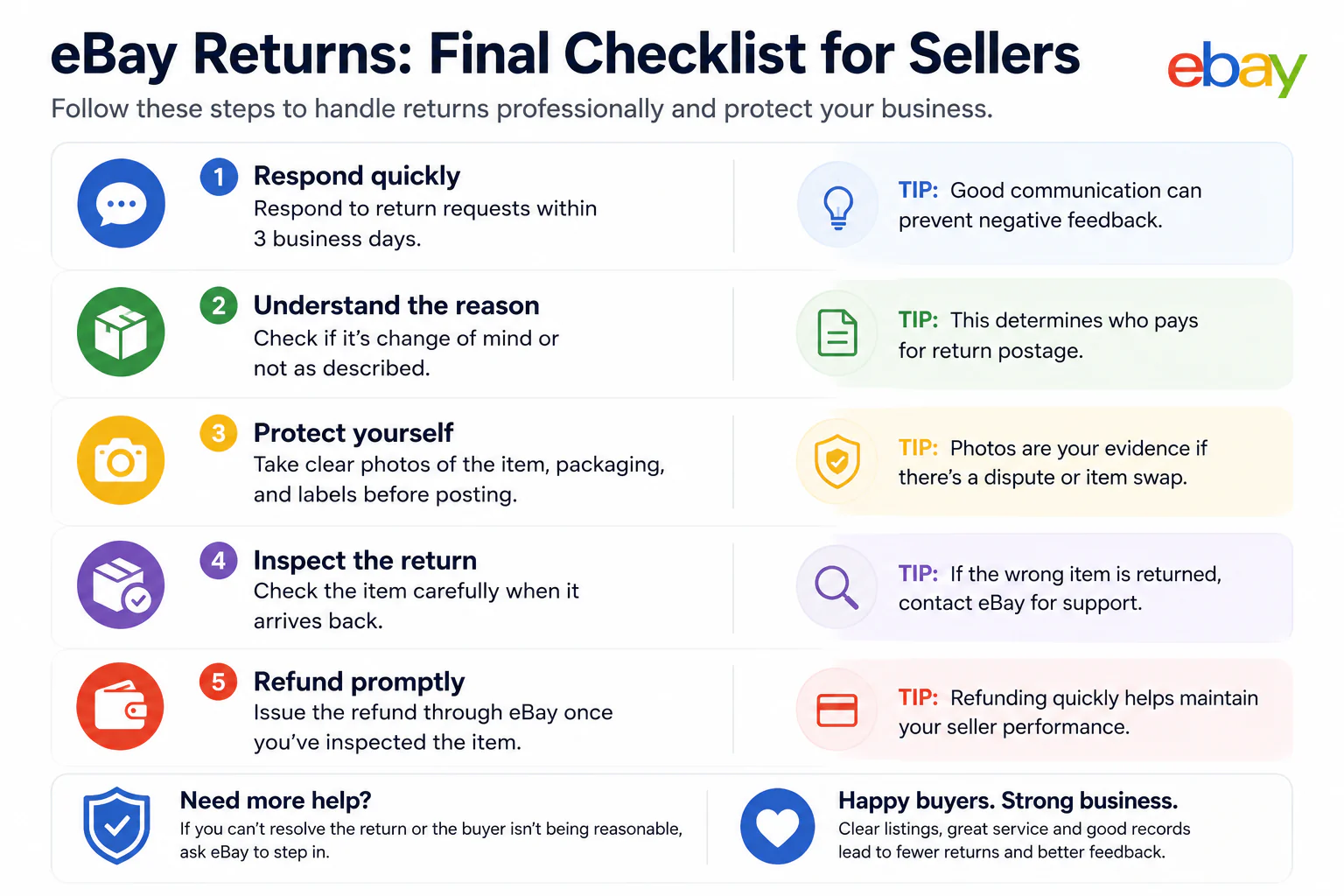
Final checklist for sellers
When a return request comes in, use this checklist:
- Read the return reason carefully.
- Decide whether it is change of mind or not as described.
- Check your listing return policy.
- Review your photos, description, condition notes and messages.
- Respond inside eBay within the required timeframe.
- If the item is not as described, accept the return or offer a proper solution.
- If it is change of mind, follow the policy you offered in the listing.
- Do not refund before return delivery unless you intentionally want the buyer to keep the item.
- Inspect the returned item before refunding.
- Report the issue if the item comes back damaged, used, missing parts or different.
- Request feedback removal only where it fits eBay’s policy.
- Improve the next listing so the same issue is less likely to happen again.
Final thoughts
eBay returns are easier to handle when you stop treating them as one single problem.
Change-of-mind returns are mostly about the return policy you chose. Item-not-as-described returns are about whether the buyer received what your listing promised. Australian Consumer Law adds another layer for business sellers, especially where a product has a major problem or does not match the description.
The practical seller rule is simple:
Be accurate before the sale, respond quickly after the request, keep evidence, use eBay’s return process, and ask eBay to step in when the case genuinely needs review.
That will not stop every difficult return. But it gives you the best chance of protecting your account, your margin and your sanity.