
Choose Listalong if you mainly sell on eBay and Depop and want to keep listing through those marketplaces. Consider Shopfront if you need a broader marketplace catalogue, photo-based AI listing tools or team workflows.
Both can reuse existing listings. Both advertise automation. The decision is which jobs you need covered, how many active items you manage and what the required plan costs in Australian dollars.
I run Listalong. This is a founder-written comparison using Shopfront’s public product documentation and Listalong’s current workflow, checked on 25 September 2026. It is not an independent performance test, and advertised capabilities should be tested with your own accounts and stock.
Then compare the price.
A wider toolkit can be valuable. So can keeping the listing routine you already know. Start with the work your store needs done.
Quick comparison
| What matters | Listalong | Shopfront |
|---|---|---|
| Marketplaces | eBay and Depop, in both directions | Advertises eBay, Depop, Grailed, Shopify, Facebook Marketplace and Vestiaire Collective |
| Starting point | Listings you create on eBay or Depop | Imported channel listings or listings created within Shopfront |
| Import existing stock | Pulls listings from both connected stores | Channel imports into a central inventory |
| Choose one item or a batch | Yes | Crosslisting and bulk tools advertised |
| Automatic crosslisting | Available; new eBay category rules can allow or exclude items going to Depop | One-click crosslisting and scheduling advertised; an equivalent automatic new-category rule was not verified |
| Sold-item handling | Linked sold-item sync, normally within minutes | Automatic delisting after sale detection; timing depends on plan |
| Automatic relisting | Ending and recreation rules, including an eBay Sell Similar-style outcome | Advertises automatic delisting and fresh listing creation |
| Combined Australia Post shipping | Eligible eBay and Depop orders exported together; label PDF used to match tracking | Its comparison says it does not offer Listalong’s MyPost CSV export |
| AI listing creation from photos | Not the workflow offered here; reuse existing listing information | Advertised photo-to-listing generator |
| Team and API requirements | Verify any specialist requirements before choosing | Team workspaces and API access advertised; check tier |
| Subscription currency | AUD | USD, even when local estimates are displayed |
Shopfront sources: crosslisting, imports, AI creation, team workspaces and feature overview. Listalong’s features explain its current scope. A feature described as unverified is not necessarily absent.
Monthly pricing in Australian dollars
Shopfront explicitly states that billing is in USD. Its AUD amounts below are estimates using the RBA rate for 25 September 2026: A$1 = US$0.7019. Divide USD by 0.7019 and round to the nearest dollar. Taxes, card fees and the payment provider’s conversion rate can affect the actual charge.
| Plan | Monthly subscription | Active inventory allowance |
|---|---|---|
| Listalong Standard | A$19 | Fewer than 1,500 active linked items |
| Listalong Large Store | A$39 | 1,500–3,500 active linked items |
| Shopfront Pro | About A$43 — billed US$30 | 200 active products |
| Shopfront Premium | About A$85 — billed US$60 | 1,000 active products |
| Shopfront Premium Plus | About A$171 — billed US$120 | 3,000 active products |
| Shopfront Enterprise | Custom quote | Confirm agreed capacity and terms |
Sources: Listalong pricing and Shopfront pricing. These are monthly billing figures, excluding promotional discounts. Shopfront also warns of usage charges after included units are exhausted.
Listalong’s annual options are A$190 and A$390, paid upfront. Both plans include every current feature; the difference is catalogue capacity. Its 14-day trial starts when both accounts are connected, requires no card and does not silently become a paid plan. Shopfront advertises a trial, but confirm its current duration, payment requirements and renewal terms at signup.
What does the inventory limit actually count?
An active-inventory allowance is not a monthly cap on how many new listings you may create. Listalong counts one item linked across both marketplaces once. Sold, ended, deleted and historical items do not consume its active allowance.
Shopfront describes its allowance as active products and advertises unlimited listing and delisting actions. Confirm how variants, quantities and archived stock count for your catalogue before importing it. Do not equate a product limit with an unlimited inventory allowance.
For example, if you manage 800 distinct active items, compare the plans whose allowances fit that catalogue. Also ask whether you need features beyond two marketplaces: a cheaper plan is not a substitute for a channel your business relies on.
Can you keep listing on eBay or Depop as usual?
This is the central reason to consider Listalong. Create the original listing in the marketplace you already use, then reuse it on the other one. You can keep your familiar photo upload, listing form and everyday routine.
Listalong brings in listings from both stores. Select a group or review items individually; connecting your accounts alone does not publish your entire backlog. See the bulk-import walkthrough and Depop-to-eBay guide.
Shopfront also imports existing marketplace listings, so it would be inaccurate to say you must manually recreate every item there. It describes a central inventory that can hold imported listings as well as newly created products.
The distinction is the workflow you want to use every day. Test what happens after you create a new listing directly on a marketplace, how it appears in the tool and how you send it to the next channel. Importing a backlog once and automatically handling future listings are separate behaviours.
Automatic crosslisting versus choosing what to send
For Listalong’s eBay-to-Depop workflow, category rules let you automatically send suitable new stock, keep other items for review or exclude categories. These controls are shown in the automatic crosslisting guide.
For example, you might approve a consistent clothing category while excluding prohibited electronics. A category rule still requires judgment about the actual item. Destination requirements and marketplace restrictions continue to apply.
Shopfront advertises crosslisting to selected channels and scheduling. I did not verify a matching rule that automatically publishes every newly imported item in a selected category. If that is important, ask for a demonstration with your source marketplace rather than treating the general word “automation” as proof of the same behaviour.
Sold-item sync: compare detection as well as removal
Both products describe linked inventory handling after a sale. Listalong normally ends the corresponding listing within minutes, subject to working connections and successful marketplace actions.
Shopfront’s pricing table lists sale checks at one hour, 30 minutes and 10 minutes across its three priced tiers. Its inventory-sync page gives a broader plan-dependent range. Confirm which timing applies to your account and channel.
A check interval is not a guaranteed end-to-end removal time. Neither a promotional claim about immediate removal nor a normal operating time proves that two buyers can never purchase close together. Check alerts and resolve failed ending actions promptly.
Shopfront also advertises synchronising edits such as photos, descriptions and prices. Do not assume Listalong’s sold-item sync means every edit is mirrored identically. Test the particular field changes you need before relying on them.
Relisting and eBay Sell Similar
Listalong includes rules for ending and recreating older listings, with an eBay result comparable to Sell Similar. That differs from simply leaving an existing listing to renew.
Shopfront’s relisting documentation also describes ending listings and publishing fresh ones on a schedule. Automatic relisting therefore is not exclusive to Listalong. The public description does not establish that Shopfront invokes eBay’s exact Sell Similar action.
Check what happens to listing identifiers, history and linked status when an item is recreated. Improve weak photos, pricing and missing details before expecting a new listing to help. Neither approach guarantees better search placement or sales. Our Relist vs Sell Similar guide explains the practical differences.
Australia Post shipping across both stores
Listalong’s combined shipping process brings eligible orders from eBay and Depop into an Australia Post workflow:
- Check sender details, parcel information and the service for each order.
- Export the combined order CSV and import it into Australia Post to prepare labels.
- Upload the resulting label PDF to Listalong so tracking can be matched back to orders and shipping status updated.
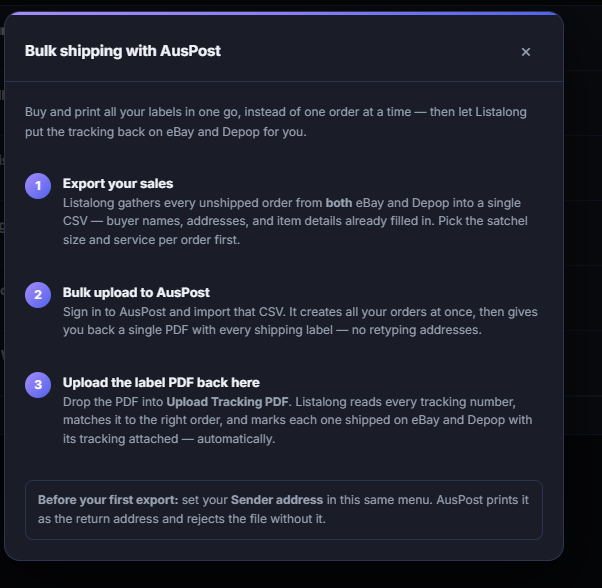
You still pay for postage and must follow any marketplace-specific label requirements. Check the matched orders and exceptions rather than assuming every PDF or order is eligible.
Shopfront’s own comparison acknowledges that it does not offer Listalong’s MyPost CSV export. That supports this specific distinction; it is not a claim that Shopfront has no shipping settings or order tools at all.
When Shopfront’s wider toolkit is useful
Shopfront is worth testing if you need channels beyond eBay and Depop. Its crosslisting page advertises six destinations. Verify the exact regional account and workflow for each one you intend to use; a listing integration does not imply identical import, editing and sale-detection support everywhere.
Its AI generator is relevant if your starting point is a folder of product photos rather than an existing marketplace listing. Its team tools may also matter if several people work on the same catalogue. Check seat permissions, limits and usage allowances during evaluation.
If those are essential to your business, Listalong’s lower subscription price does not make it a like-for-like replacement. If you would leave most of those tools unused, they may add little value to your own workflow.
A note about older Listalong comparisons
Shopfront’s comparison says its Listalong information was checked in August 2026. Some details no longer describe the current product: Listalong is not permanently free, crosslisting works in both directions, and paid plans have active linked-item allowances.
Use the current pricing and workflow pages for those details. The same date discipline applies to this article: check current terms before subscribing, especially currencies, limits and any feature your decision depends on.
A practical trial checklist
Use a representative small batch and record the outcome in each tool:
| Test | What to record |
|---|---|
| Import an existing listing | Photos and details present; missing fields; time spent correcting it |
| Find an item already on both stores | Whether the existing pair is identified without creating another listing |
| Crosslist one item, then a group | Actual review work and any failed actions |
| Create new stock in your usual marketplace | Whether the tool handles it the way you expect |
| Observe a genuine sale | Detection, matching listing removal and any alerts |
| Process eligible orders | Label preparation, tracking matching and remaining manual work |
| Review the bill | Plan capacity, currency, additional usage and cancellation terms |
Do not manufacture purchases to test a sale. Observe genuine orders and use any provider-supported test method. Avoid running overlapping relisting or publishing rules from two tools against the same stock while comparing them.
Which would I choose?
For an Australian seller who mainly uses eBay and Depop, wants to keep listing there and needs crosslisting, linked sold-item handling and combined Australia Post administration, Listalong is the focused option I would test first.
For a shop that needs more marketplaces, photo-based listing creation or a shared team catalogue, Shopfront deserves a proper trial. Compare what the whole workflow saves you rather than assuming more features or a lower starting price settles the decision.
You can also read the broader crosslisting cost comparison before choosing a subscription.
Try Listalong with your own stock.
Connect eBay and Depop, review a small batch and see how the linked workflow fits your store.
Start your 14-day trial No card required. Plans from A$19/month after the trial.