
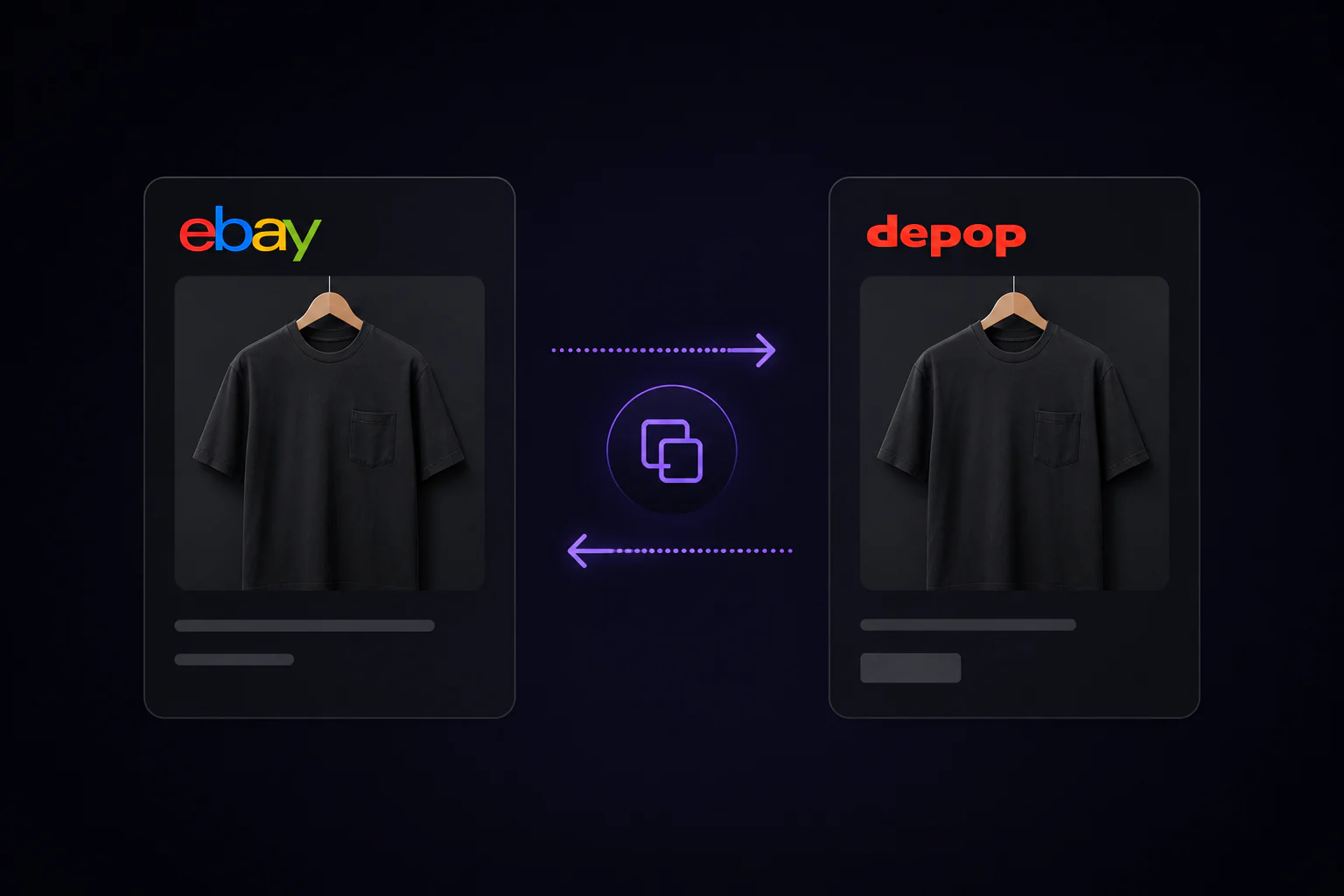
Selling on one marketplace can limit how many buyers see your inventory. Cross-listing allows you to advertise the same item on multiple marketplaces, helping you reach more potential buyers without purchasing additional stock.
For Australian resellers, this could mean listing an item on eBay and also offering it to shoppers on Depop.
However, cross-listing also creates additional work. You need to transfer product information, keep listings accurate and remove an item from every marketplace as soon as it sells.
This guide explains what cross-listing is, how it works and what beginners should consider before selling on multiple platforms.
What does cross-listing mean?
Cross-listing means advertising the same physical item for sale on more than one online marketplace.
For example, you may create an eBay listing for a second-hand shirt and then create another listing for the same shirt on Depop.
You still own only one shirt. The item is simply being shown to buyers on two different marketplaces.
If the shirt sells on eBay, the Depop listing must be removed. If it sells on Depop, the corresponding eBay listing must be ended.
Cross-listing is sometimes also called:
- Multi-platform selling
- Multi-channel selling
- Marketplace cross-posting
- Cross-posting listings
These terms generally describe the same basic idea: making the same inventory available to buyers in more than one place.
Why do resellers cross-list their inventory?
The main reason to cross-list is to give each item more opportunities to sell.
Different marketplaces attract different buyers. An item that receives little attention on one platform may perform better on another.
For example, eBay has a broad customer base covering many product categories. Depop is more focused on fashion, personal style, vintage clothing and second-hand apparel.
A branded shirt may appeal to someone searching for a specific brand on eBay. The same shirt may appeal to a Depop buyer searching by style, colour or aesthetic.
By using both marketplaces, the reseller can place the item in front of two different groups of buyers.
What are the benefits of cross-listing?
More people can discover your items
A listing can only be found by people using the marketplace where it has been published.
Cross-listing increases the number of places where buyers can find your inventory.
It does not guarantee a sale, but it gives suitable products more exposure.
Existing inventory gets another chance to sell
Cross-listing does not require you to buy more stock.
Instead, you are using inventory you already own and listing it in another relevant marketplace.
This can be particularly useful for clothing that has been sitting on eBay without receiving much interest.
You are less dependent on one marketplace
Sales can change from week to week. Search visibility, buyer activity and marketplace demand can also vary.
Selling on more than one platform can reduce your reliance on a single source of sales.
Different products may perform better on different platforms
Some products naturally suit one marketplace better than another.
General goods, collectibles, electronics, replacement parts and older items may be better suited to eBay.
Fashion, streetwear, branded clothing and vintage pieces may also find an audience on Depop.
Cross-listing gives suitable products the opportunity to reach buyers where they are most likely to shop.
What information can be reused?
An existing marketplace listing usually contains most of the information needed to create another listing.
This may include:
- Product photos
- Listing title
- Description
- Brand
- Size
- Colour
- Condition
- Price
- Measurements
- Material
- Item details
This means you should not need to photograph the product again or write the entire listing from the beginning.
However, some information may need to be adjusted for the second marketplace.
For example, an eBay title may focus on searchable product details, while a Depop listing may benefit from clearer style information.
The important details should remain accurate on both platforms.
How does cross-listing work?
The basic process is straightforward.
Step 1: Create the original listing
Start by listing the item on your main marketplace.
For many Australian resellers, this will be eBay.
Include:
- Clear product photos
- An accurate title
- A useful description
- The correct size and brand
- Measurements where relevant
- Any faults or signs of wear
- A realistic price
This listing becomes the main source of information for the second listing.
Step 2: Decide whether the item suits another marketplace
Not every item needs to be listed everywhere.
Before cross-listing an item, consider:
- Whether that type of product is allowed
- Whether buyers on the second marketplace are likely to want it
- Whether the category is available
- Whether the item can be described accurately
- Whether the expected selling price makes the extra work worthwhile
Clothing, shoes, accessories and vintage fashion may suit both eBay and Depop.
Products such as electronics, appliances, gaming consoles or spare parts may be more appropriate for eBay alone.
Always check the marketplace’s current selling policies before publishing an item.
Step 3: Create the second listing
Reuse the product photos and accurate listing details from the original listing.
Select the correct:
- Category
- Brand
- Size
- Condition
- Colour
- Price
- Shipping information
Review the listing before publishing it.
Cross-listing should save time, but the second listing still needs to be accurate and suitable for the marketplace where it will appear.
Step 4: Keep both listings connected
Once the item is available on two marketplaces, you need a reliable way to identify the matching listings.
Some resellers use:
- Stock keeping units
- Inventory numbers
- Spreadsheets
- Storage location codes
- Cross-listing software
The goal is to quickly identify every active listing connected to the same physical item.
Step 5: Remove the other listing when the item sells
This is the most important part of cross-listing.
When an item sells on one marketplace, remove it from every other marketplace as soon as possible.
Do not wait until the order has been packed or posted.
Leaving the second listing active creates the risk that another buyer will purchase an item you no longer have.
What is double-selling?
Double-selling happens when one physical item is purchased by two different buyers on separate marketplaces.
For example:
- A shirt is listed on eBay and Depop.
- A buyer purchases it on eBay.
- The Depop listing remains active.
- A second buyer purchases it on Depop.
The reseller now has two orders but only one item.
This may lead to:
- A cancelled order
- A disappointed buyer
- Negative feedback
- Marketplace account issues
- Extra customer service work
Preventing double-selling is one of the most important responsibilities when cross-listing inventory.
Manual cross-listing compared with cross-listing software
Cross-listing can be managed manually or with software.
Manual cross-listing
Manual cross-listing usually involves copying photos and product details from one marketplace into another.
This can work well for a small number of items.
The reseller remains responsible for:
- Creating each listing
- Updating prices
- Tracking matching inventory
- Monitoring sales
- Removing sold listings
- Updating shipping information
The process is inexpensive, but it becomes more difficult as the number of active listings grows.
Cross-listing software
Cross-listing software helps transfer listing information between marketplaces.
Depending on the software, it may also help with:
- Importing existing listings
- Reusing photos and descriptions
- Matching categories
- Reviewing listings before publication
- Tracking inventory
- Removing sold listings
- Managing shipping information
The main benefit is not simply publishing the second listing. It is reducing the repetitive work involved in keeping both marketplaces accurate.
How Listalong helps
Listalong is designed for Australian resellers who sell on eBay and Depop. It can start with an existing listing on either marketplace and cross-list it to the other one.
You continue listing through eBay or Depop as normal.
Listalong reuses available photos, titles, descriptions, brands, sizes and prices for the other marketplace. Cross-listing can run automatically, or you can choose items yourself.
Destination-specific details and warnings remain visible when something needs attention.
When an item sells on either marketplace, Listalong can end the corresponding listing on the other platform. This helps reduce the risk of selling the same physical item twice.
The aim is to make the second marketplace feel like an extension of the workflow you already use rather than an entirely separate system.
Is cross-listing suitable for beginners?
Cross-listing can be useful for beginners, but it is usually best to start small.
Begin with a limited number of products that clearly suit both marketplaces.
This gives you time to understand:
- How each marketplace works
- What information needs to be changed
- How orders are managed
- How quickly sold listings must be removed
- Which products attract interest on each platform
You do not need to cross-list your entire eBay store immediately.
Starting with 10 to 20 suitable items can help you test the process without making inventory management overwhelming.
Which products should beginners cross-list first?
Good products for an eBay-to-Depop cross-listing test may include:
- Branded shirts
- Jackets
- Jeans
- Streetwear
- Vintage clothing
- Shoes
- Fashion accessories
- Distinctive or unusual clothing
Look for items that have:
- Clear photos
- A visible brand
- An identifiable size
- Accurate measurements
- A style that suits Depop
- Enough value to justify the listing work
Avoid starting with products that are difficult to categorise, prohibited by the marketplace or unlikely to interest its buyers.
Should every eBay listing be cross-listed?
No. Cross-listing works best when you select products that suit the second marketplace.
Publishing unsuitable inventory can create extra administration without producing meaningful buyer interest.
Before cross-listing an item from eBay to Depop, ask:
- Is this product allowed on Depop?
- Is it relevant to Depop buyers?
- Are the photos suitable?
- Is the size and condition clear?
- Is the potential sale worth the extra work?
- Can I remove the listing quickly when it sells?
If the answer to several of these questions is no, it may be better to leave the item on eBay only.
How much does cross-listing cost?
The cost depends on how you manage the process.
Manual cross-listing may not require a separate software subscription, but it takes additional time.
Cross-listing software usually charges a subscription or usage fee in exchange for reducing repetitive work and helping manage inventory.
Marketplace selling fees may also differ between platforms.
Before cross-listing, consider:
- Marketplace fees
- Payment processing
- Postage costs
- Packaging costs
- Software costs
- The time required to create and manage listings
The important question is whether the extra sales opportunities justify the additional cost and administration for your business.
Common cross-listing mistakes
Listing unsuitable products everywhere
More listings do not always lead to more sales.
Choose marketplaces based on the product and its likely buyer.
Forgetting to remove sold listings
This is the biggest operational risk.
Remove matching listings immediately after a sale or use a system that handles sold-item syncing.
Using inaccurate information
Do not assume every detail can be copied without review.
Check the category, size, condition, price and shipping details before publishing.
Losing track of inventory
Use stock numbers, labels or storage locations so you can find an item when it sells.
Expanding too quickly
Managing hundreds of manually cross-listed items can become difficult.
Test the process with a smaller group before adding more inventory.
Is cross-listing worth it?
Cross-listing can be worthwhile when:
- You already have suitable inventory
- Your products appeal to buyers on both marketplaces
- You can reuse most of your listing information
- You have a reliable inventory system
- You remove sold listings quickly
- The additional sales justify the extra work
It may not be worthwhile when the products are unsuitable for the second marketplace or when inventory cannot be kept accurate.
For many small resellers, the best approach is selective cross-listing rather than putting every item on every available platform.
Start with a small group of suitable listings
You do not need to change your entire reselling workflow to try cross-listing.
Choose a small group of branded clothing or fashion items that are already listed on eBay. Check that they are suitable for Depop, then create accurate listings using the photos and product information you already have.
Monitor which products receive views, likes, offers and sales.
Once you are comfortable managing inventory across both platforms, you can decide whether to cross-list more of your eBay store.