
If you already sell on eBay Australia, Depop can be a useful second marketplace for clothing, shoes, vintage, streetwear and branded fashion.
The problem is not whether you can list on both.
The problem is whether you can do it without doubling your work.
Manual cross-listing sounds easy at first. You copy your eBay photos, rewrite the title, adjust the description, add size and brand details, set your shipping, publish the item on Depop, then remember to remove the other listing when it sells.
That is fine for a few items.
It gets annoying once you have 30, 50 or 100 active listings.
The best eBay to Depop cross-listing tool in Australia is not necessarily the biggest tool with the most marketplaces. It is the tool that fits how you already sell.
For many Australian resellers, that means starting with eBay, reusing the work already done there, reviewing which items make sense for Depop, and avoiding the mistake that scares every cross-lister: selling the same item twice.
Quick answer: what is the best eBay to Depop cross-listing tool in Australia?
For Australian sellers who already list on eBay and want to add Depop, Listalong is the most focused option.
For the workflow covered in this guide, Listalong takes an existing eBay listing and cross-lists it to Depop automatically or when you choose the item yourself. It also works in reverse, from Depop to eBay, and linked sold-item sync normally ends the matching listing after a sale. Listalong is available with a 14-day free trial; paid plans are available if you choose to continue after the trial.
That does not mean Listalong is the best tool for every reseller.
If you sell across lots of marketplaces, a broader multi-channel tool may make more sense. Crosslist, Vendoo and List Perfectly are broader cross-listing or reseller workflow tools with pricing and feature sets aimed at sellers who want more general marketplace coverage. Shopfront may also appear in your research, but confirm its current public marketplace support and pricing directly before comparing it against the others.
So the honest answer is:
Listalong is the best fit for Australian sellers who want eBay and Depop working together without paying for marketplaces they do not need. Bigger tools may be better if you genuinely manage many channels.
Why eBay to Depop cross-listing matters more in Australia now
For Australian resellers, eBay and Depop have both become more interesting.
From 12 May 2026, eBay Australia removed transaction fees for eligible Australia-based sellers with AU $25,000 or less in sales over the past 12 months. eBay says eligible sellers pay no transaction fees on eBay.com.au sales, although this is not available to Pro sellers and other charges can still apply, such as optional listing upgrades, international sales fees and postage label costs.
Depop is also changing its fee structure in Australia. Depop says that from 22 July 2026, it is removing selling fees in Australia, while payment processing fees still apply. Depop also has buyer-side marketplace fees in some markets, so sellers should check the current Depop fee page before pricing items.
That creates a simple question for Australian clothing resellers:
If eBay is still the broad marketplace and Depop is becoming more attractive for fashion sellers, should you be using both?
For many sellers, the answer is yes, but only if the admin does not eat the profit.
Cross-listing gives your item a second chance to be seen. A Harley-Davidson shirt, Dr. Martens boots, Adidas track jacket, Nike jacket, Country Road dress or vintage graphic tee might sit quietly on eBay but get more attention on Depop. The same item can appeal to different buyers on different platforms.
But cross-listing only works if the workflow is under control.
If every Depop listing takes another five to ten minutes, and you then need to manually track sold items across both platforms, the extra exposure can quickly become extra stress.
What should an eBay to Depop cross-listing tool actually do?
A good eBay to Depop cross-listing tool should do more than copy text from one box to another.
At a minimum, it should help with five things.
1. Reuse your existing eBay work
Your eBay listing already has most of the information needed for a Depop listing.
You have already taken photos. You have already written a title. You have probably added condition notes, measurements, brand, size, colour, material and postage details.
A good tool should reuse as much of that as possible.
Listalong can reuse available eBay photos, titles, descriptions, prices, brands, sizes, condition notes and item details for Depop. You can enable automatic cross-listing or choose listings yourself, with destination-specific warnings where details need attention.
That matters because the boring part of cross-listing is not usually deciding whether something belongs on Depop. The boring part is rebuilding a listing you have already built once.
2. Let you review before publishing
Not every eBay item belongs on Depop.
Depop is strongest for fashion, style-led items, vintage, streetwear, sneakers, accessories and trend-driven clothing.
That means a good cross-listing workflow should not blindly send every eBay item to Depop.
A Nintendo DS, phone charger, toy bundle, printer cable or random household item might be fine on eBay but wrong for Depop. On the other hand, a branded jacket, workwear shirt, vintage tee, leather boots or current-style dress may be worth testing.
This is where visible checks and seller control help. Automatic cross-listing can save time, while destination-specific warnings and the option to choose items let the seller check category, title, photos, price and suitability when needed.
3. Help prevent double-selling
Double-selling is the main risk of cross-listing.
If one physical item is listed on eBay and Depop at the same time, you need a process for what happens when it sells.
If it sells on eBay, the Depop listing needs to come down.
If it sells on Depop, the eBay listing needs to end.
You can do that manually, but it is easy to forget, especially if you sell part-time, pack orders at night, or have a lot of similar items.
A good eBay to Depop cross-listing tool should have sold-item removal or at least a clear workflow to help you avoid accidentally selling the same item twice.
Listalong says its feature set includes sold-item removal in both directions. Crosslist includes autodelisting on some plans, according to its public pricing page.
4. Fit Australian shipping
This is where Australian sellers can run into problems with generic tools.
A lot of cross-listing software is built around US marketplaces and US shipping habits. Australian resellers usually care about Australia Post, satchels, tracked postage, MyPost Business, flat-rate shipping and local buyer expectations.
Depop’s safety advice says sellers should only buy and sell through Depop and use tracked shipping if not using Depop Shipping.
That makes tracking and shipping admin important. The listing is only half the job. The order still needs to be packed, labelled and updated.
Listalong’s Australian seller pages specifically mention Australia Post workflow support, including MyPost bulk import and tracking push-back.
5. Cost less than the extra value it creates
A cross-listing tool should pay for itself in time saved, errors avoided or extra sales created.
This is where small Australian resellers need to be careful.
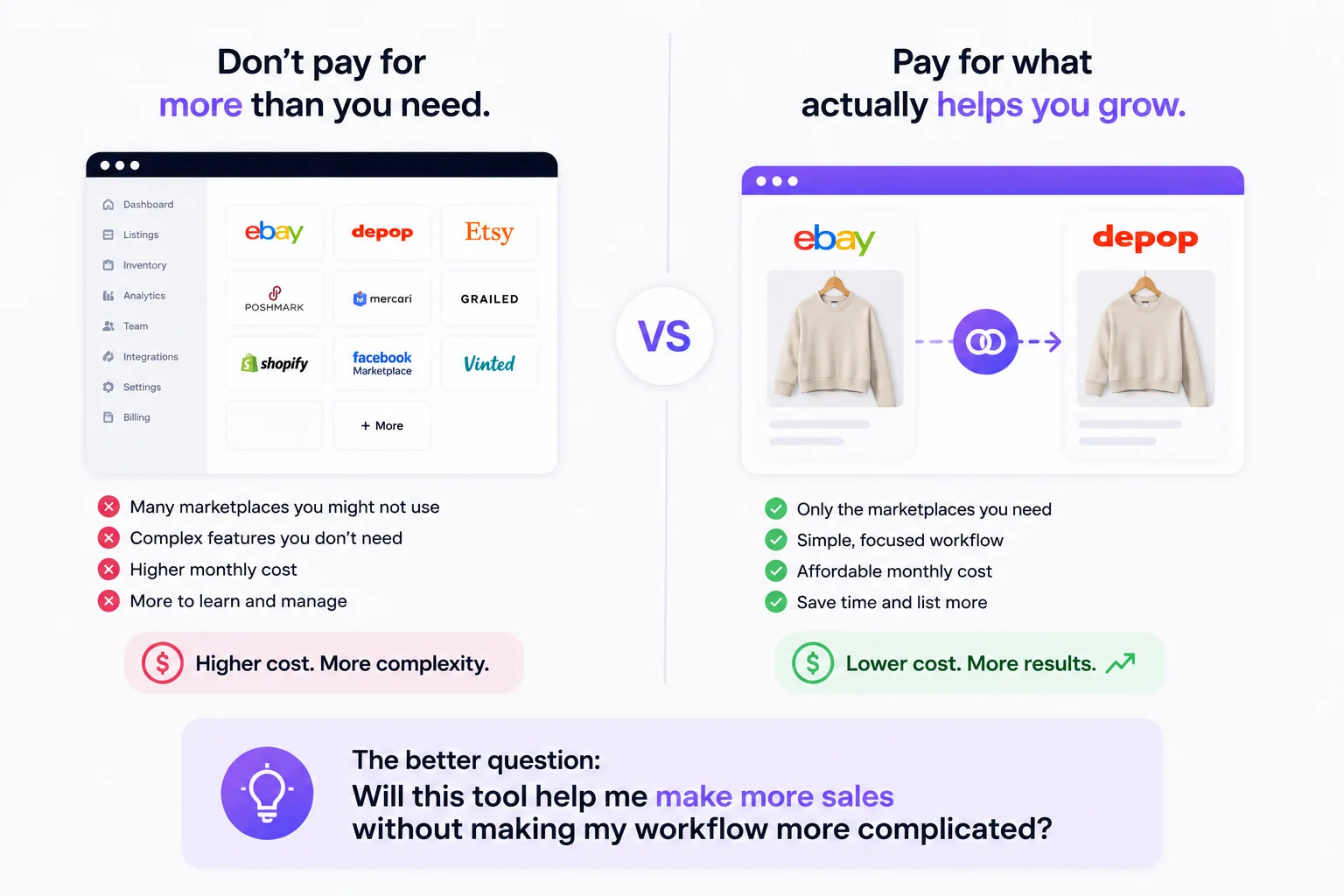
A tool with many marketplaces, analytics, team accounts and a central inventory system may be great for a high-volume seller. But if you only want to take your eBay clothing listings and test them on Depop, a large monthly software bill may be hard to justify.
For a small seller, the question is not “Which tool has the longest feature list?”
The better question is:
Will this tool help me make more sales without making my workflow more complicated?
Best eBay to Depop cross-listing tools compared
Here is the practical comparison for Australian resellers.
| Tool | Best for | Main strength | Main limitation |
|---|---|---|---|
| Listalong | Australian sellers using eBay and Depop | Automatic or selected-item cross-listing in either direction, 14-day free trial access, sold-item removal and Australia Post support | Focused on two marketplaces |
| Crosslist | Sellers wanting broad cross-posting across many marketplaces | 11+ marketplace positioning, universal listing workflow and higher-plan autodelisting | Pricing is in USD and it is not specifically eBay-to-Depop focused |
| Vendoo | Resellers wanting inventory management and analytics | Broader reselling system with cross-listing and inventory features | More general-purpose and more US-style marketplace focused |
| List Perfectly | Sellers wanting a large marketplace listing system | Supports many marketplaces and offers tiered plans | Higher entry price than a focused eBay-to-Depop tool |
| Shopfront | Sellers researching broader marketplace workflows | Worth comparing if its current support matches your channels | Public channel support and pricing should be checked directly before deciding |
| Manual cross-listing | Sellers testing a handful of items | Free and simple to start | Slow, repetitive and higher risk of forgetting sold items |
Listalong: best for Australian sellers who want eBay and Depop without a second workflow
Listalong is the most focused tool in this comparison.
It is not trying to be a massive “sell everywhere” platform. It connects the two marketplaces that matter most to many Australian resellers: eBay and Depop.
That matters.
A lot of Australian sellers already know how to create eBay listings. They know how to write eBay titles. They know how to check sold comps. They already have their photos, measurements and descriptions inside eBay.
Listalong works from that starting point—and it also works for sellers who already list on Depop and want to reach eBay buyers.
Keep listing in eBay or Depop as you normally do. Listalong can cross-list automatically or let you choose items yourself, while destination-specific checks and Australia Post workflow support handle the extra store. Listalong is available with a 14-day free trial that starts when both eBay and Depop are connected. See Listalong pricing for the current paid plans and allowances.
The biggest advantage is simplicity.
You do not need to rebuild your whole inventory system. You do not need to commit to ten marketplaces. You do not need to change the way you source, photograph and list.
You keep listing on eBay like normal, then use suitable eBay listings to build a Depop presence.
That is a strong fit for sellers who:
- already list on eBay Australia
- mostly sell clothing, shoes, accessories or fashion-led items
- want to test Depop without rebuilding every listing
- want to review items before publishing
- worry about double-selling
- use Australia Post for shipping
- do not want to pay for features they are not using
The limitation is also clear: Listalong is not trying to replace every multi-channel tool. If you want many marketplaces all in one system, you may need something broader.
But for the specific job of eBay to Depop cross-listing in Australia, that narrow focus is the point.
Broader tools: useful when you need more marketplaces
Broader tools can make sense if your selling life is bigger than eBay plus Depop.
If you want to manage several marketplaces at once, compare current plans and features for tools like Crosslist, Vendoo, List Perfectly and Shopfront. Do the boring but important check before signing up:
- Which marketplaces are actually supported today?
- Does the tool support the exact direction you need, such as eBay to Depop?
- Does it help remove sold items, or only copy listings?
- Is the pricing in AUD or USD?
- Are you paying for marketplaces you will not use?
- Does the shipping workflow fit Australia Post?
That last point matters more than many sellers expect.
Generic marketplace support is not the same as an Australian reseller workflow.
Crosslist: best for sellers who want a general cross-listing tool
Crosslist is a broad cross-listing tool. Its site says it lets sellers list on more than 11 marketplaces.
At the time of checking, Crosslist’s public pricing page listed a Bronze plan from US $29.99/month with a monthly listing allowance, and higher plans with broader allowances and features such as CSV import/export, autodelisting and analytics.
That can be useful if you want to build a broader marketplace strategy.
But for Australian eBay-to-Depop sellers, the question is whether you need the broader system. If you are not using most of the supported platforms, you may be paying for reach you do not need yet.
Crosslist is better described as a general cross-listing tool, not a specifically Australian eBay-to-Depop workflow.
Vendoo: best for sellers who want inventory and analytics
Vendoo is one of the better-known reseller tools internationally.
It is designed for sellers who want a cross-listing and inventory management system, with features that appeal to people managing more stock and wanting more structure. Vendoo’s pricing page promotes subscription plans for different seller sizes, marketplace add-ons and a free trial.
Vendoo may be a good fit if you want a full reselling dashboard.
But if you are an Australian seller whose main workflow is eBay first, Depop second, Vendoo may feel broader than necessary. It is not mainly positioned around the specific Australian eBay-to-Depop problem.
List Perfectly: best for sellers who want a large marketplace listing system
List Perfectly is another large cross-listing platform.
At the time of checking, its public pricing page listed tiers starting from US $29/month for Simple, then higher Business, Pro and Pro Plus plans.
For sellers who want a large catalogue system and many marketplace options, that may be worth considering.
For smaller Australian sellers, the question is whether that entry price makes sense if the main goal is only eBay to Depop.
If you are selling across many platforms, List Perfectly may belong on your shortlist. If you are only trying to avoid relisting eBay items manually on Depop, it may be more system than you need.
If Vendoo and List Perfectly are your final two choices, our Australian Vendoo vs List Perfectly comparison checks their regional support wording, pricing, mobile use and sold-item automation directly.
Manual cross-listing: best for testing, not scaling
Manual cross-listing is still an option.
In fact, it is probably the best option if you only want to test five items.
Pick a few strong Depop-style items from your eBay store, copy them across manually, adjust the tone for Depop, and see what happens.
That small test can teach you a lot.
You may discover that certain brands get more likes on Depop. You may find that some items need a different photo style. You may realise that your eBay titles are too search-heavy and not natural enough for Depop. You may also find that certain stock is not worth cross-listing at all.
Manual cross-listing becomes a problem when it turns into a regular workflow.
If you are copying 20, 50 or 100 listings across, the time adds up. More importantly, every extra marketplace creates another place where a sold item needs to be removed.
Manual is fine for a test.
It is not ideal as your long-term system.
Why the best tool is not always the biggest tool
A lot of reseller software is sold on the idea of more.
More marketplaces. More dashboards. More analytics. More automation. More settings.
That can be useful, but it can also become a distraction.
Many Australian resellers do not need to be everywhere. They need a simple way to get suitable stock in front of more buyers.
If your workflow already starts on eBay, the best tool may be the one that keeps that workflow intact.
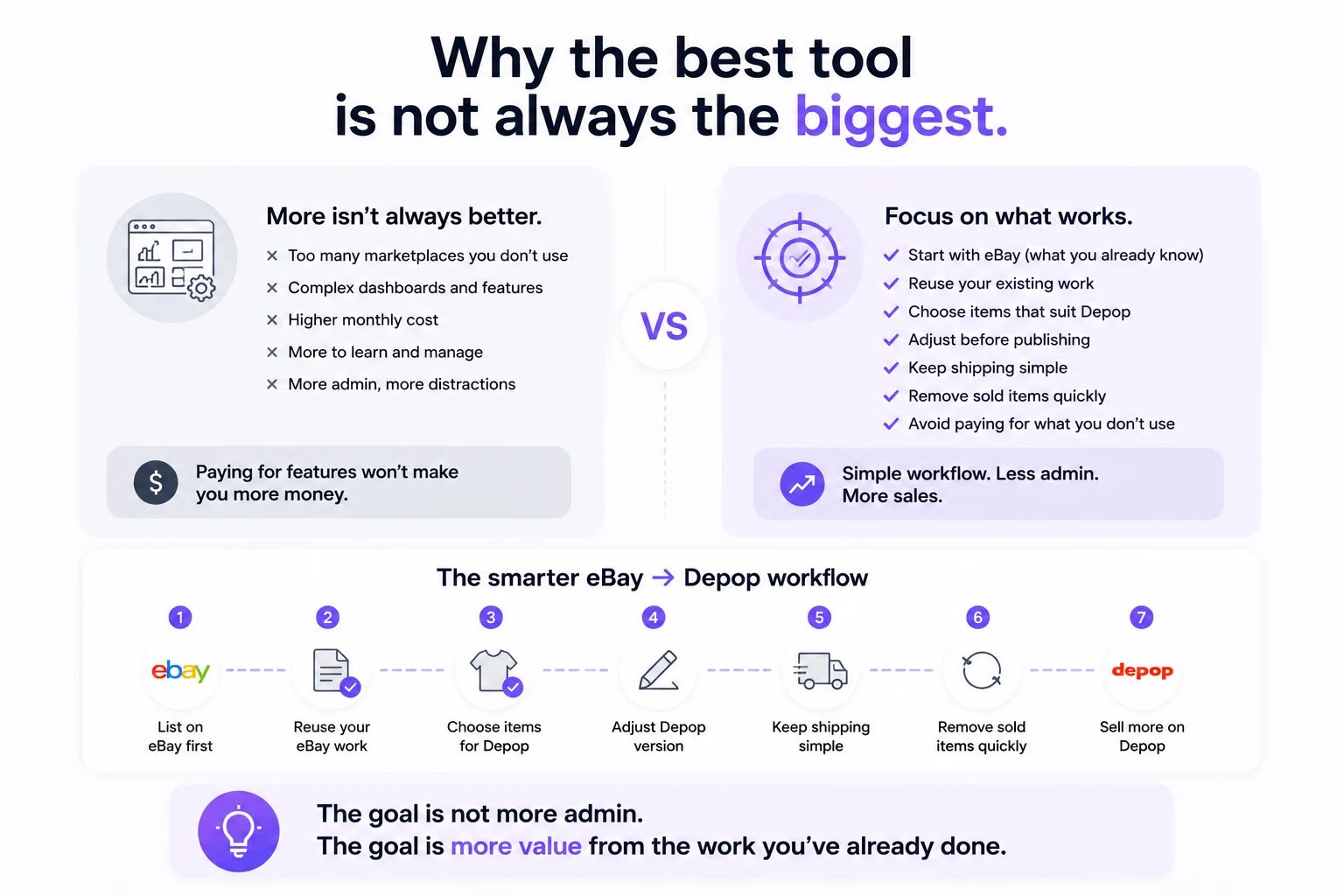
That means:
- list on eBay first
- reuse your existing eBay work
- choose which items suit Depop
- adjust the Depop version before publishing
- keep shipping simple
- remove sold items quickly
- avoid paying for marketplaces you do not use
This is why a focused eBay-to-Depop tool can make more sense than a larger international platform.
The goal is not to create more admin.
The goal is to get more value from work you have already done.
What items should you cross-list from eBay to Depop?
Not everything.
This is one of the biggest mistakes new cross-listers make.
Depop is a fashion-led marketplace. That means the best candidates are usually items with some style, brand, trend or visual appeal.
Good items to test on Depop include:
- vintage graphic tees
- Harley-Davidson shirts
- Nike and Adidas jackets
- Dr. Martens boots
- leather jackets
- Y2K and streetwear pieces
- branded jeans
- Polo Ralph Lauren shirts
- Carhartt workwear
- designer or boutique dresses
- bags and accessories
- unique or aesthetic pieces
Items that may be better left on eBay include:
- electronics
- video game consoles
- DVDs
- chargers
- household parts
- toys with no fashion angle
- low-value basics
- bulky items
- items with complicated compatibility details
That does not mean those items cannot sell elsewhere. It just means Depop may not be the best home for them.
A good cross-listing tool should help you be selective. Sending everything everywhere is not strategy. It is just noise.
How to choose the right eBay to Depop tool
Before picking a tool, ask five questions.
1. Do I already list on eBay?
If yes, look for a tool that starts from eBay rather than forcing you to rebuild your workflow inside another system.
2. Do I only want Depop, or do I want many marketplaces?
If you only want Depop, a focused tool like Listalong may make more sense.
If you want a general international cross-listing system, compare Crosslist, Vendoo, List Perfectly and any other tools that support your exact channels.
3. Do I need approval before publishing?
For eBay to Depop, review matters.
Depop titles, categories, tags and buyer expectations are not always the same as eBay. A good workflow should let you check the listing before it goes live.
4. What happens when something sells?
This is the most important operational question.
Before cross-listing seriously, know exactly how sold items will be removed. If the answer is “I will try to remember,” that is risky.
5. Does the price make sense for my store?
If a tool costs US $30-70/month, that may be fine for a larger seller. But a small Australian reseller needs to ask how many extra sales are required just to cover the subscription.
The best tool is the one that fits your volume.
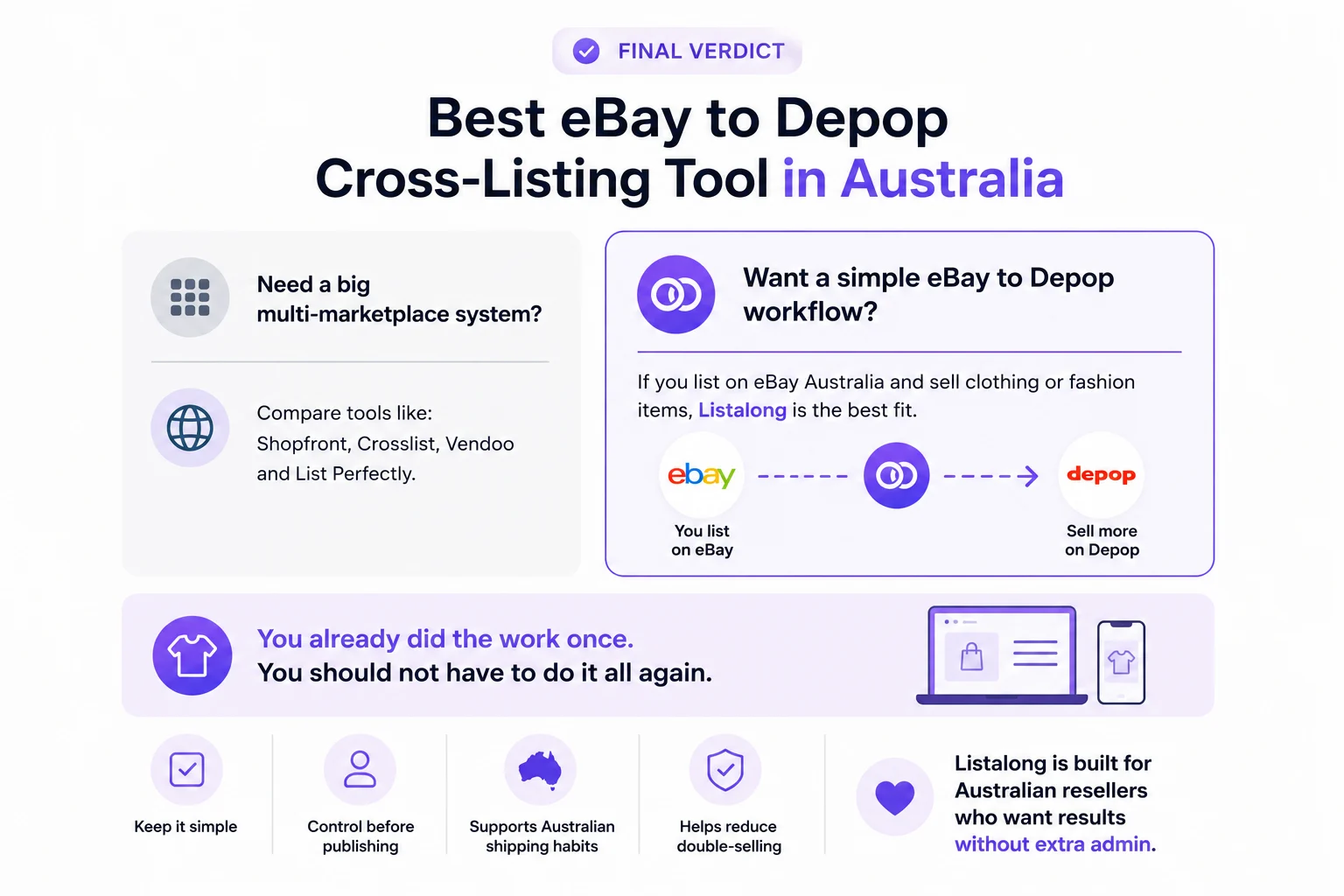
Final verdict: the best eBay to Depop cross-listing tool in Australia
If you want the biggest multi-marketplace system, Listalong is not the answer.
If you want to sell across many platforms, compare Crosslist, Vendoo, List Perfectly and any other broader tools that match your current channels.
But if your main marketplaces are eBay Australia and Depop, and you want to reach buyers on both without rebuilding every listing, Listalong is the best fit. This article focuses on eBay to Depop, while the product works in either direction.
It is focused on the exact problem Australian eBay sellers run into:
You already did the work once.
You should not have to do it all again.
For small Australian resellers, the best eBay to Depop cross-listing tool is the one that keeps things simple, gives you control before publishing, supports local shipping habits, and helps reduce the risk of double-selling.
That is what Listalong is built for.
Sources and further reading
Pricing, platform support and marketplace rules can change, so check current official pages before choosing a tool: