
Selling on both eBay and Depop sounds simple.
You already have the item.
You already took the photos.
You already wrote the title.
You already worked out the price.
So why not list it in two places?
For Australian resellers, that idea makes more sense than ever. eBay Australia now offers free selling for eligible Australia-based sellers who are not on a Pro plan and have sold AU $25,000 or less over the past 12 months, although optional upgrades, international sales and some other costs can still apply. Depop is also changing in Australia, with Depop’s help centre stating that selling fees are being removed in Australia from 22 July 2026, while payment processing fees still apply.
That means the question for a lot of resellers is no longer:
Should I try another platform?
It is:
How do I sell on both eBay and Depop without doubling my work?
That is where cross-listing software comes in.
But not all cross-listing tools are built for the way Australian resellers actually work.
Some tools are built for huge multi-platform sellers. Some are designed around US marketplaces. Some expect you to create listings inside the tool first. And some make cross-listing feel more complicated than just doing it manually.
If you already list on eBay and you want to test Depop, you need something much simpler.
You need software that helps you turn your existing eBay listings into Depop listings without uploading everything again.
Why sell on both eBay and Depop?
eBay and Depop are both resale platforms, but they do not attract buyers in exactly the same way.
eBay is broad. It works for clothing, electronics, collectibles, games, shoes, parts, homewares and almost everything else. It is also very structured. eBay item specifics include details like brand, model, size, colour and style, which help buyers find items through search and filters.
Depop is different.
Depop is much more fashion-led. It suits clothing, streetwear, vintage, shoes, accessories and pieces with style appeal. A Harley-Davidson shirt, pair of Dr. Martens, Nike jacket, vintage tee, Country Road dress or Y2K bag may suit Depop far more than a random household item would.
That difference is exactly why cross-listing can work.
You are not trying to list everything everywhere.
You are trying to give the right items a second chance to sell in front of a different buyer.
A buyer searching eBay might be looking for a specific brand, size or model.
A buyer scrolling Depop might be looking for an outfit, aesthetic or vintage piece.
Same item. Different audience.
The problem with listing manually on both platforms
The manual method is easy to understand.
You list the item on eBay first. Then you open Depop, upload the same photos, rewrite the description, choose the category, set the price, add tags and publish.
That is fine for one item.
It becomes annoying at ten items.
It becomes a real bottleneck at fifty items.
And once you have hundreds of active listings, the biggest problem is not even the listing work. It is keeping track of what is live.
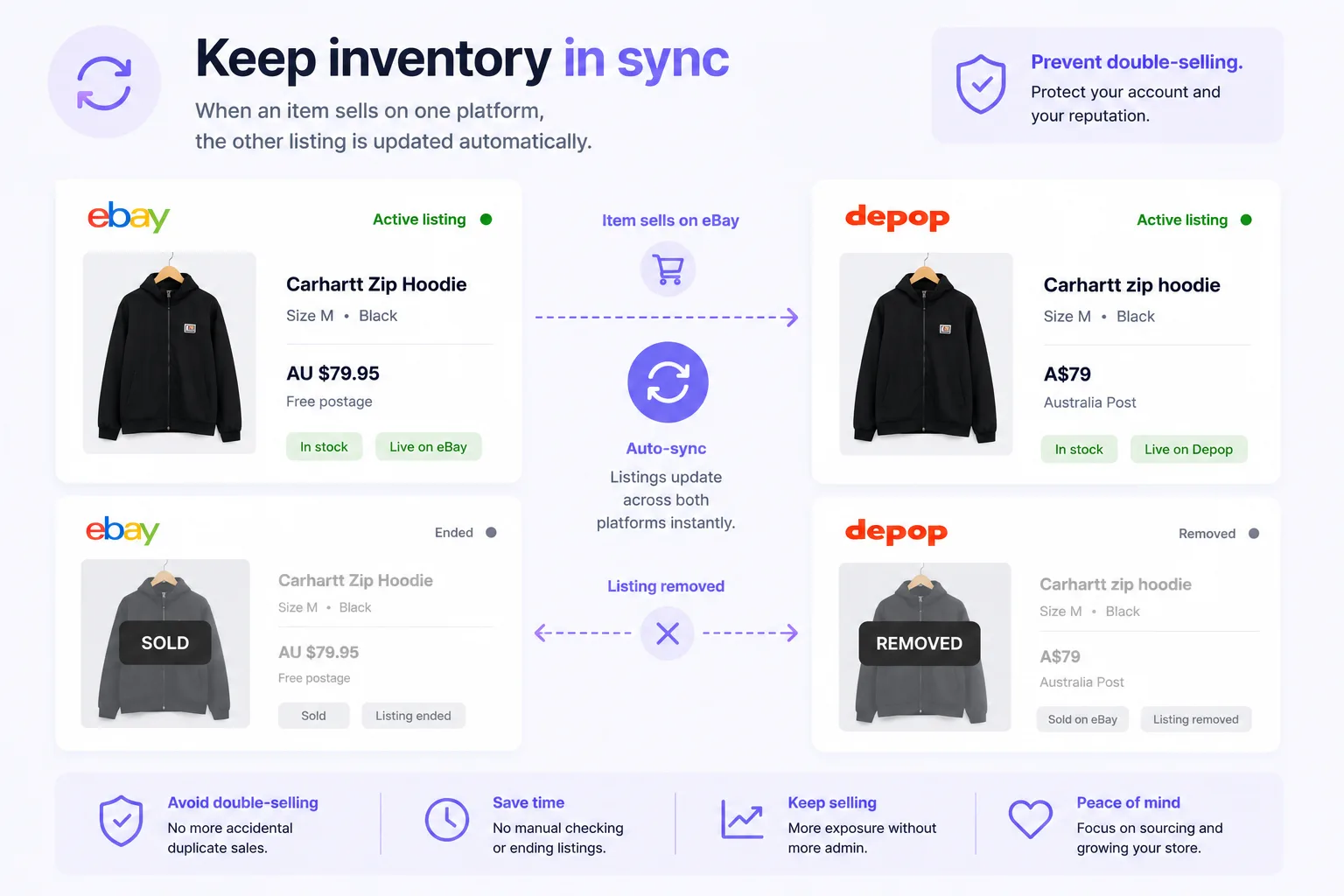
If the item sells on eBay, you need to remove it from Depop.
If the item sells on Depop, you need to end it on eBay.
If you forget, you risk selling the same physical item twice.
That is the part a lot of new cross-listers underestimate.
Cross-listing is not just about copying listings faster. It is about avoiding the mess that comes after.
What good eBay to Depop software should do
Good software to sell on both eBay and Depop should not just blast every eBay listing onto Depop.
That sounds efficient, but it is not how resale works.
A proper eBay to Depop workflow needs a few important things.
1. It should start with your existing eBay listings
A lot of Australian resellers already use eBay as their main listing platform.
That makes sense. eBay has detailed titles, item specifics, postage options, sold comps and a familiar selling flow.
So the software should not force you to rebuild your process from scratch.
The best workflow is:
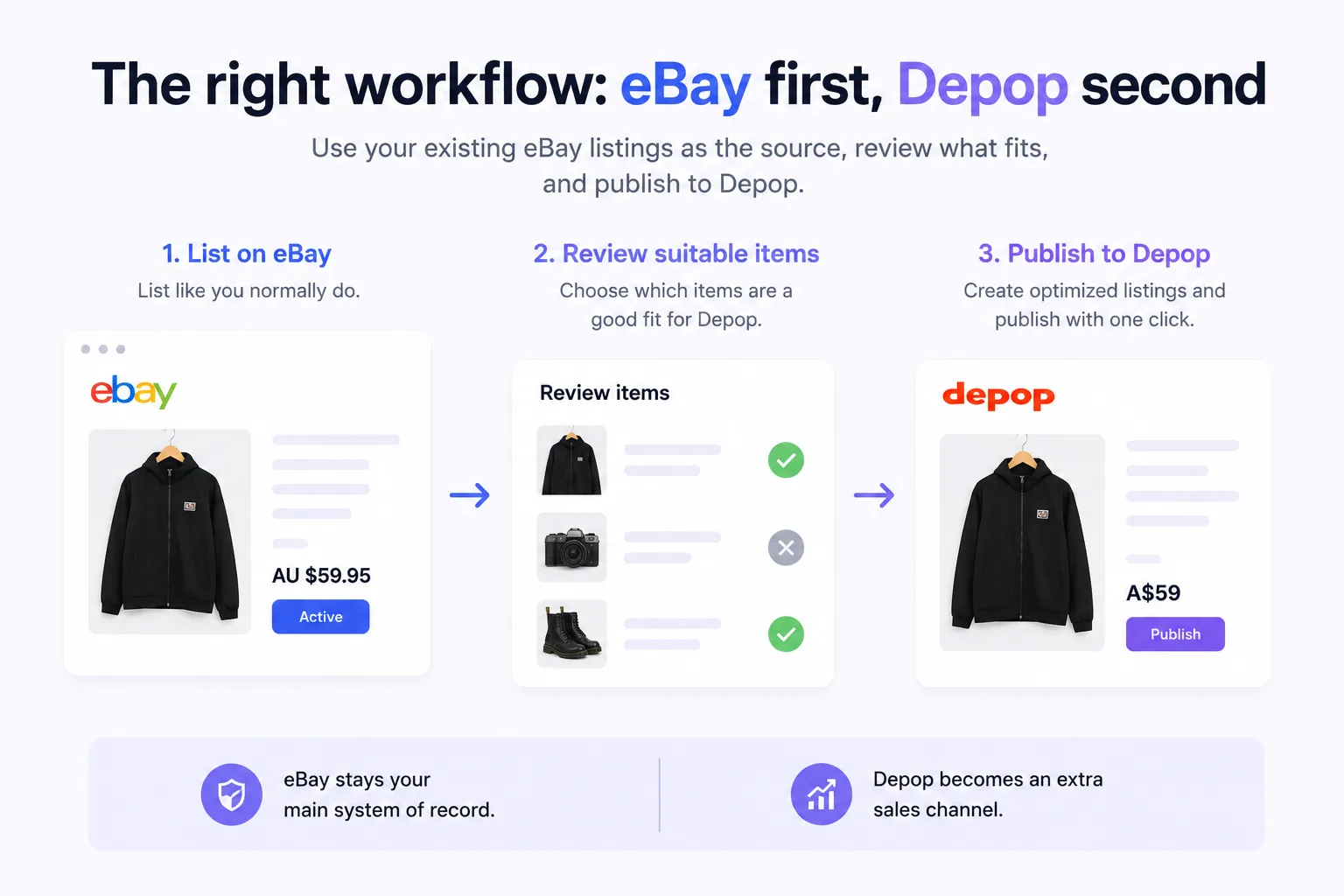
List on eBay like normal -> review suitable items -> turn them into Depop listings.
That way, eBay stays your main system of record, and Depop becomes an extra sales channel rather than a second job.
2. It should reuse your photos
Photos are one of the most time-consuming parts of reselling.
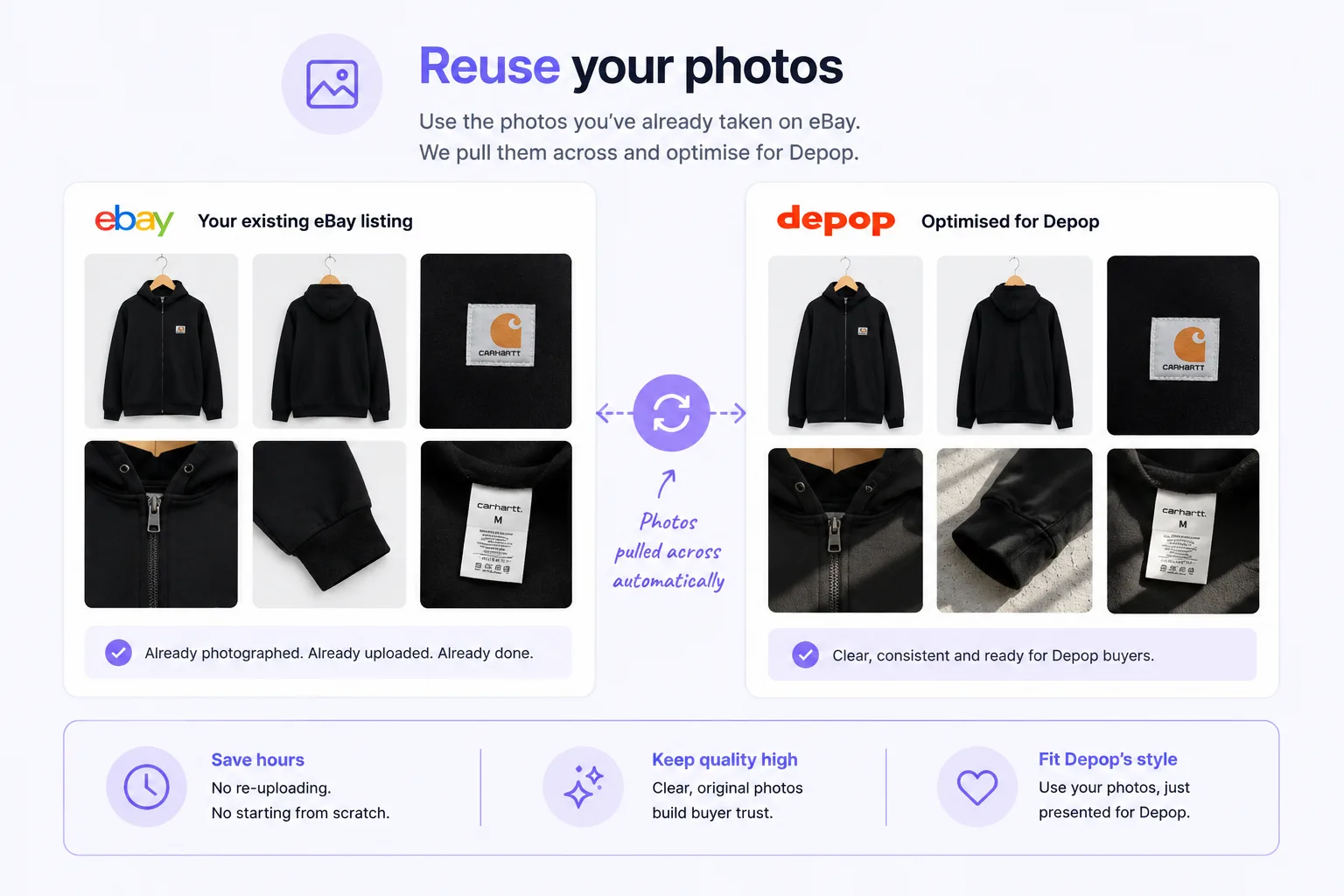
If you have already photographed the item for eBay, you should not need to upload the same images again manually.
Good cross-listing software should pull the photos from your eBay listing and prepare them for Depop.
That does not mean every image will be perfect. Depop has a more visual, style-driven feel than eBay. But for most resellers, reusing strong, clear product photos is much better than starting again.
Depop’s own seller guidance says listings should include clear photos, accurate descriptions, faults, labels and original images rather than stock photos.
So the aim should be:
Use the work you already did, but make sure the listing still feels right for Depop.
3. It should help rewrite the listing for Depop
An eBay title often looks like this:
Harley-Davidson Mens Shirt 3XL Grey Button Up Long Sleeve Casual Cotton Biker
That is good for eBay search.
But on Depop, you may want something slightly more natural:
Harley-Davidson grey button-up shirt, men’s 3XL. Great casual biker/workwear style.
The information is mostly the same, but the feel is different.
Depop recommends including searchable words, measurements, fit notes, condition, shipping information and relevant item details such as category, brand, colour and style.
So the software should not just copy and paste blindly.
It should help convert an eBay-style listing into a Depop-friendly listing.
That means keeping the important details:
- brand
- size
- condition
- measurements
- flaws
- material
- colour
- style
- postage notes
But it should remove unnecessary eBay clutter and make the listing easier to read.
For a deeper practical walkthrough, read how to cross-list eBay listings to Depop.
4. It should filter out items that do not belong on Depop
This is a big one.
Not every eBay item should go to Depop.
If you sell clothing, shoes and accessories, a lot of your stock may be suitable.
But if your eBay store also has video games, consoles, electronics, toys, DVDs, trading cards, appliance parts or random bulk lots, you need filters.
Depop’s prohibited and restricted lists include categories such as counterfeit items, drop-shipping, hazardous materials, medical devices, restricted perfumes and cosmetics, software, technology and electronics, tickets, tobacco and more.
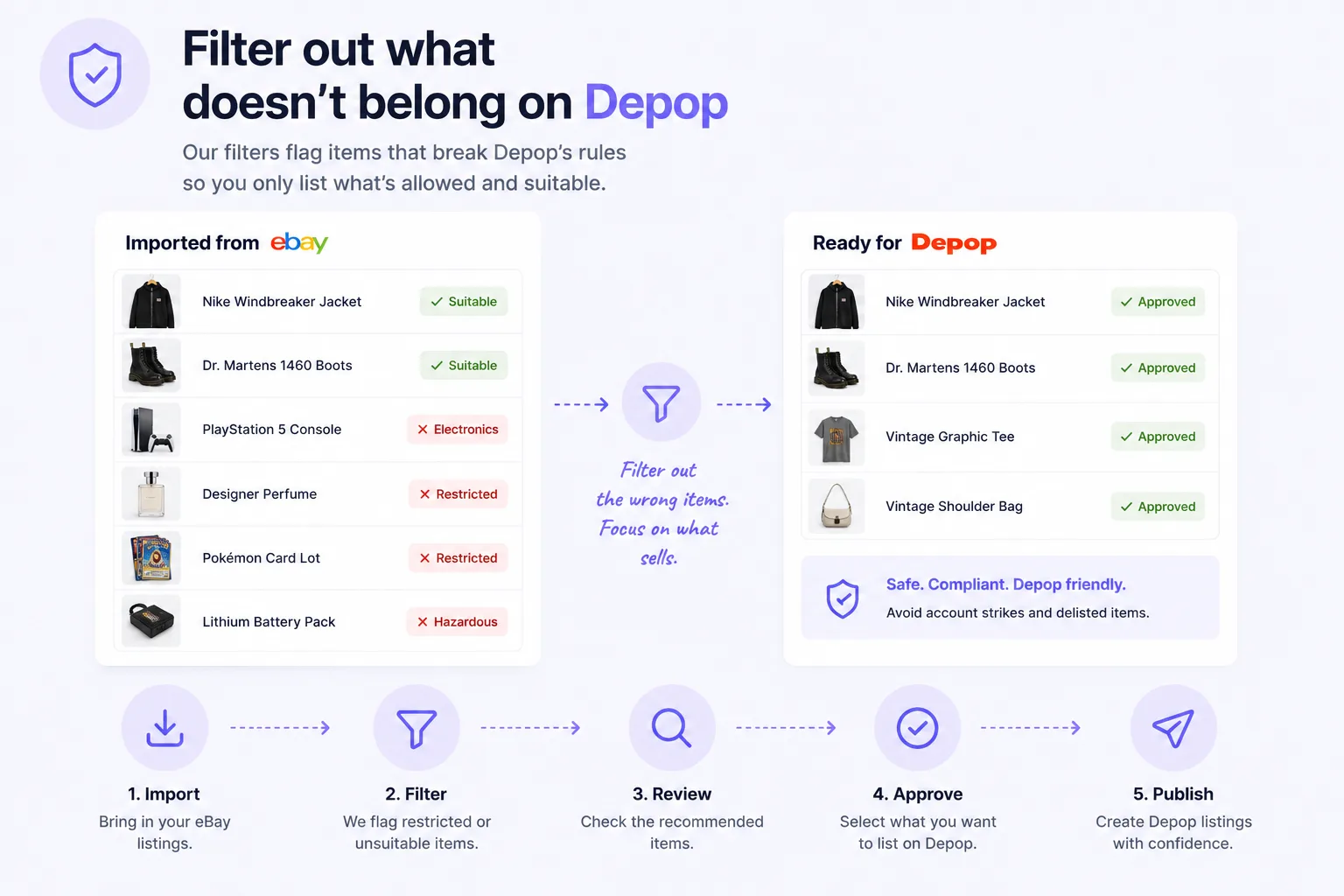
That means cross-listing software should help you avoid sending the wrong items across.
A good tool should be able to flag obvious problem categories such as:
- electronics
- gaming consoles
- batteries
- software
- counterfeit-risk items
- restricted cosmetics
- medical items
- unsafe children’s products
- anything that is not really suited to Depop’s fashion marketplace
This matters because the fastest cross-listing workflow is not always the best one.
The safest workflow is:
Import -> filter -> review -> approve -> publish.
5. It should keep inventory in sync
This is the part that matters once you start getting sales.
Selling on both eBay and Depop can increase exposure, but it also creates one major risk:
double-selling.
If you only have one physical item and it sells on eBay, the Depop listing needs to come down.
If it sells on Depop, the eBay listing needs to end.
Doing this manually is possible, but it depends on you checking every sale quickly and remembering every duplicate listing.
That might be fine for a hobby seller with five items.
It is not ideal for a reseller with 100, 300 or 800 active listings.
Good software should help prevent double-selling by syncing sold items between platforms.
That is not a nice-to-have feature.
It is one of the main reasons to use software in the first place.
6. It should suit Australian postage workflows
Australian resellers do not need a tool that assumes everything works like the US market.
You need a workflow that makes sense with Australian postage, Australia Post satchels, domestic shipping, tracking and local buyer expectations.
This is especially important if you are already buying postage through eBay or using your own Australia Post process.
eBay says some fee benefits and label experiences can depend on eligibility and seller setup, so Australian sellers should check the current eBay help page before building pricing rules around any one fee model. Depop’s Australian seller-fee change also matters because from 22 July 2026, sellers should allow for payment processing fees even when the Depop selling fee is removed.
Depop also uses buyer-side marketplace fees in some countries. Australian sellers should check the current Depop help pages and checkout flow before assuming what a buyer will see at payment time.
That does not mean you should overcomplicate pricing.
It just means software for Australian resellers should understand the local context.
Selling a $30 shirt in Australia is different from selling a $30 shirt in the US.
Postage, fees, buyer expectations and platform habits all matter.
You can also use the Listalong eBay vs Depop fee calculator when comparing item prices.
The best workflow: eBay first, Depop second
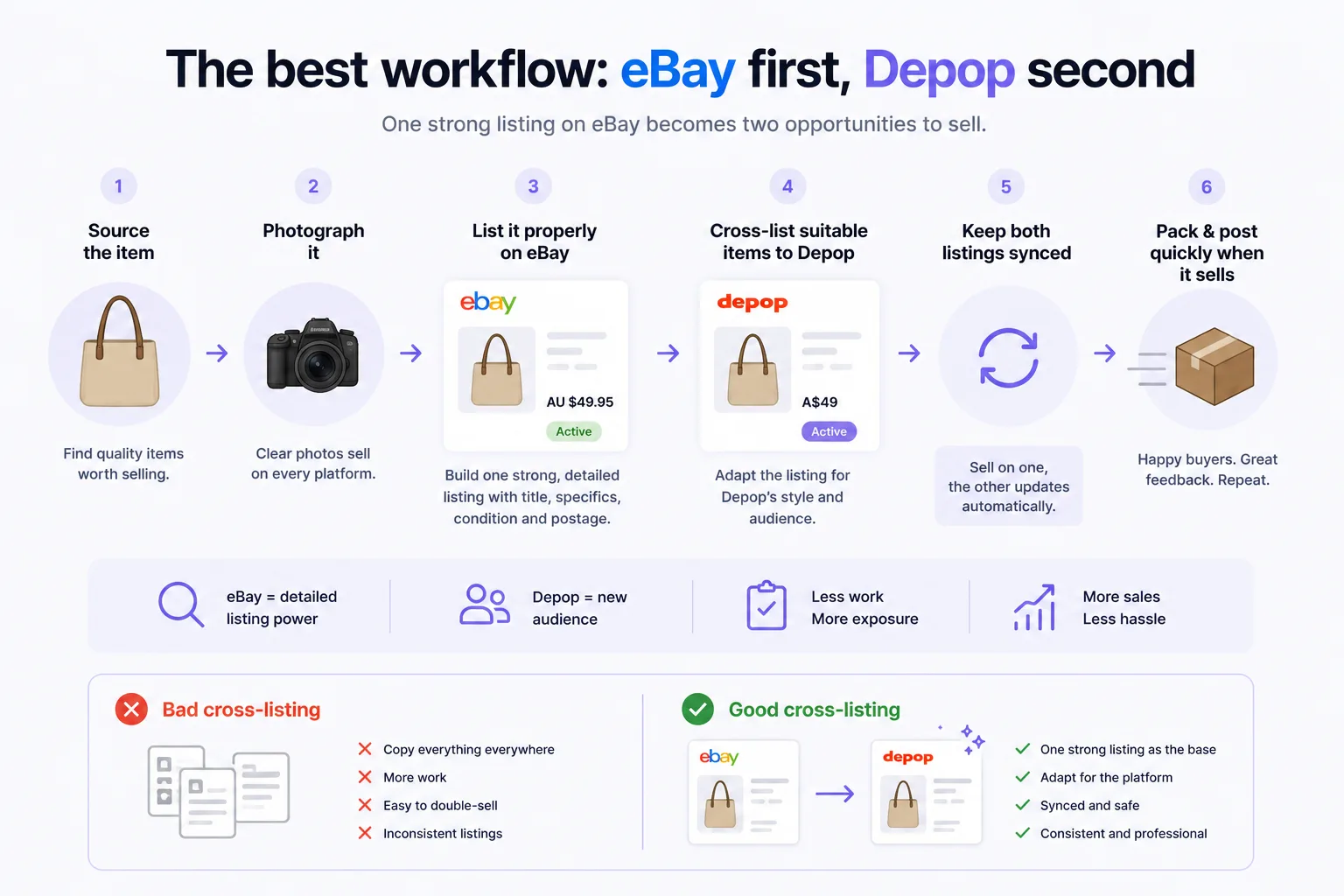
For most Australian resellers, the simplest workflow is still:
- Source the item.
- Photograph it.
- List it properly on eBay.
- Cross-list suitable fashion items to Depop.
- Keep both listings synced.
- Pack and post quickly when it sells.
The reason this works is simple.
eBay is usually the more detailed listing environment. You can build a strong listing with a searchable title, item specifics, condition notes and postage details.
Then Depop becomes the second audience.
You are not writing everything twice.
You are adapting the listing for a different marketplace.
That is the key difference.
Bad cross-listing is copying everything everywhere.
Good cross-listing is using one strong listing as the base, then adjusting it for the platform.
What items are worth cross-listing from eBay to Depop?
Depop is not the right home for every item.
The best candidates are usually fashion items with some kind of brand, style or visual appeal.
Good eBay to Depop candidates include:
- vintage graphic tees
- Harley-Davidson shirts
- Nike and Adidas jackets
- Dr. Martens boots
- Levi’s jeans
- Polo Ralph Lauren shirts
- designer dresses
- streetwear
- Y2K clothing
- workwear
- leather jackets
- bags
- sneakers
- interesting accessories
Items that are usually not worth sending to Depop include:
- most electronics
- gaming consoles
- phone chargers
- DVDs
- random household items
- car parts
- appliance parts
- generic basics with no brand appeal
- damaged items that need too much explaining
- anything restricted or prohibited by Depop
This is where a review step matters.
A tool that automatically sends every eBay item to Depop can create more problems than it solves.
A tool that helps you review and approve the right items is much safer.
Manual cross-listing vs software
You can sell on both eBay and Depop manually.
For a small number of items, that might be enough.
Manual cross-listing works if you:
- only have a few items
- are testing Depop for the first time
- do not mind copying photos and descriptions
- can keep track of sold items yourself
- check both platforms every day
Software starts to make sense when:
- you already list regularly on eBay
- you have a backlog of suitable fashion items
- you want to test Depop without doubling your listing time
- you are worried about double-selling
- you want a repeatable workflow
- you want to spend more time sourcing and listing, not copying and pasting
The real value is not just speed.
The real value is consistency.
A simple cross-listing system means you can keep listing on eBay like normal, then push suitable items to Depop as part of your routine.
Where Listalong fits
Listalong is built for Australian resellers who want eBay and Depop working together without learning a separate listing system.
It is not trying to be a huge multi-marketplace system.
It is not designed around ten different platforms.
The idea is much simpler:
One listing. Two marketplaces. More buyers.
Listalong can take an existing eBay or Depop listing and cross-list it to the other marketplace automatically, or let you choose individual items or groups yourself.
The goal is to make the eBay to Depop workflow feel natural:
- keep listing on eBay like normal
- review which items suit Depop
- avoid sending unsuitable items across
- approve before publishing
- reduce duplicate work
- help prevent double-selling
That review step is important.
A good cross-listing tool should not treat a Nike jacket, a PlayStation console and a phone charger the same way.
The Nike jacket might be perfect for Depop.
The console probably is not.
Listalong is built around that difference.
What to look for in software to sell on both eBay and Depop
Before choosing any tool, ask these questions.
Does it work with eBay Australia?
Some tools say they support eBay, but the details matter.
Australian sellers need a workflow that suits eBay.com.au, Australian postage and local resale habits.
Does it start from your existing eBay listings?
If you already list on eBay, the tool should not make you create everything again somewhere else.
Does it help with Depop-style descriptions?
Depop listings should feel readable and natural, not like a messy eBay copy-paste.
Does it filter unsuitable items?
This is especially important if your eBay store contains more than clothing.
Does it help prevent double-selling?
If the same one-off item is live on two platforms, sold-sync should be one of the main features you care about.
Does it keep things simple?
A tool should save time, not give you a second admin system to manage.
Is it worth selling on both eBay and Depop?
For the right stock, yes.
If you sell fashion, shoes, accessories or vintage clothing, Depop can give your items another audience.
But it is only worth it if the workflow stays manageable.
If cross-listing means you spend every night copying descriptions, uploading photos and checking sold items, it can quickly become more trouble than it is worth.
The best setup is one where eBay remains your main listing workflow, and Depop becomes a second channel for the items that genuinely suit it.
That is the sweet spot.
Not every item everywhere.
Just the right items in the right places.
Final thoughts
The best software to sell on both eBay and Depop is not necessarily the biggest tool.
For Australian resellers, the best tool is the one that fits how you already work.
If you already list on eBay, you should not have to start again just to test Depop.
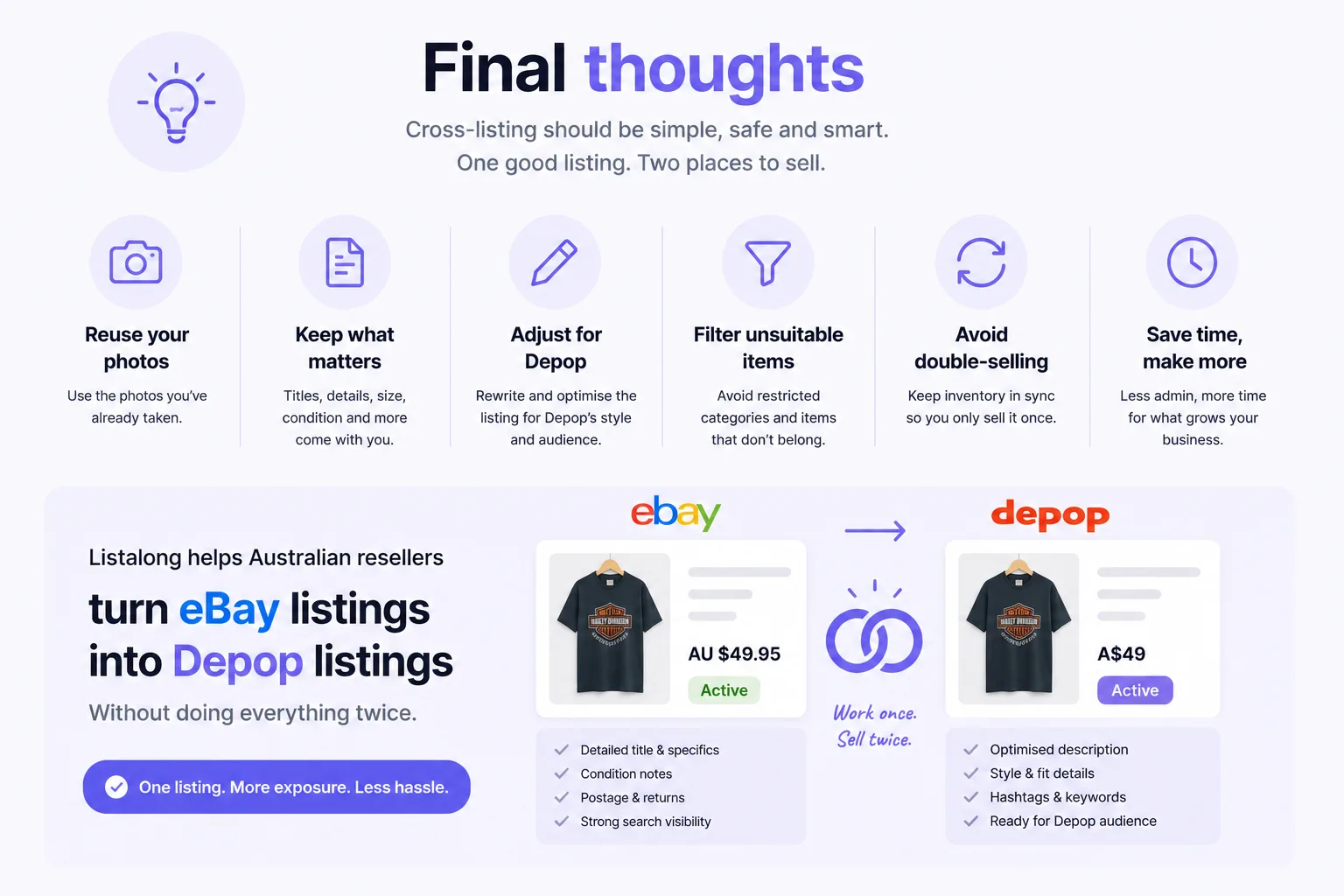
You should be able to reuse your photos, keep the important listing details, adjust the wording, filter unsuitable items and avoid selling the same item twice.
That is what cross-listing should do.
Not make reselling more complicated.
Just help one good listing work harder.
Listalong is built for Australian resellers who want one listing on eBay or Depop to reach buyers on both marketplaces without doing everything twice.
FAQ
Can I sell the same item on eBay and Depop?
Yes, many resellers list the same one-off item on more than one marketplace. The important part is making sure that when it sells on one platform, it is removed from the other platform quickly.
What is the risk of selling on both eBay and Depop?
The main risk is double-selling. If one item is live on both platforms and two buyers purchase it before you remove one listing, you may need to cancel an order. That can hurt your seller experience and create unnecessary stress.
Is Depop good for Australian resellers?
Depop can be useful for Australian resellers who sell clothing, shoes, accessories, streetwear, vintage and branded fashion. It is usually less useful for general eBay stock like electronics, games, DVDs, homewares or parts.
Should I list on eBay first or Depop first?
For many Australian resellers, eBay first makes sense because the listing can include detailed titles, item specifics, condition notes and postage information. Then suitable fashion items can be adapted for Depop.
Do I need cross-listing software?
Not if you only have a few items. But if you list regularly, have a lot of suitable clothing, or are worried about keeping sold items synced, software can save time and reduce mistakes.
Is Listalong affiliated with eBay or Depop?
No. Listalong is an independent tool and is not affiliated with eBay or Depop.
Useful next reads
- eBay to Depop cross-listing tool Australia
- How to cross-list eBay listings to Depop
- How to turn an eBay listing into a Depop listing
- How to avoid selling the same item twice
- eBay vs Depop for Australian sellers