
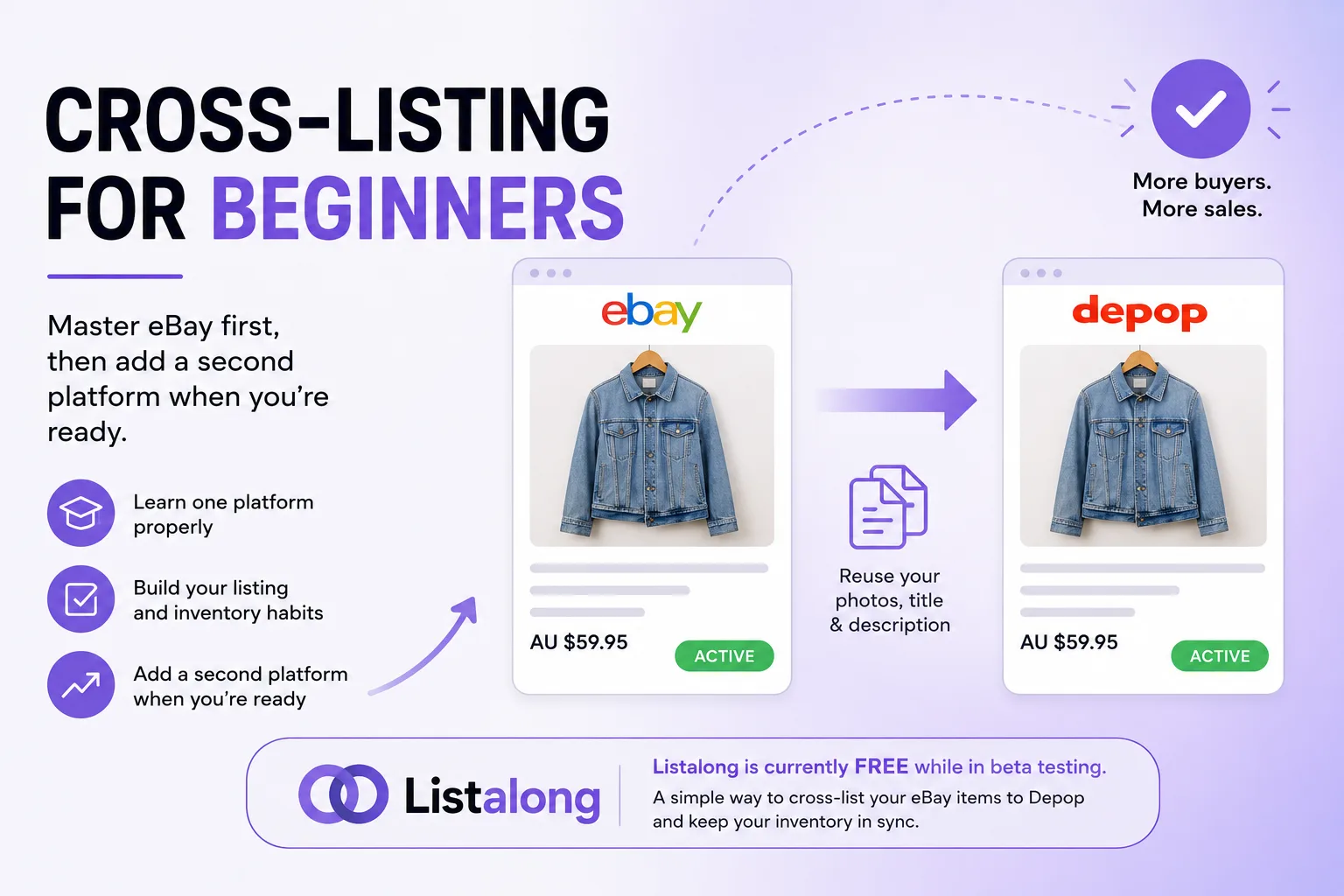
Cross-listing sounds simple.
You list one item on eBay, then list the same item on Depop, Facebook Marketplace, Grailed or another sales channel so more buyers can find it.
In theory, that means more exposure and more chances of a sale.
In real life, beginners can get tangled quickly if they try to list everywhere at once. You need to know where the item is listed, where it is stored, what price it is listed for, what postage option applies, and what needs to happen when it sells.
That is why the best beginner approach is not to list on every platform immediately.
For most Australian resellers, the safer path is:
- Master one platform first.
- Build a repeatable listing and inventory process.
- Add a second platform only when your first workflow is under control.
For many sellers, that means starting with eBay, then adding Depop for suitable fashion, shoes, vintage and streetwear items.
What is cross-listing?
Cross-listing is when you list the same physical item for sale on more than one marketplace at the same time.
A simple example:
- You have one pair of Dr. Martens boots.
- You list them on eBay.
- You also list them on Depop.
- If they sell on eBay, you remove the Depop listing.
- If they sell on Depop, you end the eBay listing.
That is cross-listing.
It can help you reach different buyer audiences, but it also creates more admin. The more platforms you use, the more important your system becomes.
Why beginners should master one platform first
A common beginner mistake is thinking more platforms automatically means more profit.
Sometimes it does. But only if you can keep up with the extra work.
Each marketplace has its own buyer behaviour, listing style, search habits, postage expectations and rules. Trying to learn eBay, Depop, Facebook Marketplace, Grailed, Shopify and every other sales channel at once can quickly become overwhelming.

For beginners, the better path is:
- Learn one platform properly.
- Build a repeatable listing process.
- Understand what sells.
- Get confident with postage and customer messages.
- Add a second platform once your first platform feels manageable.
- Only then consider adding more.
The key point:
Cross-listing works best after you already have a decent single-platform workflow.
If you are still forgetting measurements, losing track of stock, guessing postage or struggling to list consistently, adding more platforms may create more problems than sales.
Why eBay is a good first platform for Australian resellers
For many Australian resellers, eBay is a practical place to start because it teaches the basics.
You learn how to:
- write searchable titles
- add item specifics like brand, size, colour and style
- compare similar sold items
- calculate postage
- answer buyer questions
- handle orders and returns
- keep your stock organised
Those skills matter everywhere. A good eBay listing habit usually makes you a better seller on Depop, Facebook Marketplace, Etsy or your own store later.
Once you can list consistently on eBay, pack orders properly, calculate postage and find stock quickly, you are in a much better position to add a second marketplace.
Why Depop can be a good second platform
Depop is not the same as eBay.
eBay is often more search-led. Buyers may search for a specific brand, size, product type, model or replacement item.
Depop is more visual and style-led. It can work well for:
- vintage clothing
- Y2K fashion
- streetwear
- sneakers
- denim
- jackets
- branded basics
- bags and accessories
- festival-style clothing
- trend-driven pieces
That does not mean every eBay item belongs on Depop.
It means Depop can be a useful second platform when the item fits the audience.
Do not cross-list everything
This is one of the most important beginner rules.
Just because you can list something on multiple platforms does not mean you should.
A vintage Harley-Davidson shirt might make sense on eBay and Depop. A pair of RM Williams boots might make sense on both. A Country Road linen dress might also suit both audiences.
But a gaming console, camera, bulky homeware item, car part or random electronic accessory probably does not belong on Depop.
Beginners should be selective.
Good beginner categories for eBay to Depop cross-listing include:
- T-shirts
- jeans
- jackets
- hoodies
- sneakers
- boots
- dresses
- skirts
- bags
- caps
- vintage and Y2K pieces
- recognisable fashion brands
Avoid using Depop as a dumping ground for everything in your eBay store. That is how your workflow gets messy.
The safest beginner workflow
The simplest beginner workflow is not complicated. It just needs discipline.
1. List on eBay first
Create your eBay listing properly.
Use clear photos, a searchable title, item specifics, measurements, condition notes and postage details.
This becomes your main listing record.
2. Pick only the items that suit Depop
Do not cross-list your whole store.
Start with 5 to 10 items that feel like a good Depop fit. Choose items with strong photos, clear sizing and fashion appeal.
3. Reuse the work you already did
You have already taken photos.
You have already written the title.
You have already entered the brand, size, colour, condition and description.
The goal is not to do the same work twice. The goal is to reuse the work from your eBay listing and adjust it for Depop.
4. Review before publishing
Beginners should avoid blindly pushing everything to another marketplace.
Before posting to Depop, check:
- Is this item allowed on Depop?
- Does it suit Depop’s audience?
- Are the photos good enough?
- Is the size clear?
- Are measurements included?
- Is the price suitable?
- Is the condition explained clearly?
5. Track where the item is listed
Once the same item is listed in two places, you need to know that.
Use a spreadsheet, SKU, stock number, storage tub label or cross-listing tool.
Do not rely on memory.
6. Remove the other listing when it sells
This is the part that matters most.
If the item sells on eBay, the Depop listing needs to come down. If the item sells on Depop, the eBay listing needs to end.
That is how you avoid selling the same item twice.
The biggest beginner risk: double-selling
Double-selling is when the same physical item sells on two platforms before you remove the duplicate listing.
Example:
- You list a denim jacket on eBay and Depop.
- It sells on eBay on Friday night.
- You forget to remove it from Depop.
- It sells on Depop on Saturday morning.
- Now you have two buyers and only one jacket.
That creates a bad experience for the buyer and a stressful situation for you.
This is the main reason beginners need a system before cross-listing heavily. Manual tracking can work when you only have a few items. Once you have dozens or hundreds of listings, it becomes much easier to miss something.
Manual cross-listing vs using a tool
You can cross-list manually.
For a small number of items, that might be fine.
Manual cross-listing usually means:
- downloading or reusing photos
- copying the title
- rewriting the description
- adding size, brand and condition again
- checking both platforms after a sale
- removing sold items manually
- tracking everything in a spreadsheet
That works when you are testing the idea. But it becomes repetitive if you are listing regularly.
This is where a tool can help.
Listalong is built for Australian resellers who use eBay and Depop and want the two marketplaces working together.
Instead of rebuilding each listing from scratch, Listalong can cross-list an existing eBay or Depop listing to the other marketplace automatically, or let you choose individual items or groups yourself.
It is not designed to make beginners sell everywhere at once.
It is designed to help with the next logical step:
You have learned eBay. Now you want to add Depop without creating a second job.
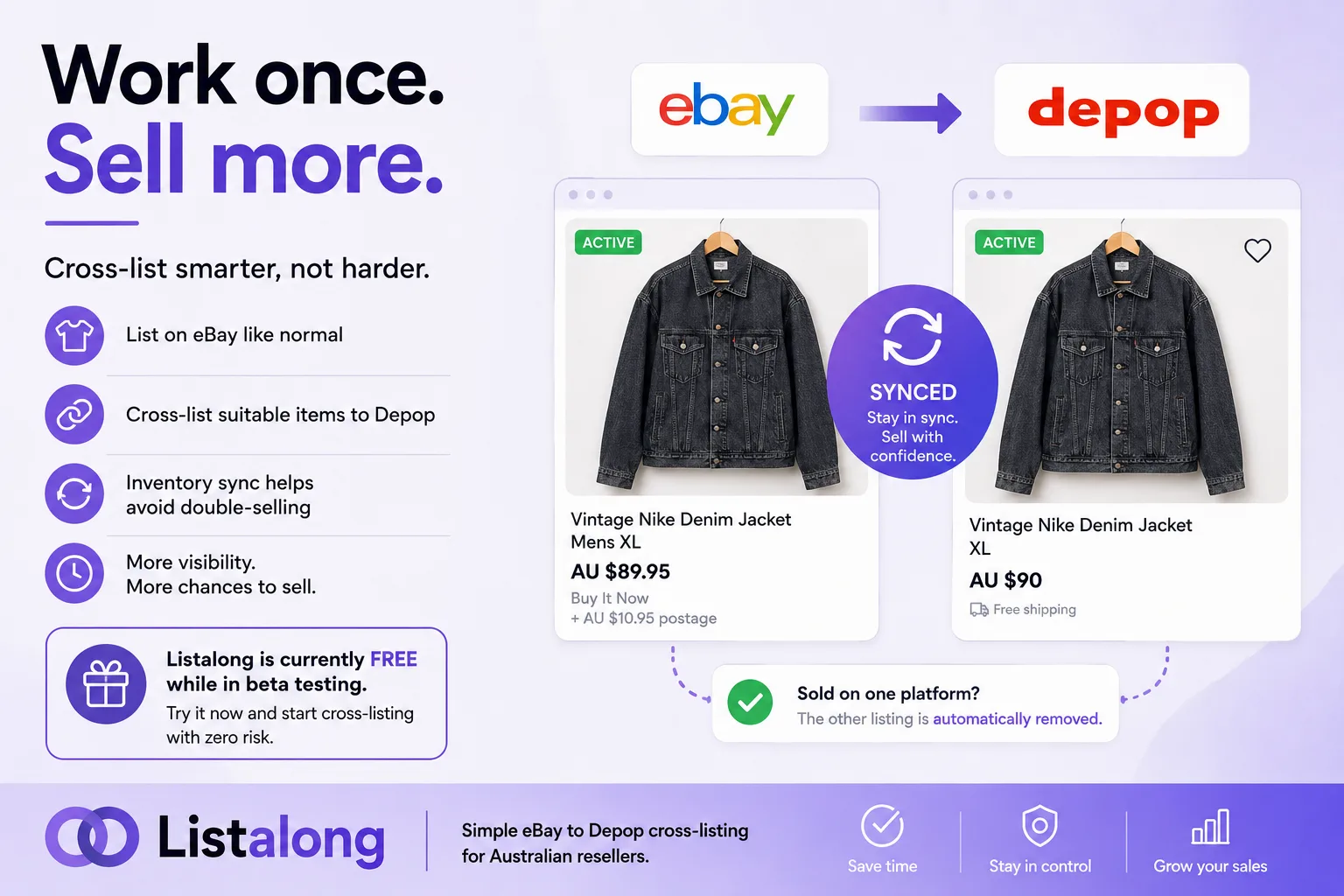
Listalong is available with a 14-day free trial, making it a low-risk way to try cross-listing between eBay and Depop before committing to another paid tool.
When should you add a second platform?
You should consider adding a second platform when:
- you can list on eBay without overthinking every step
- you understand postage costs
- you know where your stock is stored
- you can find sold items quickly
- you are listing consistently
- you know which brands and categories work for you
- you can handle buyer messages and orders
- you have a system for removing sold items
You probably should not add a second platform yet if:
- you regularly lose stock
- you forget to post orders
- your postage pricing is still guesswork
- your listings are missing basic details
- you do not know where each item is stored
- you are already overwhelmed by one marketplace
Cross-listing is a growth step, not a shortcut.
It works best when your foundation is already solid.
When should you add more than two platforms?
Beginners should be careful here.
Going from one platform to two is already a big step. Going from two platforms to five is a different level of inventory management.
Before adding more marketplaces, ask:
- Is the extra platform likely to suit my stock?
- Will it bring different buyers?
- Can I keep inventory synced?
- Can I manage the extra messages?
- Can I remove sold listings quickly?
- Is the extra admin worth the extra sales?
For most small Australian resellers, the sensible progression is:
- Start with eBay.
- Add Depop when you are ready.
- Only add more marketplaces once you have proven that two-platform selling is manageable.
That is much safer than trying to become a multi-channel seller from day one.
Beginner cross-listing checklist
Before you cross-list an item, check:
| Question | Why it matters |
|---|---|
| Is it already listed properly on eBay? | Your eBay listing becomes the source record. |
| Does it suit Depop’s audience? | Not every eBay item belongs on Depop. |
| Is it allowed on Depop? | Marketplace rules still apply. |
| Are the photos clear? | Depop is visual, and poor photos reduce trust. |
| Is the size obvious? | Clothing buyers need sizing confidence. |
| Are measurements included? | Measurements reduce questions and returns. |
| Is the condition clear? | Flaws should be obvious before purchase. |
| Is the price realistic? | The same price may not work on every marketplace. |
| Do you know where the item is stored? | More platforms make inventory discipline more important. |
| Can you remove the other listing when it sells? | This is how you avoid double-selling. |
If you cannot answer those questions, fix the listing before cross-listing it.
Best items to start with
If you are new to cross-listing, start with items that are easy to photograph, easy to store and easy to post.
Good starter items include:
- branded T-shirts
- denim jeans
- lightweight jackets
- hoodies
- sneakers
- boots
- mini and midi dresses
- caps
- shoulder bags
- vintage shirts
- streetwear brands
- Y2K-style pieces
Avoid starting with fragile, bulky, high-risk or rule-sensitive items.
Your first cross-listed items should be simple.
Final verdict
Cross-listing is not about doing twice as much work.
It is about making the work you already did go further.
Beginners should not rush into every marketplace at once. The smarter path is to master one platform first.
For many Australian resellers, that means learning eBay properly: titles, item specifics, photos, postage, pricing, storage and order handling.
Once that feels manageable, adding Depop can be a practical next step, especially for fashion, vintage, streetwear, shoes, bags and trend-driven pieces.
Start small. Cross-list suitable items only. Keep your inventory organised. Avoid double-selling.
Then, once eBay and Depop feel under control, you can decide whether adding more platforms is actually worth it.
If you already list on eBay or Depop and want a simpler way to reach buyers on the other marketplace, Listalong is available with a 14-day free trial that starts when both eBay and Depop are connected. Create free account.
You already listed it once. You should not have to do it all again.