
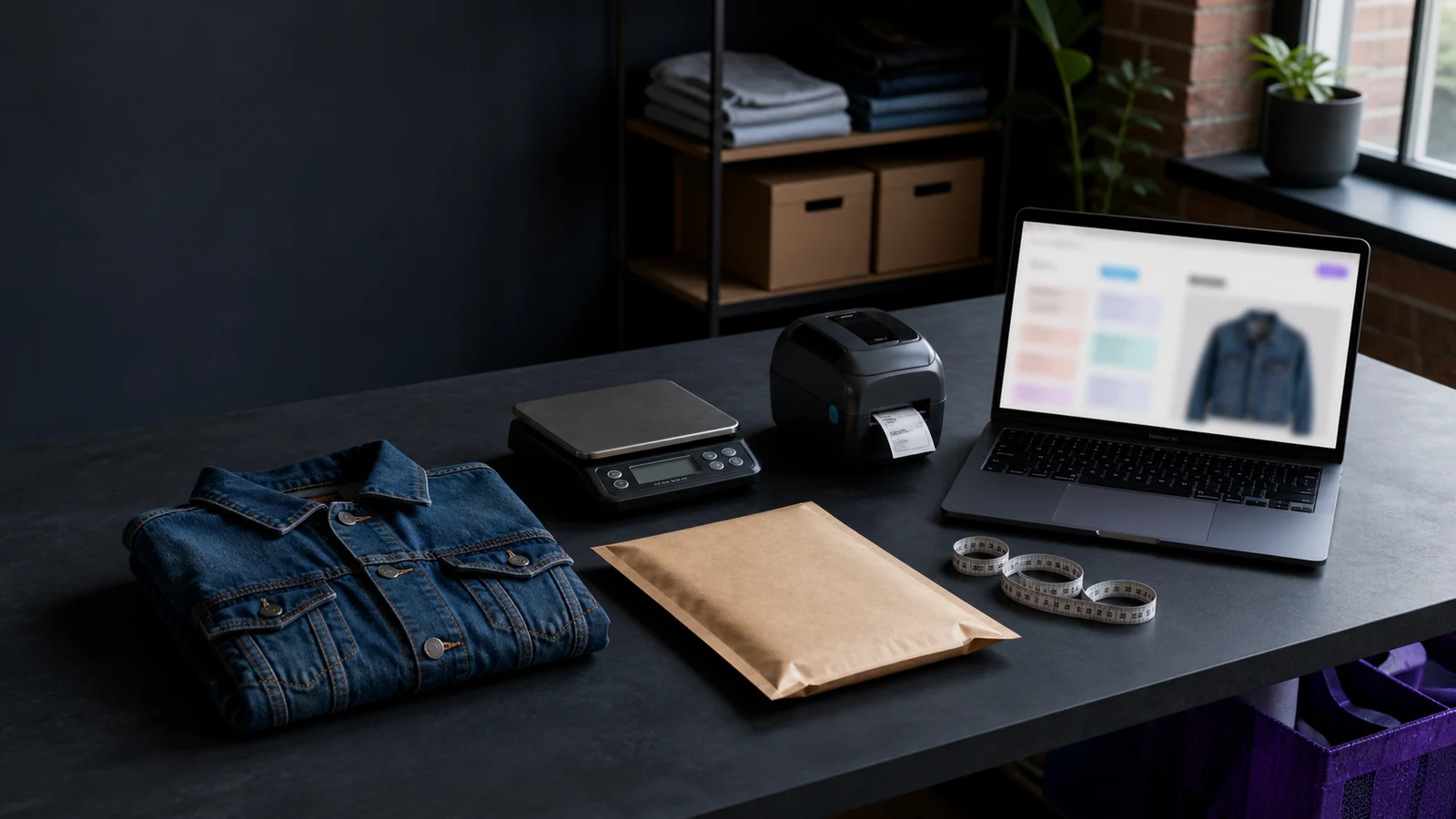
A cross-listing tool reuses your photos, title and description across marketplaces. For Australian sellers, the useful comparison is whether it supports your exact accounts, fits your listing routine and helps you handle sold stock.
Our shortlist at a glance
This is an honest comparison, not a pretend independent review. We built Listalong, so you should know where our bias sits. We have described Listalong’s limits as well as its strengths, and checked competitor details against their public websites and help pages on 19 August 2026.
We ranked each option by the things that matter to an Australian reseller:
- evidence that Australian marketplace accounts are supported
- how well it fits an eBay-to-Depop or multi-marketplace workflow
- what happens when a cross-listed item sells
- the amount of setup and ongoing admin
- whether the cost makes sense for a small reseller
Prices below are the provider’s advertised starting position and may be charged in US dollars. Check the checkout total and current plan limits before subscribing.
| Tool | Australian account position | Best suited to | Advertised starting price* |
|---|---|---|---|
| Listalong | Built for eBay Australia and Depop | Cross-listing in either direction, automatically or by selection | 14-day free trial |
| Crosslist | Explicitly supports Australia | Sellers using several supported marketplaces | US$29.99/month |
| PrimeLister | Documents eBay Australia support | Higher-volume eBay-led sellers | US$29.99/month |
| Shopfront | Australian-focused and multi-region | Larger multi-channel resale operations | US$30/month |
| Vendoo | Lists eBay and Depop, but its public help page does not clearly confirm the Australian variants | Sellers who have confirmed their exact accounts with Vendoo | US$14.99/month |
| List Perfectly | Official support is limited to US-based marketplaces | Sellers using supported US accounts | Not recommended for eBay.com.au |
| Manual listing | Works anywhere | Testing only a handful of items | Free, but slow |
*Public prices checked 19 August 2026. Trial terms, currencies, taxes and plan limits can change.
Choose a starting point in 30 seconds
You do not need to compare every feature in every plan. Start with the job you actually need to complete:
| Your situation | Sensible starting point | Why |
|---|---|---|
| Your main marketplaces are eBay and Depop | Listalong | Focused two-marketplace workflow, with a 14-day free trial |
| You need several marketplaces with explicit Australian availability | Crosslist | Broader platform coverage and a documented Australian option |
| You run a higher-volume, eBay-led operation | PrimeLister | Broader automation and documented eBay Australia support |
| You operate a larger Australian multi-channel business | Shopfront | Australian-focused inventory and marketplace workflow |
| You use supported US marketplace accounts | Vendoo or List Perfectly | Broad tools, but regional support needs to match your accounts |
| You only want to test two or three listings | Manual cross-listing | No subscription or setup, provided you remove sold items promptly |
If the first row describes you, choose the workflow that matches where you list first: eBay to Depop or Depop to eBay. You can cross-list automatically or choose items yourself, and no access code is required.
You may also see Flyp recommended in overseas reseller groups because it advertises a long free trial and a low monthly price. It is not included in the Australian shortlist because Flyp’s current Crosslister support is USA-only, despite listing eBay and Depop among its marketplaces.
For many Australian resellers, the real question is not “which tool has the most features?”
The better question is:
Which tool matches the way I already list?
If you already list everything on eBay and only want to push suitable fashion, shoes or accessories to Depop, you may not need a full multi-marketplace command centre. A simpler eBay to Depop cross-lister may be enough.
What Australian resellers should look for
Australian sellers have different needs from US sellers.
A lot of reseller software is built around marketplaces like Poshmark, Mercari, Whatnot or Vinted. Some of those platforms are unavailable in Australia or are not the main place local resellers list stock. Vinted itself launched here in July 2026, but that does not mean every tool supports its Australian site—and Vinted’s ordinary Australian accounts prohibit commercial selling. See our Depop versus Vinted Australia comparison for the policy distinction.
That matters because you do not want to pay for a tool based around marketplaces you are not going to use.
Before choosing a cross-listing tool in Australia, check these five things.

1. Does it support the marketplaces you actually use?
For Australian resellers, the most useful marketplaces are usually:
- eBay Australia
- Depop
- Facebook Marketplace
- Etsy, for handmade, vintage or niche products
- Shopify, if you have your own store
- Grailed, for some streetwear and menswear
- local selling channels, depending on the category
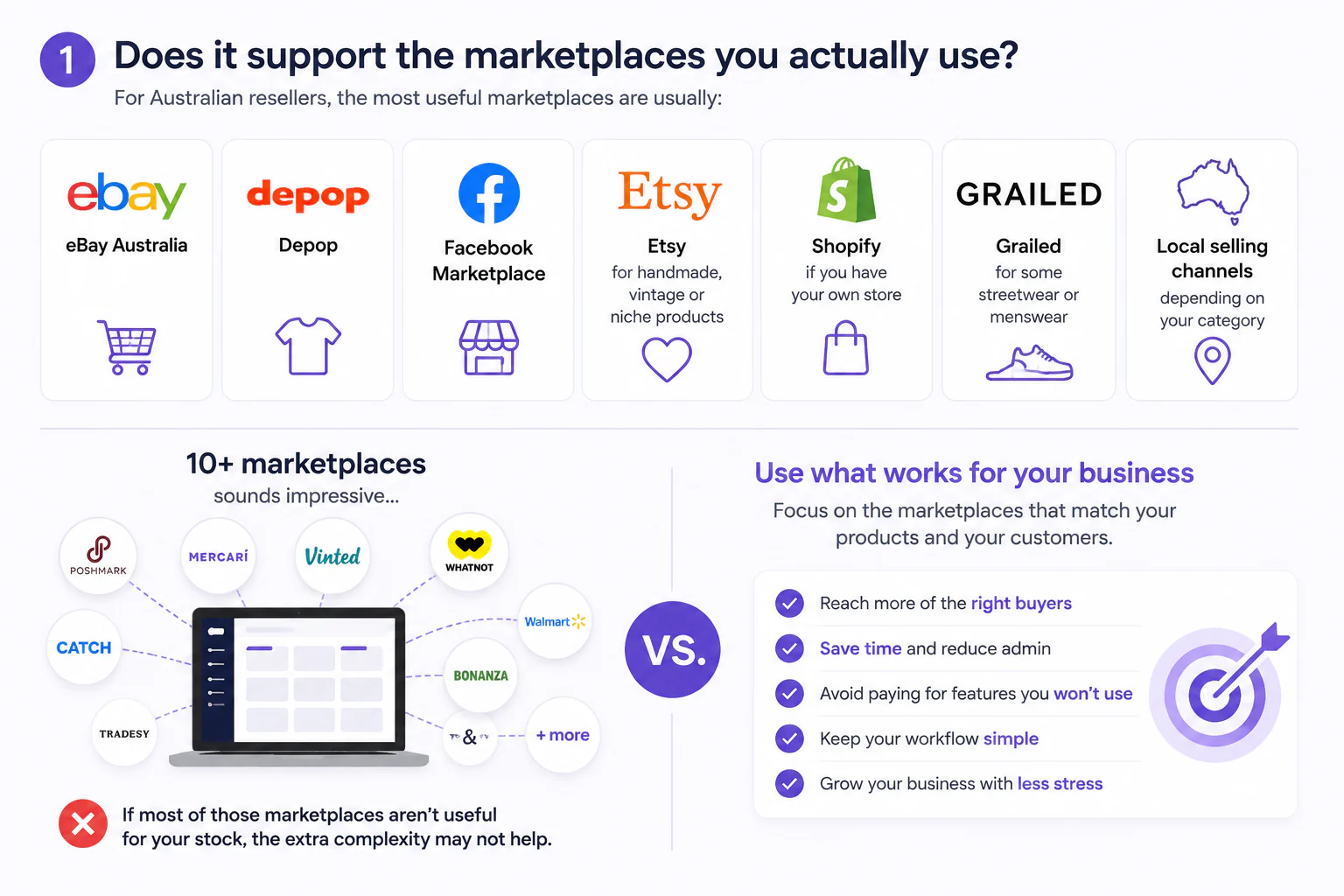
A tool supporting 10 or more marketplaces sounds impressive, but if most of those marketplaces are not useful for your stock, the extra complexity may not help.
Good software should match your real workflow, not a theoretical workflow.
2. Does it work with your starting platform?
Some sellers create listings inside the cross-listing tool first, then publish out to multiple marketplaces.
Other sellers already have a normal process. For example, many Australian resellers list on eBay first because they already understand eBay titles, item specifics, postage, offers and sold comps.
If your stock already starts on eBay, the tool should make that easier. It should not force you to rebuild your entire process before you can test another marketplace.
3. Does it help avoid double-selling?
Double-selling is one of the biggest risks of cross-listing.
If the same physical item is listed on eBay and Depop, there is still only one item on your shelf. If it sells on eBay, the Depop listing should come down. If it sells on Depop, the eBay listing should end.
Without that process, cross-listing can create more stress than it solves.
At minimum, you need a manual checklist. Ideally, your tool should help remove or end the matching listing after a sale.
4. Is it priced for your volume?
If you list hundreds of items per month, a larger paid tool may make sense.
If you are a small reseller listing casually after op shop trips, a bigger monthly subscription can eat into your profit quickly. A $50 item with $15 profit does not leave much room for expensive software if you only list a small number of items.
Do the maths based on your real store:
- How many items do you list each month?
- How much time does cross-listing save?
- How much extra profit does the second marketplace bring in?
- How many extra sales would you need to cover the software cost?
5. Is it beginner-friendly?
Many resellers do not want another complicated dashboard. They just want to stop copying photos and descriptions manually.
The best tool is the one you will actually use every week.
If the setup feels heavier than the problem, you may not stick with it.
Best cross-listing tools for Australian resellers
There is no single best tool for every seller. A high-volume reseller with five marketplaces has different needs from a part-time seller who only wants to test Depop.
Here is the practical breakdown.
Listalong: best for a focused eBay-and-Depop workflow
Best for: Australian sellers who use eBay and Depop without needing a long list of extra marketplaces.
Listalong is built around a focused workflow:
- Start with an existing eBay or Depop listing.
- Reuse useful listing data for the other marketplace.
- Cross-list automatically or choose individual items or groups yourself.
- Check any destination-specific warnings.
- Use linked sold-item sync to reduce double-selling risk.
It is not trying to be a giant multi-marketplace platform. That is the point.
For Australian resellers, this can be a strength. Keep listing in eBay or Depop as you normally do while Listalong manages suitable listings on the other marketplace.
Listalong is aimed at the seller who thinks:
I already did the work once. I do not want to upload the same photos, title, brand, size, description and price again on the other marketplace.
What Listalong looks like in practice
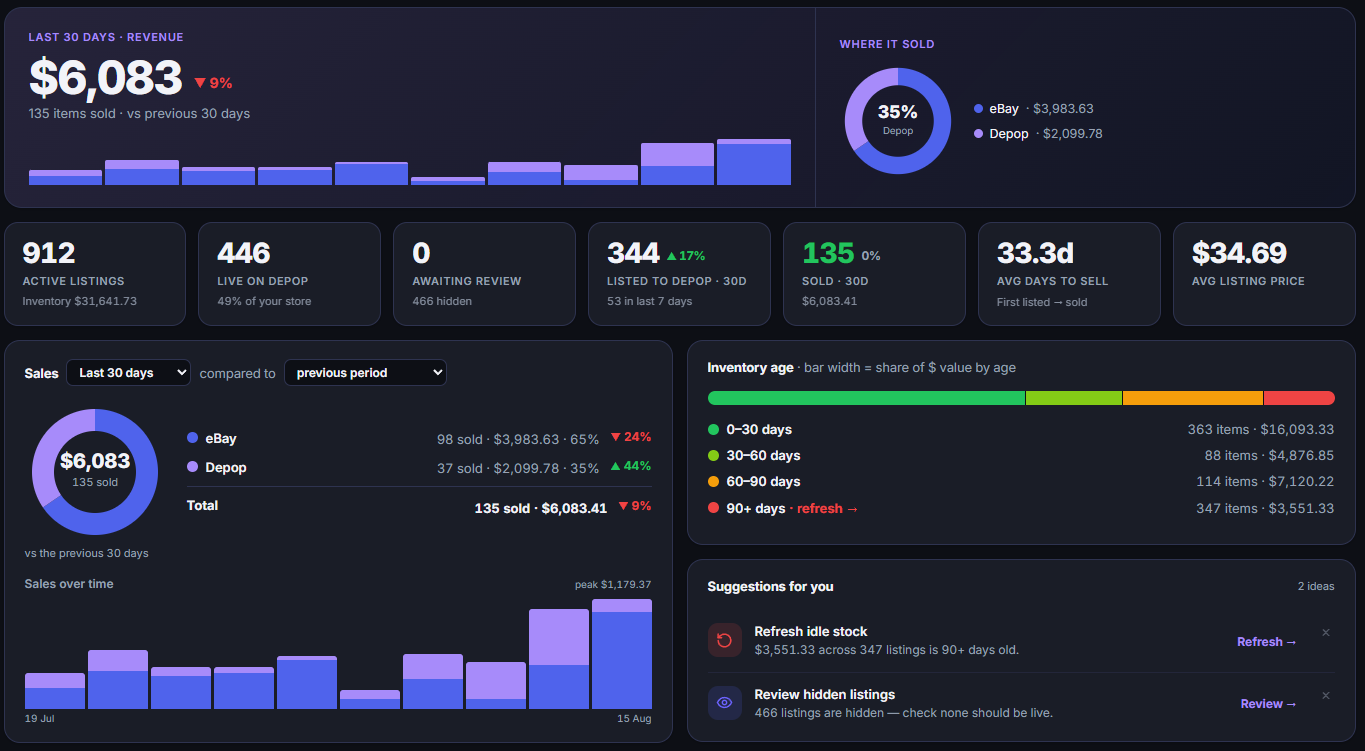
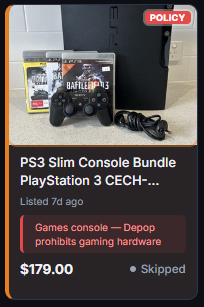
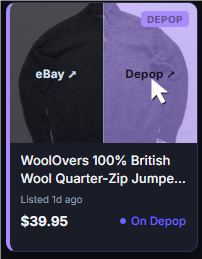
The screens below come from a working Australian reseller account. The dashboard brings eBay and Depop activity together, while individual listing cards show whether an item was skipped for policy reasons, made live or is old enough to refresh.

Listalong may suit:
- eBay and Depop sellers who want the other marketplace managed for them
- resellers with fashion, shoes, accessories or vintage items
- sellers who want automatic cross-listing with the option to choose items themselves
- sellers worried about double-selling
- Australian resellers who do not need ten marketplaces
It may not be the best fit if you want advanced warehouse features, team accounts, bulk enterprise inventory tools or support for every marketplace from day one.
Best use case: you keep listing on eBay or Depop as normal, while Listalong manages suitable listings on the other marketplace without making you learn a new listing system.
Listalong is available with a 14-day free trial that starts when both eBay and Depop are connected. Create free account; no access code is required.
Vendoo: broad features, but confirm Australian account support
Best for: resellers who want a broad multi-marketplace cross-listing and inventory platform.
Vendoo is one of the better-known reseller cross-listing tools. Its public product pages position it around cross-listing, inventory management, importing, bulk actions, analytics and multi-channel workflows.
That makes Vendoo a stronger option for sellers who want more than a simple eBay to Depop workflow.
Vendoo may suit sellers who:
- list on several marketplaces
- want inventory management in one place
- use bulk listing or delist/relist features
- want analytics and broader sales tracking
- are building a larger resale operation
For Australian resellers, the main question is whether you actually need that much platform coverage. If you only care about eBay and Depop, Vendoo may be more tool than you need.
That does not make it bad. It just means it is built for a broader use case.
There is also a regional question to settle before paying. Vendoo’s public marketplace list includes eBay and Depop, but it does not clearly state that eBay.com.au and Australian Depop accounts are supported. Ask Vendoo about your exact accounts and test the publishing flow during the trial rather than relying on marketplace logos alone.
Best use case: you are serious about multi-platform selling and want one central system for listing, tracking, delisting and analysing inventory across several marketplaces.
List Perfectly: a strong US tool, not an Australian recommendation
Best for: sellers using supported US-based marketplace accounts who want a large all-in-one listing catalogue.
List Perfectly is another major reseller software platform. Its public pricing and feature pages promote broad marketplace support, catalogue-style workflows, inventory features, bulk actions and listing assistance.
List Perfectly may suit sellers who want a central catalogue and a broader set of tools rather than a narrow eBay to Depop workflow.
Australian sellers need to check the regional limitation first. List Perfectly’s current FAQ says it is officially built, tested and supported for use in the United States. Its contact page says it fully supports US-based marketplaces and shops, and gives eBay Canada as an example of a regional eBay channel it cannot support.
If these are the two broad tools on your shortlist, read the detailed Vendoo vs List Perfectly comparison for Australian sellers before opening a trial or paying for a plan.
That means “supports eBay” should not be treated as confirmation that it supports eBay.com.au.
It can be a good fit for:
- sellers managing a larger inventory
- sellers using multiple marketplaces
- sellers who want to build listings inside a central catalogue
- sellers who need more advanced workflow features
- sellers who are comfortable with a bigger software system
For Australian sellers, ask support about your exact accounts before considering the setup and monthly cost. Our full guide examines whether List Perfectly works in Australia, including eBay Australia, Depop, pricing and Auto Delist.
Choosing between it and Crosslist? The Crosslist vs List Perfectly Australia comparison shows why two similar international feature lists can produce very different answers for an eBay.com.au account.
If you are only listing 20 or 30 items and mainly want to try Depop from eBay, a full catalogue system may feel heavier than necessary.
Best use case: you want a full reseller listing system and your marketplace accounts fall within List Perfectly’s supported region.
Crosslist: best broad tool with explicit Australian support
Best for: sellers who want broad marketplace support and a cross-listing app that publicly mentions Australia.
Crosslist positions itself as a cross-listing app for creating one listing and publishing across multiple marketplaces. Its public site has marketed broad marketplace coverage and availability in countries including Australia.
For Australian resellers, that is useful because many reseller tools are US-first.
Our full Crosslist Australia review checks its eBay.com.au setting, Depop workflow, current plan limits and the practical difference between server-side and extension-based automatic delisting.
Crosslist may suit sellers who:
- want to publish to many marketplaces
- are comfortable using a dedicated cross-listing app
- have enough volume to justify the monthly cost
- want to test multiple channels beyond eBay and Depop
- prefer a broader cross-posting tool over a focused eBay to Depop workflow
The main downside for a smaller Australian seller is the same as with other broad tools: if your real workflow is only eBay to Depop, you may be paying for more platform coverage than you need.
Crosslist currently advertises plans from US$29.99 per month, with listing limits varying by plan. Its site also advertises automatic sales detection, mobile access, bulk actions and support for Australia. Those features make it the strongest broad comparison here, but they also make it a larger system than a two-marketplace seller may need.
Best use case: you want a general-purpose cross-listing app with wide marketplace support and Australian availability.
PrimeLister: best for higher-volume eBay-led sellers
Best for: higher-volume Australian sellers who use eBay.com.au and want broader inventory and automation tools.
PrimeLister’s documentation explicitly includes an eBay AU connection and refers to the eBay.com.au login. That is stronger regional evidence than a generic eBay logo.
It also supports Depop, Etsy, Shopify, Grailed and other marketplaces, although Australians should test their exact accounts. Some regional documentation is stale: PrimeLister still mentions Poshmark Australia even though that marketplace closed in 2023.
PrimeLister may suit sellers who:
- have enough inventory for bulk actions to save meaningful time
- want cloud-based automatic delisting for compatible one-off items
- work from a computer with Google Chrome
- use several supported sales channels rather than only eBay and Depop
- are comfortable with a subscription charged in US dollars
PrimeLister currently lists a Basic cross-listing plan at US$29.99 per month and a Pro plan at US$49.99 per month. Multi-quantity listings need manual handling in Auto Delist, and Facebook Marketplace is excluded from automatic delisting.
Our full PrimeLister Australia review checks the Australian evidence, Depop questions, pricing inconsistency, mobile limits and a practical trial plan.
Best use case: you run a larger multi-channel inventory, eBay Australia is central to it and the time saved can justify a US-dollar subscription.
Shopfront: best for an Australian multi-channel operation
Best for: Australian sellers who want a broader inventory and cross-listing system.
Shopfront’s current site is aimed directly at Australian resellers. It promotes cross-listing across eBay, Depop, Grailed, Shopify, Facebook Marketplace and Vestiaire Collective, along with inventory sync, AI listing assistance and sales reporting.
Its entry Pro plan is advertised at US$30 per month for up to 200 active products. That makes Shopfront a more substantial option than Listalong: it may suit a reseller who wants one central operation, but it may be unnecessary if the main job is keeping eBay and Depop working together.
Shopfront may suit sellers who:
- want a tool built with Australian sellers in mind
- sell across several supported channels
- need inventory sync, reporting or team workflows
- have enough stock to justify a larger system and monthly subscription
For small resellers, it may still be more tool than needed if the goal is simply “take my eBay listing and put it on Depop”.
Our Shopfront alternative comparison looks more closely at where its broader multi-channel approach differs from Listalong’s focused eBay and Depop workflow.
Best use case: you want an Australian-oriented multi-channel system rather than a focused eBay-to-Depop helper.
Manual cross-listing: workable for a tiny test
Best for: very small sellers testing only a few items.
Manual cross-listing costs nothing, but it costs time.
You can list an item on eBay, then manually copy the photos, title, brand, description, size and price into Depop. This might be fine for five items. It becomes painful at 50 items.
Manual cross-listing also increases the risk of mistakes:
- forgetting to remove a sold item
- copying the wrong size
- missing condition notes
- choosing the wrong category
- forgetting to update price changes
- selling the same item twice
Manual listing is best when you are still testing whether cross-listing is worth doing. Once you know that a second marketplace can generate sales, software becomes easier to justify.
Best use case: you have only a few items and want to test Depop before relying on a tool.
Which tool is best for eBay to Depop cross-listing?
If your main goal is specifically eBay to Depop cross-listing, be careful not to overbuy.
A broad marketplace tool may be useful if you want eBay, Depop, Etsy, Facebook Marketplace, Shopify, Grailed and more.
But if your actual workflow is:
- List on eBay.
- Reuse the listing for Depop.
- Review before publishing.
- Remove the item from the other platform when it sells.
Then a focused tool like Listalong may make more sense than a full multi-marketplace system.
The goal is not to collect software features. The goal is to make listing faster without creating extra admin.
Which tool is best for high-volume resellers?
If you list hundreds of items per month and sell across multiple platforms, broader tools like Vendoo, PrimeLister, Crosslist or Shopfront may be worth comparing. Check the regional support of each destination rather than assuming every advertised marketplace works with an Australian account.
At higher volume, features like bulk listing, inventory dashboards, analytics, delist/relist tools and multi-marketplace management can become more valuable.
A high-volume seller might care about:
- bulk importing
- bulk cross-posting
- auto-delisting
- analytics
- inventory labels
- multi-account support
- team workflows
- Shopify integration
- large catalogue management
For that type of seller, a larger system may be worth the cost.
Which tool is best for small Australian resellers?
For small Australian resellers, the best cross-listing tool is usually the one that removes the most annoying job without adding a bigger one.
If you source from op shops, Salvos, Savers, garage sales or Facebook Marketplace, you probably do not want your software to feel like enterprise inventory management.
You likely want something simple:
- reuse existing eBay listing data
- avoid uploading photos twice
- review before publishing
- list suitable items to Depop
- avoid accidental double-selling
- keep the cost low enough to make sense
That is where a focused tool can be stronger than a giant tool.
If you mainly sell clothing, shoes, accessories, branded basics, Y2K items, vintage, streetwear or casual fashion, eBay and Depop can complement each other well. eBay has broad search demand, while Depop can suit trend-driven fashion buyers.
Is cross-listing worth it for Australian resellers?
Cross-listing can be worth it if the second marketplace gives your item access to a different buyer.
It is most useful when:
- the item suits more than one marketplace
- the photos are already good
- the listing information is reusable
- the extra platform has active buyers for that style
- you have a way to remove sold items quickly
- the extra sales justify the extra admin or software cost
Cross-listing is less useful when:
- the item is very low value
- the item is hard to ship
- the marketplace is not suited to the product
- you only have one or two items
- you are likely to forget to remove sold listings
- the software costs more than the extra profit it creates
For a $15 low-margin item, cross-listing may not be worth much effort. For a $60 jacket, $120 pair of boots or $200 designer dress, getting the item in front of more buyers can make more sense.
The hidden risk: double-selling
The biggest problem with cross-listing is not creating the second listing.
The biggest problem is what happens after the item sells.
If the same jacket is listed on eBay and Depop, there is still only one jacket. Once it sells, the other listing needs to come down.
That is why any serious cross-listing workflow should have a plan for sold items.
For small sellers, one double-sale can create:
- cancelled orders
- unhappy buyers
- negative feedback
- account health issues
- refund admin
- stress
Cross-listing should increase your chances of selling. It should not increase your chances of making mistakes.
Australian reseller checklist
Before choosing a cross-listing tool, ask yourself:
What platform do I already list on?
If your main platform is eBay, choose something that works well from eBay.
What platform do I actually want to add?
If the answer is only Depop, you may not need a 10-marketplace tool.
How many items do I list per month?
Small-volume sellers need to be careful with monthly software costs. High-volume sellers may save enough time to justify more expensive tools.
Do I sell items that suit Depop?
Depop tends to suit fashion, streetwear, vintage, Y2K, shoes, accessories and trend-driven items. Not every eBay listing belongs there.
Am I worried about double-selling?
If yes, prioritise sold-sync or auto-delisting features.
Do I want simple or powerful?
There is no wrong answer. Some sellers need powerful. Others need simple.
Final verdict
The best cross-listing tool for Australian resellers depends on how complicated your resale business is.
If you want a large multi-marketplace system, tools like Vendoo, PrimeLister, Crosslist and Shopfront are worth researching—but confirm regional marketplace support before choosing. PrimeLister documents eBay.com.au but has some stale regional material, while List Perfectly currently describes its official support as US-based.
If your first goal is improving the eBay listing itself rather than copying it elsewhere, start with the best tools to help boost eBay sales in Australia before choosing a cross-lister.
If eBay and Depop are the marketplaces that matter to your Australian resale business, Listalong is designed to connect them without charging you for a long list of channels you do not need.
That is the key difference.
Some cross-listing tools are built to help you sell everywhere.
Listalong is built for sellers who want to create a listing once on eBay or Depop, cross-list it to the other marketplace automatically or by choice, and avoid doing the same work twice.
For many Australian resellers, that is enough.
Compare individual tools
Already considering a particular product? Visit our crosslisting comparison library for individual Listalong comparisons, including Flyp, Zipsale, ResellKit and OneShop, with regional support checks and pricing sources.
Also considering FLUF Connect? Read our FLUF vs Listalong comparison for its published Australian coverage, current pound-denominated plans and the differences in sold-item handling.
For current direct comparisons, read Crosslist vs Listalong and SellerAider vs Listalong. Both separate plan pricing, Australian support and sold-item handling.
For a direct comparison of subscriptions and daily workflows, read List Perfectly vs Listalong, Listelf vs Listalong, PrimeLister vs Listalong and Shopfront vs Listalong.
Sources and further reading
Features, marketplace support and prices change, so check provider pages before choosing:
- Vendoo
- Vendoo supported marketplaces
- List Perfectly pricing
- List Perfectly international-support statement
- Does List Perfectly work in Australia?
- Crosslist pricing and Australian availability
- PrimeLister Australian marketplace connections
- PrimeLister pricing
- Does PrimeLister work in Australia?
- Shopfront
- Listalong free trial
- How to cross-list eBay listings to Depop
- How to sell on eBay and Depop at the same time